
The correlation between US stocks and bonds drops to a 30-year low, UBS warns: the next shock may come from the interest rate market

The correlation between US stocks and US Treasury yields has dropped to its lowest level in nearly 30 years. This structural shift is reshaping the logic behind multi-asset investing and planting new risks in the market.
According to Whirlwind Trading Desk, UBS noted in its equity derivatives strategy report released on June 16 that equity and bond yields are currently deeply negatively correlated—that is, rising yields correspond with falling stock prices. This pattern fundamentally undermines the traditional role of bonds as a hedging tool against stock risk, forcing multi-asset investors to cut both stocks and bonds simultaneously when seeking risk aversion, which could trigger a self-reinforcing effect of coordinated deleveraging.
At the same time, rate volatility remains relatively low compared to equity volatility, but historical patterns suggest this situation may be at a turning point, with considerable potential for a rise in bond volatility.
The report suggests that investors consider capturing the repricing opportunity of rate volatility relative to equity volatility through a TLT/SPY December at-the-money straddle swap, and is bullish on the upside potential of cyclical sectors such as regional banks under scenarios of rising yields and improving economic growth.
Stock-bond correlation drops to 30-year low, challenging multi-asset hedging logic
The two-month rolling correlation between the S&P 500 Index and the 10-year US Treasury yield has fallen to its lowest level since 1996, and the beta of equities to bond yields is also at multi-decade lows.
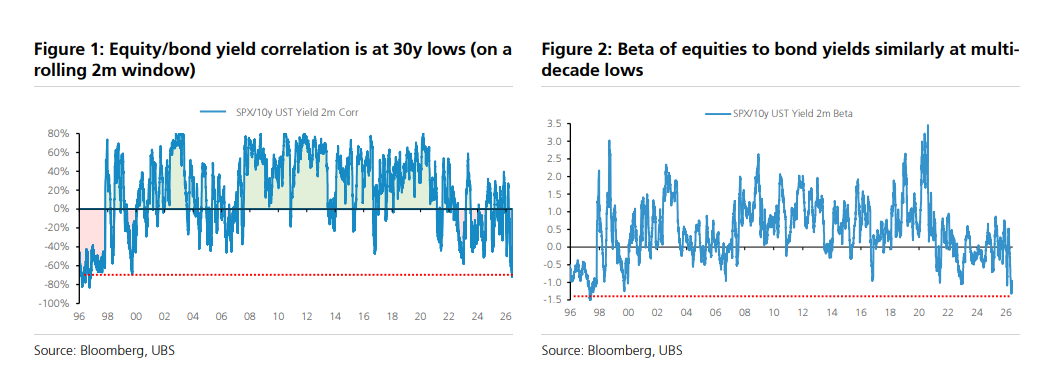
In a positive correlation environment, bonds naturally act as diversification tools against equity risk. In the current deeply negative correlation regime, bonds and equities often move together, nullifying this mechanism. Such a state has a potentially self-reinforcing nature: when macro uncertainty rises, investors are forced to simultaneously cut exposure to both equities and bonds, which may exacerbate market volatility.
Historically, negative stock-bond yield correlation tends to persist or even deepen during rate hike cycles. Data from past hiking cycles since the 1970s shows this phenomenon was especially pronounced in the 1980s and 1990s. It is notable that the Fed funds futures market is currently pricing in about an 80% probability the Federal Reserve will hike at least 25 basis points before the December FOMC meeting, although this is not the base case scenario.
Low rate volatility may not last, with room for bond volatility to catch up
Since the end of 2023, the strategy has been to "sell bond volatility, buy equity volatility," which has largely played out—mainly benefiting from a sharp decline in bond volatility during periods when the Fed cut or paused hikes. However, this trade logic may now be at an inflection point.
Historical data shows that during Fed hiking cycles, the MOVE index—which measures rate volatility—typically rises significantly relative to the VIX index, which measures equity volatility, especially when equity-bond yields are negatively correlated.
A defining feature of the post-COVID era is that higher rate volatility is usually tied to a flattening yield curve, especially a "bear flattening" with front-end yields rising more than the back-end, closely linked to the market's pricing of Fed hike expectations.
Based on this analysis, the report advises investors to consider a TLT/SPY December at-the-money straddle swap, buying TLT (i.e., long rate volatility) and selling SPY (i.e., short equity volatility) at a notional ratio of about 1.5 to 1. The current pricing of this structure is attractive relative to historical levels.
The S&P 500 has largely priced in "good yield upside," but opportunities remain in regional banks and other sectors
Using its "Market Cookbook" framework, the report evaluates how various assets have priced in a mild yield-upside scenario. This framework assumes yield increases are driven by improving economic growth rather than higher inflation expectations, alongside a modest steepening in real yields and a moderate widening of credit spreads.
The evaluation shows that the S&P 500 at the index level has largely reflected this scenario—odds of a further gain over 3% are below 23%, while odds of a rise over 7% are under 4%. However, some cyclical sectors remain underpriced, especially regional banks, large banks, and oil & gas exploration and production (E&P).
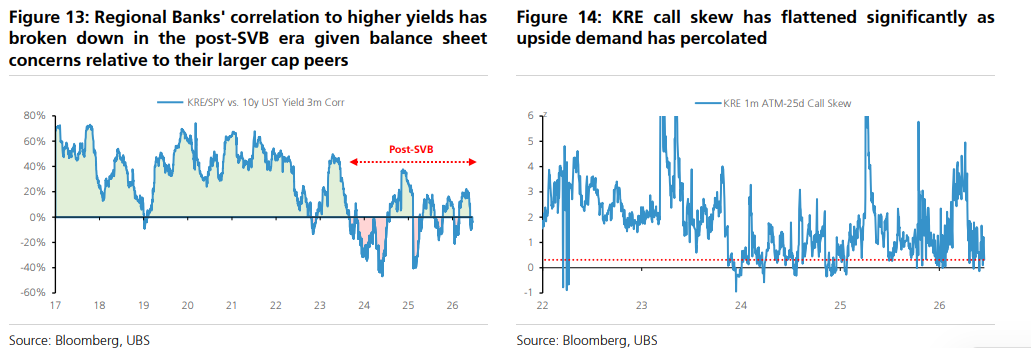
For regional banks, since the post-SVB period their correlation with rising yields has clearly weakened, mainly due to market concerns around their balance sheets. This feature means that even under a dovish or "not overly hawkish" Fed, this trade still bears profit potential. Meanwhile, KRE’s call option skew has markedly flattened, with the 1-month at-the-money to 25-delta call skew in the bottom 10th percentile over the past five years, making related option structures more attractively priced.
Disclaimer: The content of this article solely reflects the author's opinion and does not represent the platform in any capacity. This article is not intended to serve as a reference for making investment decisions.
You may also like
After the midterm elections, AI cools down and bonds benefit: 10-year US Treasury options bet on yields heading towards 4.35%
In this week's US midterm elections, the Democratic Party swept Congress, leading to a massive sell-off of major US tech stocks. As a result, demand for safe-haven assets surged, and US Treasury prices soared across the board on Thursday.

Buyers Disappear Amid AI Sell-off! Goldman Sachs Trading Desk Phones Flooded With Calls But No Takers, Hedge Funds and Retail Investors Withdraw Together
Goldman Sachs traders stated that Wednesday was one of the busiest trading days for their equities desk this year, while Thursday was the complete opposite. Investors were asking how much further the market could fall, but there was almost no buying activity; some hedge funds began selling stocks they had just bought on Wednesday. UBS data showed that Thursday's selling pressure mainly came from hedge funds. According to JPMorgan estimates, retail investors had a net sell-off of about $1.3 billion, marking the highest single-day volume in a year. The "fear index" VIX surged intraday to an eight-month high. Investors rushed to purchase protective options, and premiums for main equity index put options were twice the usual amount.

Airbnb (ABNB.US) Q3 accelerates across the board: revenue grows 19%, fastest in over three years, new $12 billion buyback, and raises full-year guidance
This shareholder letter, which opens with "Airbnb returns to growth mode," has delivered on its promises: revenue growth reached its fastest pace in over three years, booking volume accelerated significantly compared to the previous quarter, the company announced a new $12 billion share buyback authorization and raised its full-year guidance. Boosted by these developments, the stock price surged nearly 12% in after-hours trading.
AI Trading Mass Withdrawal, U.S. Stocks Record $2.8 Trillion "Wipeout"! Nasdaq Drops Nearly 6%, Chip Index Plunges Over 10%, Data Center Industry Chain Dives
The Nasdaq 100 closed down more than 6%; the total market value of technology stocks evaporated by $2.5 trillion in a single day. The semiconductor index recorded its largest drop since the pandemic, with SanDisk closing down 22%, AMD down 17%, and Nvidia down 9.3%. AI infrastructure stocks saw Lumentum drop nearly 19% and Bloom Energy drop 16%. Tesla fell more than 10%. From chip manufacturers, power suppliers, and computing service providers to software companies and data center developers, almost no corner of the tech sector was spared from Thursday's sell-off. The accumulated high valuations and crowded trades in tech stocks further amplified the decline. Unlike previous sector rotations where capital shifted to other sectors, this sell-off spread across all S&P industry sectors.
Crypto prices
More


