
Jensen Huang breaks ground in Texas as Coherent optical chip factory begins construction

Nvidia and Coherent’s optical interconnection strategy is moving from plans to reality.
On June 16, Nvidia founder and CEO Jensen Huang and Coherent CEO Jim Anderson jointly attended the groundbreaking ceremony for Coherent’s expanded facility in Sherman, Texas.
This expansion will increase the capacity of the world’s first 6-inch indium phosphide (InP) wafer mass production line, providing critical optical interconnect devices for Nvidia’s AI infrastructure. Coherent also announced that it has received a $50 million CHIPS Act grant to support the construction of this facility.
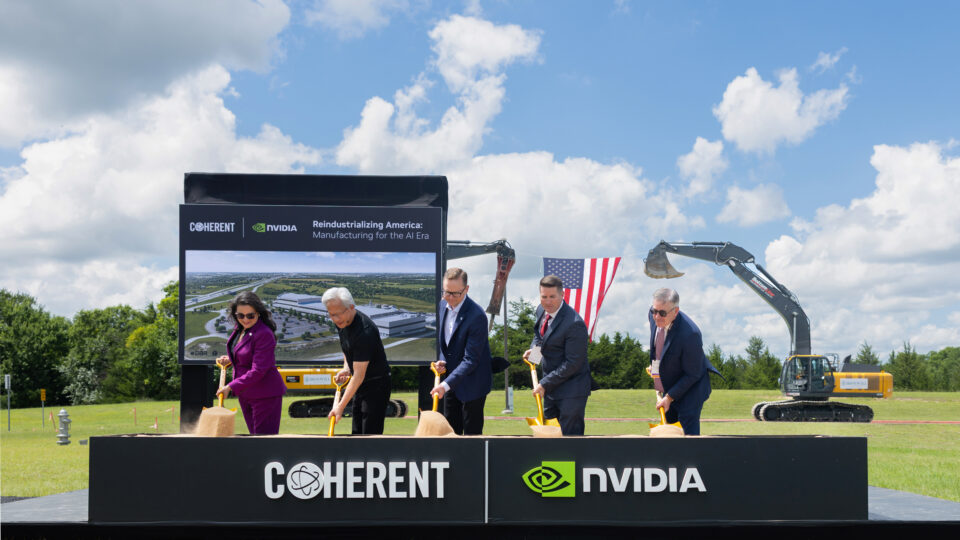
This project marks the first substantial milestone since Nvidia announced a $2 billion investment and multibillion-dollar procurement commitment to Coherent in March this year, deepening their nearly two-decade partnership. This development highlights the core role of optical interconnects in AI infrastructure construction, while also providing a clearer timeline for Coherent’s capacity expansion.
Optical Interconnect: The Physical Bottleneck for AI Expansion
As the scale of AI systems continues to grow, the physical limits of copper cable transmission are becoming a real constraint for data centers.
At the ceremony, Jensen Huang explained that when 576 GPUs span eight racks and operate as a single system—as designed for the soon-to-be-launched Nvidia Vera Rubin Ultra NVL576—copper cables can no longer handle inter-rack signal transmission. As signaling rates increase, the effective transmission distance of metal traces decreases. If one insisted on using copper cables to connect eight racks, the data center would be forced to consume massive amounts of power for signal conditioning and retimers—power that could otherwise be used for computation.
While optical solutions require a one-time electro-optical conversion loss, once the conversion is done, distance incurs virtually no additional cost. At the NVL576 scale, optical interconnection offers the best energy efficiency.
Jim Anderson summed up this logic in one sentence: "AI runs on compute, but it scales through connectivity—Sherman is the manufacturing site for that connectivity."
6-Inch InP Wafers: The Technological Lever for Capacity Expansion
Coherent operates what it claims is the world’s first 6-inch indium phosphide mass production line in Sherman. This specification is highly significant in the compound semiconductor field.
Currently, most InP production lines globally are still at the 3-inch or 4-inch wafer stage. Since wafer area is proportional to the square of its diameter, upgrading from 3 inches to 6 inches increases the usable area by roughly four times, directly boosting the number of devices produced per batch and significantly reducing unit costs. This improvement in yield and cost structure is exactly the supply foundation needed for large-scale AI construction.
At the ceremony, Jensen Huang said it took 50 years to build the first production line, but in the past year, capacity has already been quadrupled, which itself is a measure of accelerating compute demands.
The expanded facility will produce InP wafers, which will ultimately be packaged as pluggable optical modules—about the size of a USB drive, inserted directly into Nvidia network switch front panels to transmit data between data center racks where copper cables can’t reach. These modules also provide external laser sources for Nvidia’s Spectrum-X Photonics and Quantum-X Photonics co-packaged optical switches.
Dual Drivers: Policy Funding and Private Capital
The expansion project has received support from both public and private funding sources.
On the public funding side, Coherent announced it has received a $50 million CHIPS Act grant, in addition to approximately $17 million in early support from the Texas CHIPS program and the Sherman Economic Development Corporation. The total budget for the CHIPS Act is about $50 billion, aiming to encourage chip manufacturing to return to the U.S.
On the private capital side, Nvidia announced in March this year that it would invest $2 billion in Coherent to support research and development, future capacity expansion, and U.S.-based manufacturing, along with multibillion-dollar commitments to purchase advanced laser and optical networking products. Nvidia has also announced plans, through industry partnerships, to establish new facilities in Arizona and Texas with the goal of producing up to $500 billion worth of AI infrastructure in the United States.
At the ceremony, Jensen Huang stated: "Coherent is a world-class company. What you do is vital to our future, the future of artificial intelligence, and the reindustrialization of the United States."
Disclaimer: The content of this article solely reflects the author's opinion and does not represent the platform in any capacity. This article is not intended to serve as a reference for making investment decisions.
You may also like
The AI boom may follow the path of the 19th-century railway bubble, and builders may not be the ultimate winners
Goldman Sachs analyst Bobby Molavi compared the current situation to the 19th-century British railway mania: 500 companies spent more than the nation's annual income building 8,000 miles of railway, with most early investors losing out, while the real beneficiaries were the later "passengers." He pointed out that the current AI craze is driven by both debt and momentum, and that the S&P 500’s forward P/E ratio of 18x is only "a bit cheaper." Whether the builders can retain value is uncertain, and history does not offer an optimistic answer.

If Anthropic's IPO goes smoothly and the stock price rises next week, then everything remains the same for AI. Otherwise, some companies will go bankrupt.
The shrinking valuations of two major giants have triggered a chain reaction—investors are adopting more conservative revenue multiples for AI startups and are directly halting high-valuation financing for companies with zero revenue. Multiple venture capital firms have advised their portfolio companies to lower valuation expectations and to quickly build up cash reserves. Market participants warn that the outcome of Anthropic’s IPO will be a barometer for the industry: if successful, the boom will continue; if it fails, some companies may face elimination.
After the Brazilian election, political discount deepens; Morgan Stanley remains bullish on Petrobras (PBR.US), focusing on fuel pricing and dividends
Morgan Stanley still maintains its most optimistic "Overweight" rating, but has lowered its year-end 2027 target price from $31 to $25.
Corning (GLW.US) receives initial "Buy" rating from Jefferies! AI factories driving a fiber optic rush, with a potential global supply gap of up to 30%
For Corning, the recent profit growth mainly comes from the expansion of AI clusters. As the number of optical links crossing cabinets and campuses increases, customers need to deploy more optical fibers within limited conduit and cabinet space, thus driving demand for high-density optical cables and connection systems.
Crypto prices
More


