
Bitget App
Trade smarter
Buy cryptoMarketsTradeFuturesStocksEarnInstitutionAI & More
Forget the price charts. Here's how bitcoin and S&P 500 look like when adjusted for the money printer

Forget the price charts. Here's how bitcoin and S&P 500 look like when adjusted for the money printer

CryptoNewsNetCryptoNewsNet2026/06/17 06:57
By:CryptoNewsNet
Back to the list

Forget the price charts. Here's how bitcoin and S&P 500 look like when adjusted for the money printer

Forget the price charts. Here's how bitcoin and S&P 500 look like when adjusted for the money printer image 0  coindesk.com 4 m
Forget the price charts. Here's how bitcoin and S&P 500 look like when adjusted for the money printer image 1

If you're only looking at the dollar price of your portfolio, you may be missing part of the picture, which is significantly shaped by money supply growth.

To the casual observer, the markets look like business as usual. While bitcoin has nearly halved to $66,000 since its $126,000 peak in October of last year, the decline could be dismissed as just another brutal, quadrennial crypto bear market. Meanwhile, the S&P 500 continues to hover near record highs.

But beneath the surface, a more interesting signal emerges when both prices are adjusted for the U.S. M2 money supply. M2 is the Federal Reserve's estimate of liquid assets, including cash on hand, money deposited in checking and savings accounts, and other short-term saving vehicles such as money market funds and certificates of deposit.

Monetary exhaustion?

Some observers see bitcoin as a high-beta barometer for dollar liquidity, and the $BTC/M2 ratio, bitcoin's price adjusted for money supply growth, is now flashing a warning. The ratio, after a sharp climb from 2023 through 2025, appears to have formed what technical analysts call a head-and-shoulders pattern, typically read as a bearish signal.
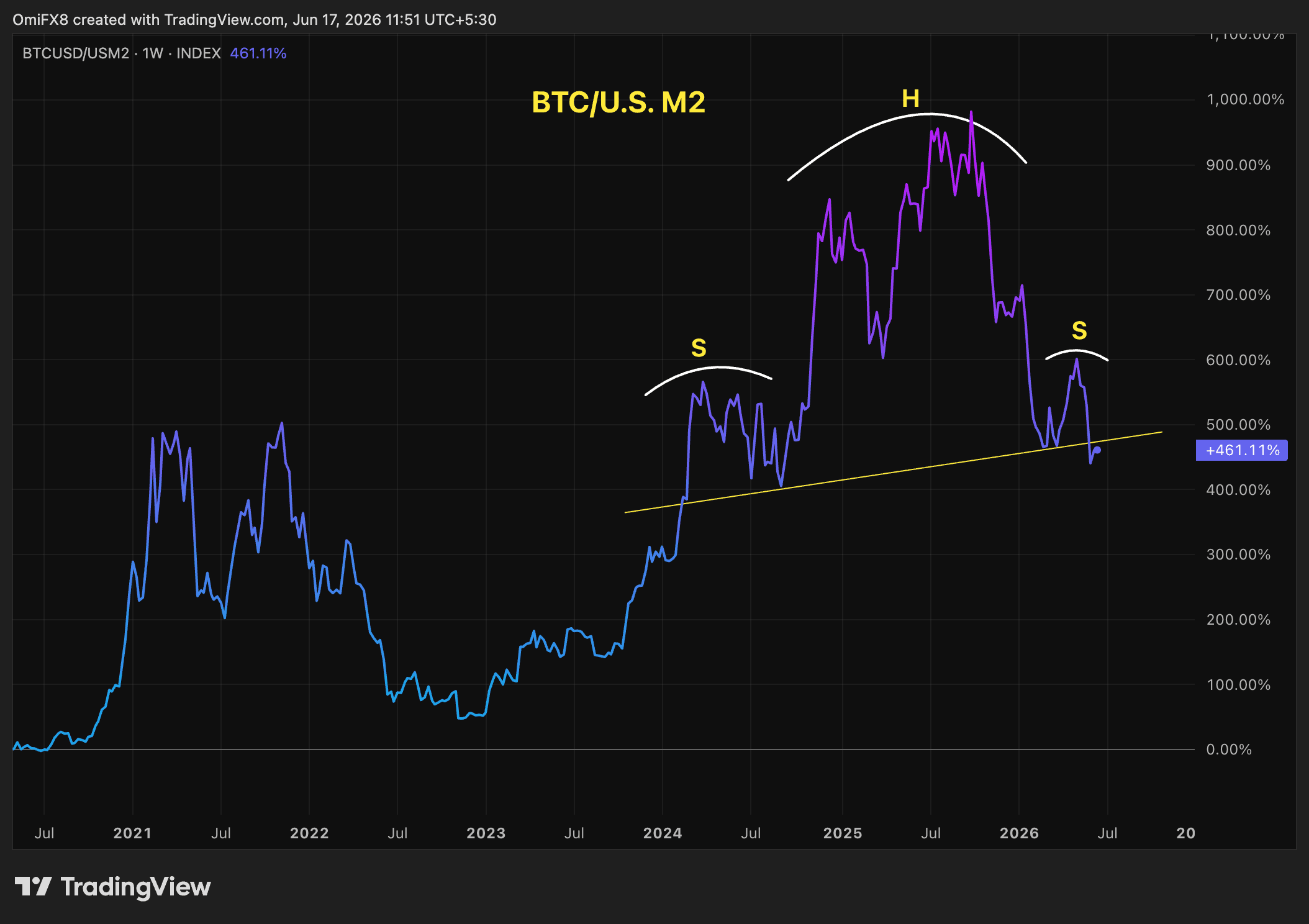
Forget the price charts. Here's how bitcoin and S&P 500 look like when adjusted for the money printer image 2 $BTC's price-to-U.S. M2 money supply. (TradingView)

If the pattern holds, it would suggest bitcoin's exponential edge over money supply growth — the dynamic that let it outrun debasement so convincingly in prior cycles — is fading. Bitcoin's ability to outpace the flood of new dollars may be approaching diminishing returns, at least for now.

That matters beyond crypto. Bitcoin has at times been viewed as a leading indicator for broader risk appetite, and the S&P 500's own money-supply-adjusted valuation tells a story that looks very different from its nominal price.
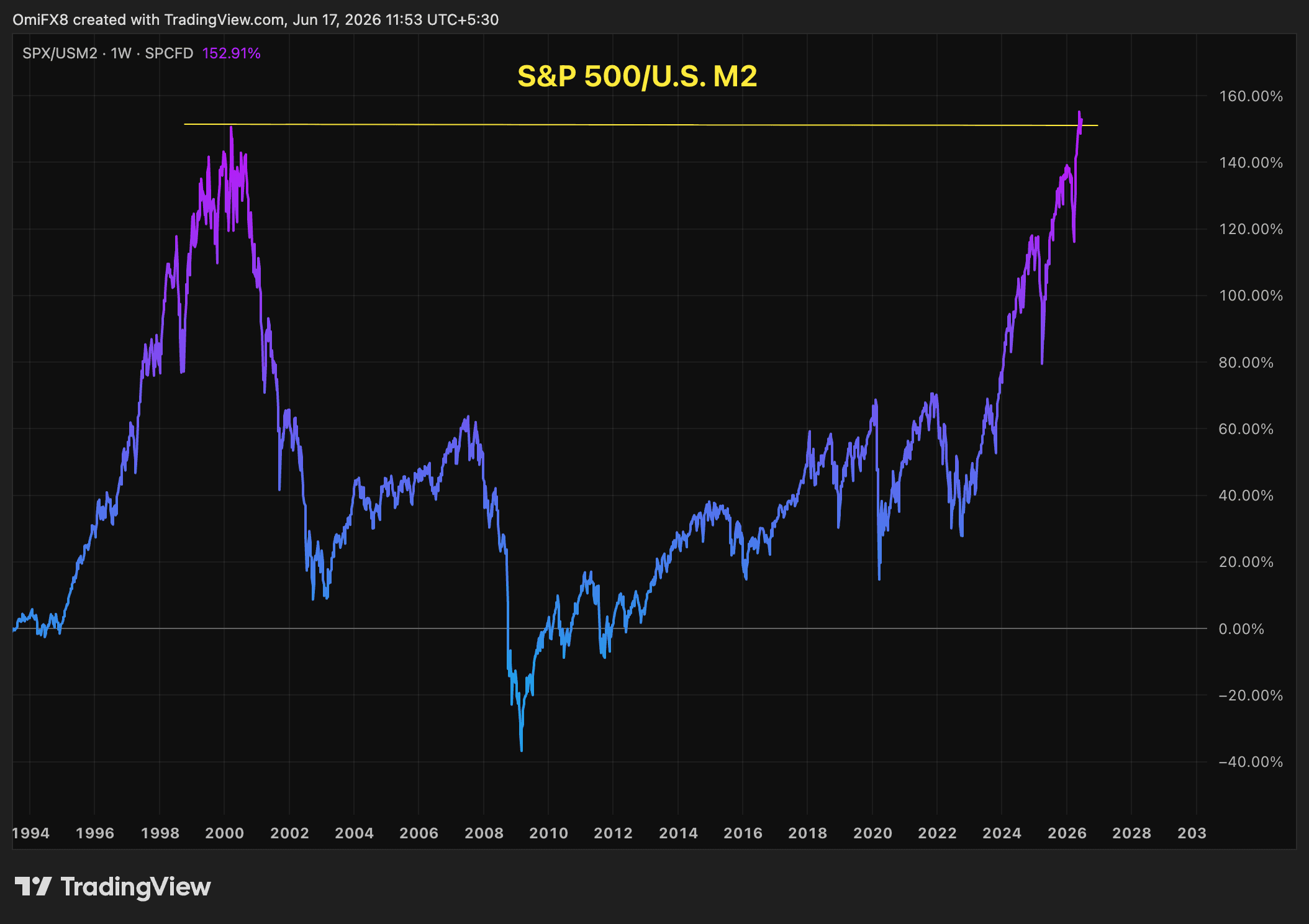
Forget the price charts. Here's how bitcoin and S&P 500 look like when adjusted for the money printer image 3 S&P 500-to-U.S. M2 (TradingView)

The index currently hovers near a record high of 7,511 points, well above its 2000 peak of around 1,500 points in nominal terms. But adjusted for two decades of M2 growth, the S&P 500 has only recently reclaimed that 2000-era high. That doesn't necessarily mean equities are as overextended as they were at the height of the dot-com bubble, as corporate earnings today are generally considered stronger and more durable compared to 1999-2000.

But on this specific money-supply-adjusted basis, it has taken a quarter-century of money-supply expansion just to get the index's monetary-adjusted valuation back to where it stood at the height of the dot-com bubble. In other words, every new dollar added to the system has had to work harder for a relatively smaller marginal gain in valuation.

The takeaway

Bitcoin has at times moved ahead of broader macro turns. If its monetary valuation is genuinely losing ground to M2 growth, it could be an early warning that the S&P 500's nominal gains rest on a thinner foundation than they appear.


0
0

Disclaimer: The content of this article solely reflects the author's opinion and does not represent the platform in any capacity. This article is not intended to serve as a reference for making investment decisions.

Understand the market, then trade.
Bitget offers one-stop trading for cryptocurrencies, stocks, and gold.
Trade now!

You may also like

The AI boom may follow the path of the 19th-century railway bubble, and builders may not be the ultimate winners

Goldman Sachs analyst Bobby Molavi compared the current situation to the 19th-century British railway mania: 500 companies spent more than the nation's annual income building 8,000 miles of railway, with most early investors losing out, while the real beneficiaries were the later "passengers." He pointed out that the current AI craze is driven by both debt and momentum, and that the S&P 500’s forward P/E ratio of 18x is only "a bit cheaper." Whether the builders can retain value is uncertain, and history does not offer an optimistic answer.

华尔街见闻•2026/11/12 03:56
The AI boom may follow the path of the 19th-century railway bubble, and builders may not be the ultimate winners

If Anthropic's IPO goes smoothly and the stock price rises next week, then everything remains the same for AI. Otherwise, some companies will go bankrupt.

The shrinking valuations of two major giants have triggered a chain reaction—investors are adopting more conservative revenue multiples for AI startups and are directly halting high-valuation financing for companies with zero revenue. Multiple venture capital firms have advised their portfolio companies to lower valuation expectations and to quickly build up cash reserves. Market participants warn that the outcome of Anthropic’s IPO will be a barometer for the industry: if successful, the boom will continue; if it fails, some companies may face elimination.

华尔街见闻•2026/11/12 03:46

After the Brazilian election, political discount deepens; Morgan Stanley remains bullish on Petrobras (PBR.US), focusing on fuel pricing and dividends

Morgan Stanley still maintains its most optimistic "Overweight" rating, but has lowered its year-end 2027 target price from $31 to $25.

智通财经•2026/11/12 03:42
After the Brazilian election, political discount deepens; Morgan Stanley remains bullish on Petrobras (PBR.US), focusing on fuel pricing and dividends

Corning (GLW.US) receives initial "Buy" rating from Jefferies! AI factories driving a fiber optic rush, with a potential global supply gap of up to 30%

For Corning, the recent profit growth mainly comes from the expansion of AI clusters. As the number of optical links crossing cabinets and campuses increases, customers need to deploy more optical fibers within limited conduit and cabinet space, thus driving demand for high-density optical cables and connection systems.

智通财经•2026/11/12 02:47
Corning (GLW.US) receives initial "Buy" rating from Jefferies! AI factories driving a fiber optic rush, with a potential global supply gap of up to 30%
