
FOMC decision looms as markets increasingly price in a Fed rate hike

Markets have increasingly priced in a future Federal Reserve rate hike ahead of this week’s FOMC meeting, with prediction markets assigning a 64% chance of tighter policy before July 2027.
- Markets now price a 64% probability of a Fed rate hike before July 2027.
- Economists expect the Fed to leave rates unchanged at this week’s FOMC meeting.
- Persistent inflation and higher energy prices have reduced expectations for future rate cuts.
According to Kalshi prediction market data, traders currently assign a 64% probability to the Federal Reserve raising interest rates before July 2027. The growing expectation comes as inflation remains elevated and energy prices have risen following tensions between the United States and Iran.
 Source:
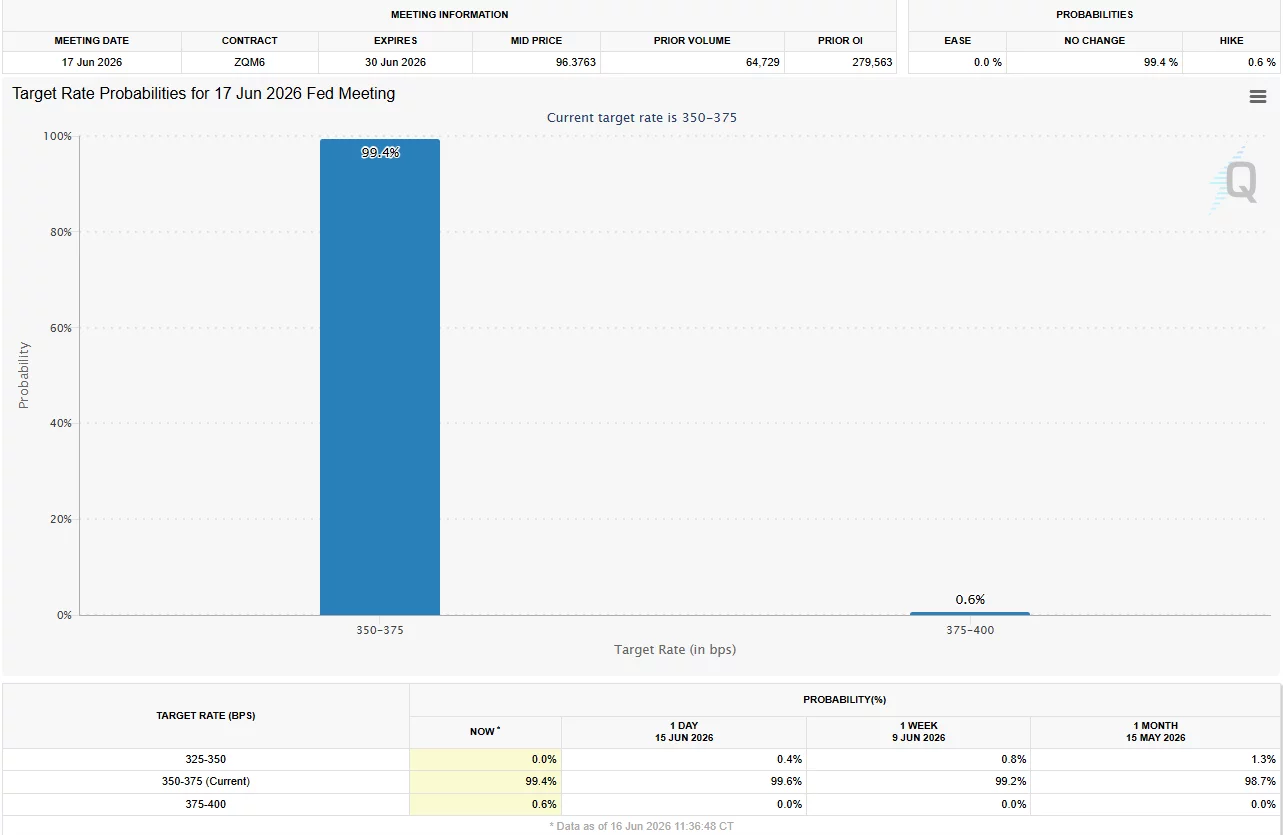
Investors are now turning their attention to the Federal Open Market Committee meeting on June 17, where CME FedWatch data shows a 99.4% probability that officials will keep benchmark rates unchanged.
 Source:
While no immediate policy move is expected, market participants are closely watching for signals about the direction of future monetary policy.
A recent Bank of America fund manager survey showed that nearly 40% of respondents expect at least one rate hike within the next 12 months, up from 16% a month earlier. At the same time, only 28% anticipate rate cuts, indicating a notable change in investor expectations as inflation pressures persist.
Markets expect policymakers to abandon easing bias
Fresh insight from CNBC’s latest points to a similar outlook. Among 32 economists, strategists, and fund managers surveyed by the network, none expect the Federal Reserve to change rates at this week’s meeting or at any point through 2027.
CNBC also cited Gregory Daco, chief economist at EY, who said Warsh may face a different policy environment than many investors expected.
“While Warsh is generally perceived as dovish, he will inherit a committee that has become noticeably more hawkish.”
While respondents do not anticipate an outright rate increase, CNBC reported that 88% expect the Fed to remove language suggesting that its next move would likely be a rate cut. Such a change would signal that policymakers are no longer leaning toward easing monetary policy.
Kevin Warsh, who is after being appointed by President Donald Trump, enters the meeting at a time when inflation has complicated the outlook for lower rates.
CNBC noted that Trump has long pushed for rate cuts, but higher inflation linked in part to tariffs and the conflict with Iran has pushed those expectations further into the future.
Fed funds futures markets have also moved in the same direction. According to CNBC, traders no longer expect meaningful policy easing over the next several years and instead see interest rates remaining close to current levels.
Inflation and oil prices keep pressure on rate outlook
Recent economic data has reinforced those concerns. As earlier, U.S. consumer prices rose 0.5% in May from the previous month, while annual inflation accelerated to 4.2% from 3.8% in April.
Rising energy costs have contributed to the inflation outlook. Oil prices moved higher in recent months as tensions between Washington and Tehran raised concerns about supply disruptions through the Strait of Hormuz.
Even so, CNBC’s survey found little support for the idea that the Federal Reserve would respond with immediate rate hikes. Instead, respondents expect the federal funds rate to remain close to its current 3.62% level through 2027.
Additional uncertainty surrounds how recent geopolitical developments may affect policy decisions. CNBC reported that a potential agreement between the United States and Iran, announced after its survey was completed, could ease pressure from energy prices and give policymakers more flexibility if inflation begins to cool.
According to CNBC, a person familiar with the matter said Warsh may also have more freedom in setting monetary policy because President Trump trusts him, potentially reducing political pressure around future rate decisions.
Disclaimer: The content of this article solely reflects the author's opinion and does not represent the platform in any capacity. This article is not intended to serve as a reference for making investment decisions.
You may also like
The AI boom may follow the path of the 19th-century railway bubble, and builders may not be the ultimate winners
Goldman Sachs analyst Bobby Molavi compared the current situation to the 19th-century British railway mania: 500 companies spent more than the nation's annual income building 8,000 miles of railway, with most early investors losing out, while the real beneficiaries were the later "passengers." He pointed out that the current AI craze is driven by both debt and momentum, and that the S&P 500’s forward P/E ratio of 18x is only "a bit cheaper." Whether the builders can retain value is uncertain, and history does not offer an optimistic answer.

If Anthropic's IPO goes smoothly and the stock price rises next week, then everything remains the same for AI. Otherwise, some companies will go bankrupt.
The shrinking valuations of two major giants have triggered a chain reaction—investors are adopting more conservative revenue multiples for AI startups and are directly halting high-valuation financing for companies with zero revenue. Multiple venture capital firms have advised their portfolio companies to lower valuation expectations and to quickly build up cash reserves. Market participants warn that the outcome of Anthropic’s IPO will be a barometer for the industry: if successful, the boom will continue; if it fails, some companies may face elimination.
After the Brazilian election, political discount deepens; Morgan Stanley remains bullish on Petrobras (PBR.US), focusing on fuel pricing and dividends
Morgan Stanley still maintains its most optimistic "Overweight" rating, but has lowered its year-end 2027 target price from $31 to $25.

Corning (GLW.US) receives initial "Buy" rating from Jefferies! AI factories driving a fiber optic rush, with a potential global supply gap of up to 30%
For Corning, the recent profit growth mainly comes from the expansion of AI clusters. As the number of optical links crossing cabinets and campuses increases, customers need to deploy more optical fibers within limited conduit and cabinet space, thus driving demand for high-density optical cables and connection systems.

Crypto prices
More


