
BTC Market Pulse: Week 25

Overview
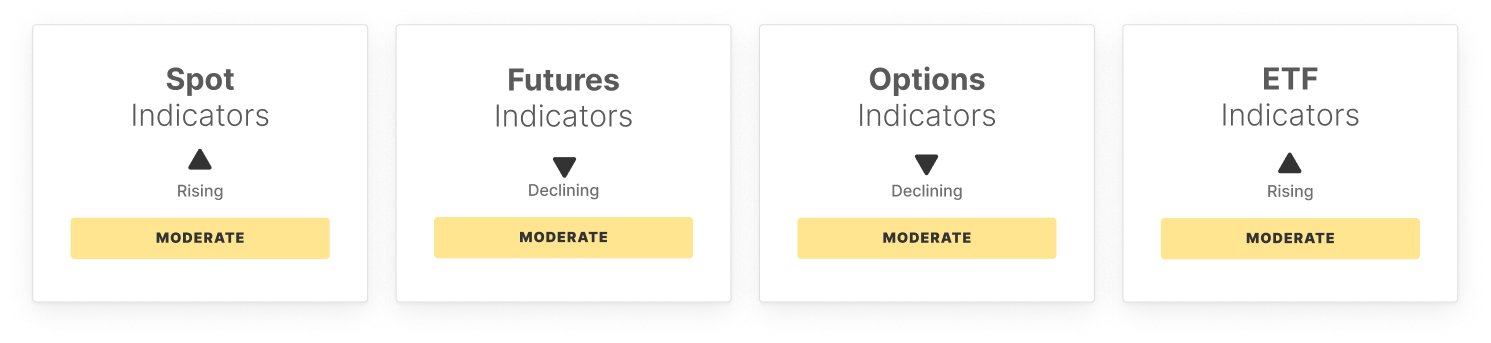
Bitcoin is staging a tentative relief bounce from deeply oversold conditions, but the structural evidence points to stabilization rather than trend reversal. The defining development of the past week is a dramatic shift in taker aggression: Perpetual CVD reversed from -$770M to +$182M and Spot CVD flipped from -$205M to near breakeven. Price momentum confirms this, with RSI climbing 94.8% off extreme oversold levels, yet at 29.1 it remains pinned near its lower statistical band, short of any sustained buyer dominance.
The recovery is happening on thin ice. Spot volume collapsed 40.4% to $5.8B and Futures Open Interest declined another 3% to $30.6B, a sign the bounce is being driven by covering rather than fresh conviction. Long-side funding payments fell 22.3% and ETF trade volume dropped 38.1% to $11.1B. The market is lighter, not healthier.
Fear is receding nonetheless. The Volatility Spread compressed 85% in a single week, from 27.71% to 4.07%, as options participants rapidly repriced tail risk lower. The 25-Delta Skew eased from 19.07% to 15.99%, reflecting reduced demand for downside hedges. ETF net outflows improved 65.5%, narrowing from -$1.3B to -$465M, and the ETF MVRV has crept back above 1.0 to 1.06. Capitulation is decelerating: the Realized P/L ratio improved 46% and the NUPL narrowed 14%, though both remain in net-loss territory.
On-chain fundamentals confirm a quieter market. Active addresses fell 6.3% and entity-adjusted transfer volume dropped 38.8% to $3.9B, well below its lower statistical band. Realized Cap Change deepened to -1.3%, signaling that capital continues to exit the network. The one encouraging read is supply composition: Hot Capital Share and the STH-to-LTH ratio have both broken below their lower bounds, indicating that recent-vintage supply has been largely flushed and the holder base is becoming more long-term dominated.
Profitability remains stressed. Just over half the circulating supply (50.8%) is held at a profit, below the 55.1% low band, suppressing sell-side pressure while extending the duration of investor stress.
Capitulation intensity is fading, sentiment hedging is unwinding, and taker behavior has shifted constructively. But the absence of volume, the declining derivatives footprint, and ongoing capital outflows mean this is a consolidation base being built, not a confirmed reversal. Conviction and institutional re-engagement remain the missing catalysts.
Off-Chain Indicators
On-Chain Indicators


Don't miss it!
Smart market intelligence, straight to your inbox.
Disclaimer: The content of this article solely reflects the author's opinion and does not represent the platform in any capacity. This article is not intended to serve as a reference for making investment decisions.
You may also like
CoreWeave's quarterly report hits record highs, but Bernstein and HSBC still maintain "sell" ratings
The main concerns focus on three major issues: management claims an annual price of $20-25 million per megawatt, while actual financial data shows only $9.2 million; independent calculations by two institutions both indicate a financing gap of about $33 billion; by 2028, the market will see an influx of 55 gigawatts of new computing power, 20 times CoreWeave’s own capacity. With current debt at $46.9 billion and equity only $4 billion, and no free cash flow within this decade—the question of whether its scarce performance can last until the loans are repaid is something even strong quarterly reports cannot answer.

The AI boom may follow the path of the 19th-century railway bubble, and builders may not be the ultimate winners
Goldman Sachs analyst Bobby Molavi compared the current situation to the 19th-century British railway mania: 500 companies spent more than the nation's annual income building 8,000 miles of railway, with most early investors losing out, while the real beneficiaries were the later "passengers." He pointed out that the current AI craze is driven by both debt and momentum, and that the S&P 500’s forward P/E ratio of 18x is only "a bit cheaper." Whether the builders can retain value is uncertain, and history does not offer an optimistic answer.

If Anthropic's IPO goes smoothly and the stock price rises next week, then everything remains the same for AI. Otherwise, some companies will go bankrupt.
The shrinking valuations of two major giants have triggered a chain reaction—investors are adopting more conservative revenue multiples for AI startups and are directly halting high-valuation financing for companies with zero revenue. Multiple venture capital firms have advised their portfolio companies to lower valuation expectations and to quickly build up cash reserves. Market participants warn that the outcome of Anthropic’s IPO will be a barometer for the industry: if successful, the boom will continue; if it fails, some companies may face elimination.
After the Brazilian election, political discount deepens; Morgan Stanley remains bullish on Petrobras (PBR.US), focusing on fuel pricing and dividends
Morgan Stanley still maintains its most optimistic "Overweight" rating, but has lowered its year-end 2027 target price from $31 to $25.

Crypto prices
More


