
How far is the current U.S. stock bull market from the historical bubble peaks?

The latest assessment from Goldman Sachs' chief US equity strategist shows that the current level of market exuberance has reached the 86th historical percentile, approaching but not yet touching the extreme levels seen during the 2000 internet bubble and the peak of the 2021 bull market.
In the past two months, the S&P 500 index surged 15% before the pullback on Friday—a gain that ranks in the 99th historical percentile since 1980. In his latest report, Goldman Sachs chief US equity strategist Ben Snider points out that although the four major historical bull market peak signals—speculative frenzy, deteriorating growth, massive equity issuance, and Fed tightening—have not yet fully triggered, each is closer to the threshold than it was a few months ago.
For the market, this assessment means there is still room for the current bull market to run, but risks are accumulating. Snider clearly states "we are not there yet," while warning that declines don't require investors to become extremely euphoric—history does not guarantee that patterns will repeat themselves in this cycle.
Rally Strength: Strongest Volatility-Adjusted Rebound in 50 Years
The speed of this rally has left a mark in history. According to Goldman Sachs data, the S&P 500 has risen about 15% in roughly two months, giving a return/volatility ratio close to 4—its highest level in over 50 years.
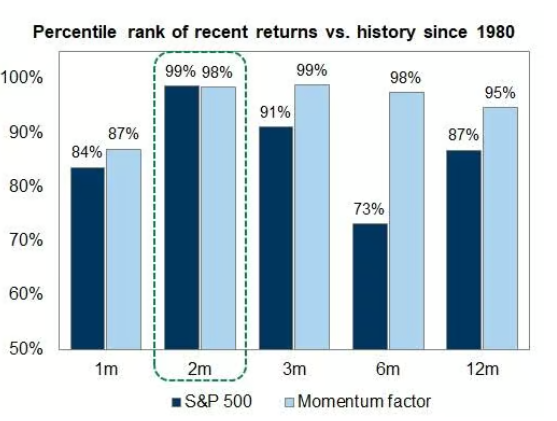
Artificial intelligence is the core theme driving this market. AI-related stocks, momentum factors, and large-cap indices have all rallied simultaneously, creating strong resonance.
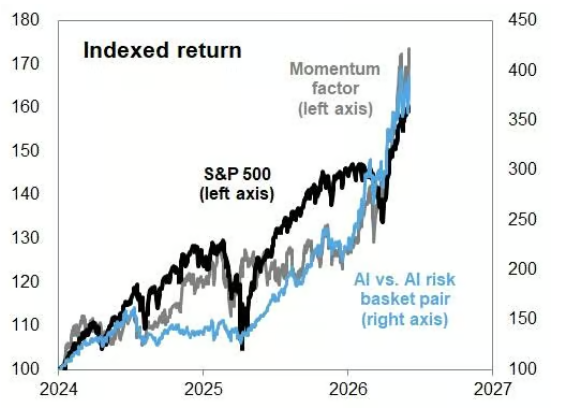
Snider points out that, unlike previous momentum-driven rallies (such as in late 1999 and late 2021), the main support for this rally comes from sharply raised recent earnings expectations, not merely an emotional bubble. This, to some extent, gives the current rally a more solid fundamental basis.
Euphoria Metrics: 86th Percentile, Below Previous Peaks
To quantify current market sentiment, Snider constructed a comprehensive framework covering nine measures in four main categories. Historically, these indicators ranked at the 100th percentile at the peak of the 2000 internet bubble, and the 95th percentile at the top of the 2021 bull market. The current reading is at the 86th percentile—higher than the historical mean but still well below the previous two extremes.
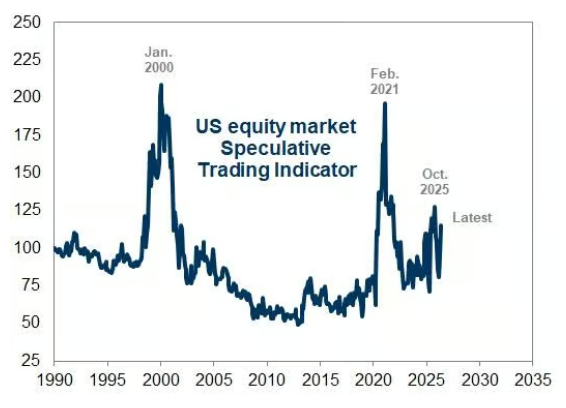
Specifically, Goldman Sachs' speculative trading indicators have increased somewhat in recent months but remain below late 2025 levels, and much lower than the peaks reached in 2000 and 2021. Among speculative trading activities, trading volumes of high-valuation stocks have risen significantly, while trading in loss-making stocks remains relatively mild. In addition, call option volumes and retail margin balances are trending upward, showing investor sentiment is heating up.
Notably, the breadth of the current rally has been extremely narrow, but it has not reached the extreme concentration of the internet bubble era.
Four Major Risk Signals: Not Yet Triggered, But Getting Closer
Goldman's analytical framework attributes the end of historically high-valuation, highly concentrated bull markets to four factors: speculative frenzy, worsening growth prospects, explosive equity issuance, and Fed policy tightening. Snider notes that none of these conditions fully apply to the current environment, but each is closer to the warning line than at the start of the year.
IPO activity is reviving, and pressure from equity issuance is beginning to emerge; higher input costs are squeezing corporate profit margins and pose a potential threat to growth prospects; the rate markets are starting to price in a higher probability of Fed rate hikes, although Goldman economists see an actual hike as unlikely.
Snider also emphasizes that market declines do not require investors to reach extreme exuberance; and the exuberant patterns seen at past bull market peaks may not recur in this cycle in the same form. This means that even if current indicators are below historical extremes, investors should not view that as sufficient assurance of a safety margin.
In summary, Goldman Sachs' assessment presents a cautious but not pessimistic outlook: the current degree of euphoria in this bull market is "moving closer and closer" to the historical peak zone but has not yet arrived. The key support for this judgment lies in the fact that the current rally is still backed by improved earnings expectations, rather than being purely emotion-driven. However, with momentum factors remaining strong, market concentration high, and some risk signals quietly heating up, Snider's report essentially signals to investors: the window remains open, but it is gradually narrowing.
Disclaimer: The content of this article solely reflects the author's opinion and does not represent the platform in any capacity. This article is not intended to serve as a reference for making investment decisions.
You may also like
Jensen Huang steps down, and the "biggest patron" of new AI players is gone too
Anthropic's tens-of-billions IPO investment, Figure AI's additional $1 billion, and Nscale's over $5 billion credit guarantee are all in negotiations but their outcomes remain uncertain. Meanwhile, its $500 billion AI financing platform has stalled, and some clients are considering switching to AMD or Google. Successor Kress has a conservative style and has repeatedly vetoed deals aggressively promoted by Jensen Huang, signaling the possible end of Nvidia's era of bold investments.
Applied Materials (AMAT.US) Q4 Earnings Call: CEO Responds to Capacity Mismatch Concerns, Says No Customer Delayed Delivery; System Capacity Expected to Double by 2028
Applied Materials released its financial results for the fourth quarter of fiscal year 2026 (ending October 25, 2026) after the US stock market closed on November 12.
The End of an Era! Semianalysis: Without Jensen Huang, Nvidia Will Become the Next Apple
Semianalysis believes that Jensen Huang’s departure marks the end of a founder-driven era. Nvidia is highly likely to replicate the "post-Steve Jobs Apple model"—shifting from aggressive bets to stock buybacks—which is not beneficial for either technological advancement or shareholders. A greater concern is that the supply chain advantages, customer trust system, and open-source ecosystem moat personally built by Jensen Huang will be difficult for his successor to replicate. By 2028, over 70% of total production capacity may shift to non-Nvidia players.

Crypto prices
More


