
CLARITY Act Momentum Slows As Approval Odds Fall To 60%

By:Newsbtc
Bitget offers one-stop trading for cryptocurrencies, stocks, and gold. Trade now!
A welcome pack worth 6200 USDT for new users! Sign up now!
A July 4 target date for advancing crypto market-structure legislation through the Senate is now looking less certain, according to Galaxy Digital’s head of research.
Senate Calendar Creates A Bottleneck
Alex Thorn revised his probability estimate for the CLARITY Act passing in 2026 from 75% down to 60%, citing a Senate schedule that has grown increasingly crowded with competing priorities.

Next week’s agenda is expected to be taken up largely by FISA-related business following a failed reauthorization vote, leaving little room for crypto legislation to advance.
var rnd = window.rnd || Math.floor(Math.random()*10e6); var pid607465 = window.pid607465 || rnd; var plc607465 = window.plc607465 || 0; var abkw = window.abkw || ''; var absrc = 'https://servedbyadbutler.com/adserve/;ID=172179;size=0x0;setID=607465;type=js;sw='+screen.width+';sh='+screen.height+';spr='+window.devicePixelRatio+';kw='+abkw+';pid='+pid607465+';place='+(plc607465++)+';rnd='+rnd+';click=CLICK_MACRO_PLACEHOLDER'; document.write('
');
if (!window.AdButler){(function(){var s = document.createElement("script"); s.async = true; s.type = "text/javascript";s.src = "https://servedbyadbutler.com/app.js";var n = document.getElementsByTagName("script")[0]; n.parentNode.insertBefore(s, n);}());}
var AdButler = AdButler || {}; AdButler.ads = AdButler.ads || []; var abkw = window.abkw || ""; var plc366606 = window.plc366606 || 0; (function(){ var divs = document.querySelectorAll(".plc366606:not([id])"); var div = divs[divs.length-1]; div.id = "placement_366606_"+plc366606; AdButler.ads.push({handler: function(opt){ AdButler.register(172179, 366606, [728,90], "placement_366606_"+opt.place, opt); }, opt: { place: plc366606++, keywords: abkw, domain: "servedbyadbutler.com", click:"CLICK_MACRO_PLACEHOLDER" }}); })();
Thorn said the obstacle is no longer political will — support for the bill has not collapsed. The problem is time.
i just sent this note to clients lowering my odds of 2026 clarity act passage from 75% immediately post-markup to 60% today
i said in may that the senate calendar was one of the biggest hurdles, and that picture has worsened. last night the FISA reauth vote failed, so now next…
— Alex Thorn (@intangiblecoins) June 5, 2026
Unresolved Issues Add To The Delay
Two sticking points remain on the table: lawmaker ethics rules and illicit finance provisions tied to the bill. Neither has been resolved, and the lack of movement on both fronts has further complicated the path forward.
Despite the lowered odds, Thorn said he remains optimistic about the bill’s eventual chances — though he cautioned that the timeline is now more fluid than many had assumed.
var rnd = window.rnd || Math.floor(Math.random()*10e6); var pid607472 = window.pid607472 || rnd; var plc607472 = window.plc607472 || 0; var abkw = window.abkw || ''; var absrc = 'https://servedbyadbutler.com/adserve/;ID=172179;size=0x0;setID=607472;type=js;sw='+screen.width+';sh='+screen.height+';spr='+window.devicePixelRatio+';kw='+abkw+';pid='+pid607472+';place='+(plc607472++)+';rnd='+rnd+';click=CLICK_MACRO_PLACEHOLDER'; document.write('
');
if (!window.AdButler){(function(){var s = document.createElement("script"); s.async = true; s.type = "text/javascript";s.src = "https://servedbyadbutler.com/app.js";var n = document.getElementsByTagName("script")[0]; n.parentNode.insertBefore(s, n);}());}
var AdButler = AdButler || {}; AdButler.ads = AdButler.ads || []; var abkw = window.abkw || ""; var plc452518 = window.plc452518 || 0; (function(){ var divs = document.querySelectorAll(".plc452518:not([id])"); var div = divs[divs.length-1]; div.id = "placement_452518_"+plc452518; AdButler.ads.push({handler: function(opt){ AdButler.register(172179, 452518, [728,90], "placement_452518_"+opt.place, opt); }, opt: { place: plc452518++, keywords: abkw, domain: "servedbyadbutler.com", click:"CLICK_MACRO_PLACEHOLDER" }}); })();
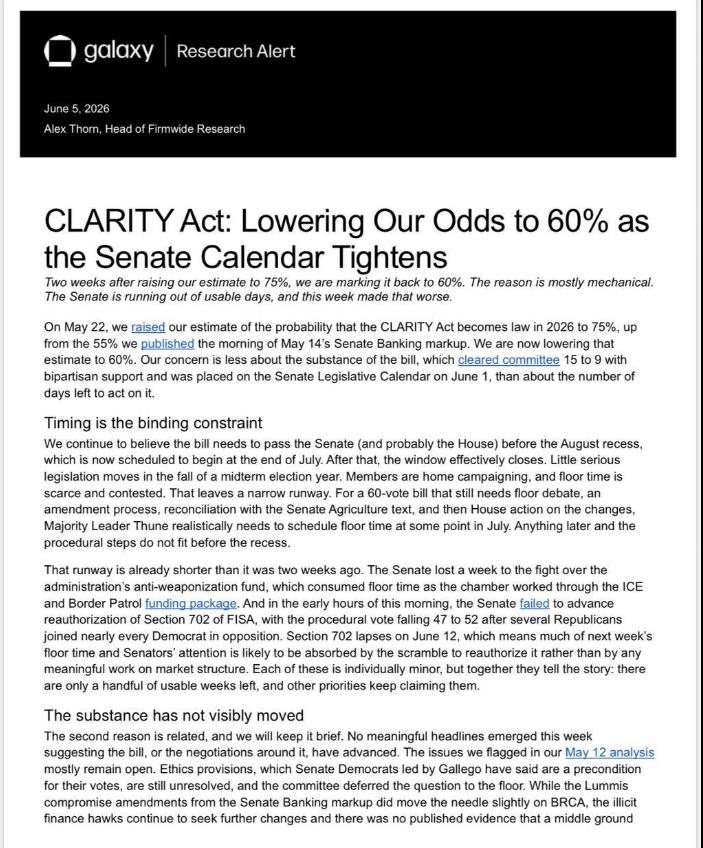 Alex Thorn on X
The CLARITY Act is widely considered the most consequential crypto legislation currently before Congress. Its central aim is to settle a long-running dispute between the Securities and Exchange Commission and the Commodity Futures Trading Commission over who regulates what in the digital asset space.
Under the proposal, tokens classified as commodities would fall under CFTC oversight, while those deemed securities would stay with the SEC — a distinction that would reshape how exchanges operate and what compliance requirements apply to crypto projects.
BTCUSD now trading at $61,052. Chart:
Supporters say federal clarity on those boundaries would cut regulatory uncertainty and keep crypto development from migrating abroad.
var rnd = window.rnd || Math.floor(Math.random()*10e6); var pid607473 = window.pid607473 || rnd; var plc607473 = window.plc607473 || 0; var abkw = window.abkw || ''; var absrc = 'https://servedbyadbutler.com/adserve/;ID=172179;size=0x0;setID=607473;type=js;sw='+screen.width+';sh='+screen.height+';spr='+window.devicePixelRatio+';kw='+abkw+';pid='+pid607473+';place='+(plc607473++)+';rnd='+rnd+';click=CLICK_MACRO_PLACEHOLDER'; document.write('
');
if (!window.AdButler){(function(){var s = document.createElement("script"); s.async = true; s.type = "text/javascript";s.src = 'https://servedbyadbutler.com/app.js';var n = document.getElementsByTagName("script")[0]; n.parentNode.insertBefore(s, n);}());}
var AdButler = AdButler || {}; AdButler.ads = AdButler.ads || []; var abkw = window.abkw || ''; var plc452519 = window.plc452519 || 0; (function(){ var divs = document.querySelectorAll(".plc452519:not([id])"); var div = divs[divs.length-1]; div.id = "placement_452519_"+plc452519; AdButler.ads.push({handler: function(opt){ AdButler.register(172179, 452519, [728,90], 'placement_452519_'+opt.place, opt); }, opt: { place: plc452519++, keywords: abkw, domain: 'servedbyadbutler.com', click:'CLICK_MACRO_PLACEHOLDER' }}); })();
A Window That May Be Closing
Senator Cynthia Lummis had previously pointed to July 4 as a marker for getting market-structure legislation moving in the Senate.
Bitmine Seeks $300M Raise To Accelerate Ethereum Accumulation Strategy
Thorn’s revised figure puts pressure on that informal target. His assessment reflects scheduling constraints, not a shift in how lawmakers view the bill itself.
For crypto stakeholders awaiting regulatory certainty, the revised outlook points to a potentially longer path toward comprehensive legislation.
Featured image from Unsplash, chart from TradingView
0
0
Disclaimer: The content of this article solely reflects the author's opinion and does not represent the platform in any capacity. This article is not intended to serve as a reference for making investment decisions.
Understand the market, then trade.
Bitget offers one-stop trading for cryptocurrencies, stocks, and gold.
Trade now!
You may also like
Biotech Insider Trading in US Stocks Diverges: ImmunityBio (IBRX.US) Cashes Out the Most, Sellas (SLS.US) Director Bought In Before a 5x Surge
Insider trading in US-listed biotech companies shows divergence.
智通财经•2026/11/12 08:37
AI investment and consumer spending drive growth! UK Q3 GDP growth rate hits highest in two and a half years
As the widespread adoption of artificial intelligence (AI) continues to drive growth in corporate and consumer spending, and the economy demonstrates resilience in the face of an energy shock caused by the Iran war, the UK economy has achieved its fastest growth rate in two and a half years.
智通财经•2026/11/12 08:27

MSCI drops Strategy, Bitcoin eyes $70,000 as ETF outflows hit $300 million
Cointurk•2026/11/12 08:21

AI servers + iPhone Duo dual engines drive, Foxconn Q3 net profit surges 34%, exceeding expectations
The financial report shows that Hon Hai's net profit for the third quarter reached TWD 77.5 billion, exceeding expectations, while revenue hit a record high of TWD 3.03 trillion. AI servers have become the primary growth engine, with the goal of capturing 50% of the global market share within two years and raising the gross margin to 10%. iPhone Duo sales are expected to reach up to 16 million units. Hon Hai Chairman Liu Yangwei stated that the shortage of memory chips and components will continue until 2027, and the performance forecasts for the company's four major product categories have been raised.
华尔街见闻•2026/11/12 08:21
Crypto prices
More
Bitcoin
BTC
$73,437.02
-0.34%

Ethereum
ETH
$2,045.16
-0.52%

Tether USDt
USDT
$0.9988
+0.00%

BNB
BNB
$672.45
-1.23%

USDC
USDC
$0.9997
-0.00%

XRP
XRP
$1.04
-1.34%

Solana
SOL
$82.78
-0.25%

TRON
TRX
$0.3167
-0.14%

Hyperliquid
HYPE
$71.1
-1.08%

Zcash
ZEC
$983.8
+0.72%
How to buy BTC
Bitget lists BTC – Buy or sell BTC quickly on Bitget!
Trade now
Become a trader now?A welcome pack worth 6200 USDT for new users!
Sign up now