
Goldman Sachs: Non-US "copper shortage" intensifies; if US tariffs are implemented, LME copper prices could surge to $14,000 in the second half of the year

Goldman Sachs has significantly raised its copper price forecasts, increasing its average 2027 LME copper price by 28% to $13,800/ton. The core logic lies in the sudden widening of the supply gap in markets "outside the US"—US imports for stockpiling continue to drain globally available supply, and in combination with delayed resumption of production at two major copper mines until 2028, deliver a supply shock that pushes the non-US copper market into deep shortage, providing strong support for an upward move in LME copper prices.
In its June 4 report, Goldman Sachs raised its average fourth quarter 2026 LME copper price forecast from $11,200/ton to $13,700/ton, a 22% increase; its full-year 2027 average price from $10,750/ton to $13,800/ton, a 28% increase. The current LME copper spot price is around $13,714/ton.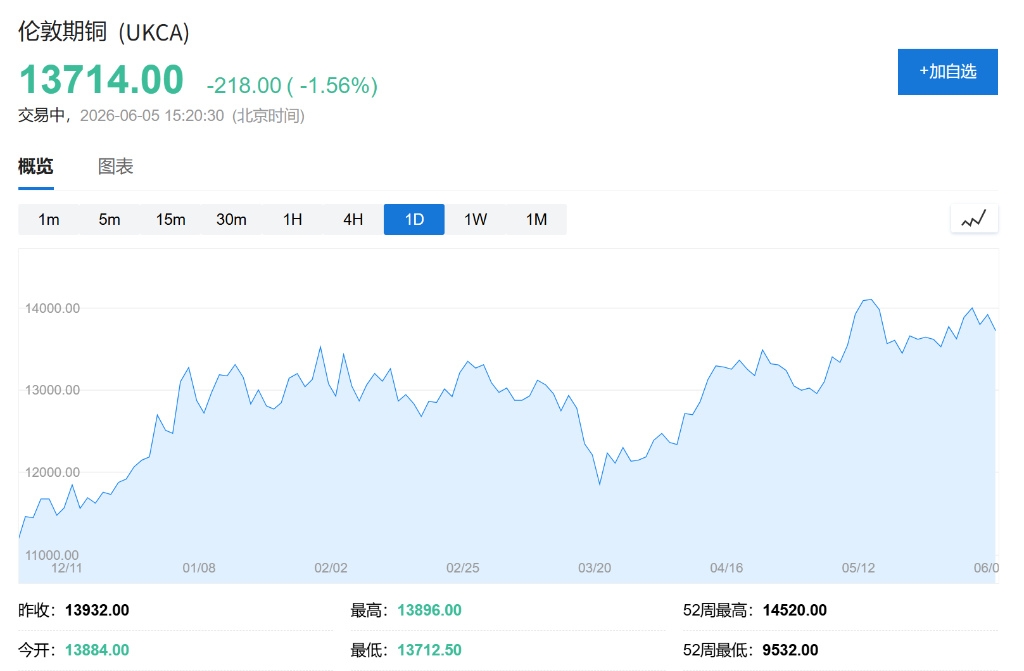
Goldman Sachs believes the most crucial recent price catalyst is the direction of US copper tariff policy, with the relevant decision expected this month. If the US announces tariffs on copper starting January 2027, it will drive importers to accelerate stocking, further tightening non-US market supply. LME copper prices could break $14,000/ton in the second half of 2026. If it's announced that no tariffs will be imposed, import demand will fall sharply, and copper prices might drop to about $12,800/ton—Goldman Sachs believes this is close to copper’s fundamental fair value.
Goldman Sachs has sharply increased its forecast for the non-US copper market supply gap in 2026 to about 640,000 tons and for 2027 to roughly 170,000 tons, both notably widened compared to prior estimates. The report points out that LME copper pricing forms in the non-US market, and sustained tightening in this region will push the LME copper price center higher.
Non-US Copper Market Gap Widens Sharply, Dual Tightening in Supply and Demand
The current widening of the non-US copper market gap is being driven by simultaneous tightening on both the supply and demand sides.
On the supply side, global mine output in 2026 and 2027 is down a total of about 350,000 tons, which is roughly 1.5% of total global mine supply; on the demand side, to avoid potential tariffs the US is massively importing copper, with US copper inventories expected to surge from about 0.1 million tons at the start of 2025 to about 1.8 million tons by the end of 2026, accumulating about 900,000 tons for the year—up from the previously forecast 550,000 tons.
Copper moving into US warehouses will no longer flow to LME or other international markets, directly compressing globally available supply. This results in a non-US market supply gap of about 640,000 tons in 2026 and about 170,000 tons in 2027, both substantially widened from earlier forecasts, supporting a higher pricing center for copper overall.
Delayed Recovery at Two Major Mines, Scrap Copper Substitution Hindered
This copper supply contraction mainly stems from delays in resuming production at two world-class mines.
Both Grasberg in Indonesia and Kamoa-Kakula in the DRC suffered output reductions due to accidents in 2025. Goldman Sachs now judges that both mines will not fully return to normal capacity until 2028. This revision directly led Goldman Sachs to reduce the forecast for 2026 global mine output by about 350,000 tons.
Scrap copper could theoretically serve as a substitute for refined copper shortages, but this channel is also currently blocked. Due to weak domestic scrap copper availability in China, scrap supply cannot effectively make up for the gap in refined copper, leaving the copper market’s overall tightness with little buffer.
Tariff Policy Is the Core Recent Catalyst, Three Scenarios Correspond to Different Price Paths
Goldman Sachs sees the direction of US copper tariff policy as the critical recent variable for LME copper prices, corresponding to three main scenarios and different price paths.
If there is no definitive tariff news for some time, copper prices are expected to remain supported near current levels, with the persistent non-US market tightness and speculative positioning both providing a floor.
If the US announces tariffs starting January 2027, importers will significantly increase stocking in the second half of 2026, further tightening non-US supply. LME copper prices could surpass $14,000/ton in the second half of 2026. But as tariffs are implemented, imports will suddenly cool in 2027, at which point prices are expected to come under pressure and fall back.
If the US explicitly states there will be no copper tariffs, import demand will fall sharply. The non-US market could turn to a slight surplus in 2027, and copper prices are expected to drop to about $12,800/ton—Goldman Sachs also sees this as the fundamental fair value in the no-tariff scenario. The report also notes that even if tariffs are not imposed now, the option is not completely off the table.
Disclaimer: The content of this article solely reflects the author's opinion and does not represent the platform in any capacity. This article is not intended to serve as a reference for making investment decisions.
You may also like
AI investment and consumer spending drive growth! UK Q3 GDP growth rate hits highest in two and a half years
As the widespread adoption of artificial intelligence (AI) continues to drive growth in corporate and consumer spending, and the economy demonstrates resilience in the face of an energy shock caused by the Iran war, the UK economy has achieved its fastest growth rate in two and a half years.

MSCI drops Strategy, Bitcoin eyes $70,000 as ETF outflows hit $300 million

AI servers + iPhone Duo dual engines drive, Foxconn Q3 net profit surges 34%, exceeding expectations
The financial report shows that Hon Hai's net profit for the third quarter reached TWD 77.5 billion, exceeding expectations, while revenue hit a record high of TWD 3.03 trillion. AI servers have become the primary growth engine, with the goal of capturing 50% of the global market share within two years and raising the gross margin to 10%. iPhone Duo sales are expected to reach up to 16 million units. Hon Hai Chairman Liu Yangwei stated that the shortage of memory chips and components will continue until 2027, and the performance forecasts for the company's four major product categories have been raised.
Applied Materials (AMAT): Can Earnings Extend a 24% Rebound?
Crypto prices
More


