
A must-read during market turbulence! If the market crashes within a year, billionaire Dalio’s AI tool recommends buying these two assets

An artificial intelligence (AI) tool based on the investment principles of billionaire hedge fund founder Ray Dalio has identified key assets investors should consider in the event of a potential market crash within the next year.
(Screenshot source: Finbold)
This guidance comes from "Digital Ray," an AI tool built on Dalio's long-term investment philosophy, focusing on diversified investing, risk management, and macroeconomic cycles.
The AI model warns that the market currently exhibits several historic conditions associated with significant downturns, including increasing leverage, high stock concentration, and tightening liquidity.
The analysis points out that the vulnerability of the U.S. stock market is rising, as corporate debt is growing faster than the overall economy, and a small number of mega-cap stocks dominate the S&P 500.
Meanwhile, higher interest rates and a tightening Federal Reserve policy are reducing the influx of cheap money that has fueled leveraged investing.
The tool adds that a rapid rise in interest rates, significant credit events, geopolitical tensions, or a sharp sell-off in large technology stocks could all trigger a broader market downturn.
Although it does not predict a full-scale collapse, the model states that under current conditions, the probability of a 15% to 20% correction within the next 12 to 18 months is higher than normal.
Recommended assets to buy in a market crash
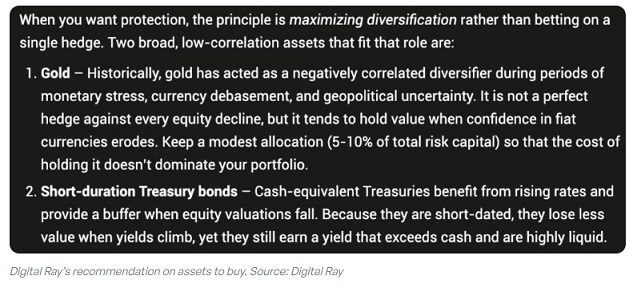
To protect portfolios during periods of high volatility, the AI system highlights the role of gold as a traditional safe haven asset: during currency instability, inflation concerns, and geopolitical uncertainty, gold tends to preserve its value.
The model suggests maintaining a moderate allocation to gold within a diversified strategy.
The second recommended asset is short-term U.S. Treasury bonds. The AI tool indicates these bonds can provide stability and liquidity during equity market declines.
(Screenshot source: "Digital Ray")
As short-term bonds, these securities are generally less sensitive to rising interest rates while still offering yields higher than holding cash.
Meanwhile, the AI model also stresses that investors should not rely on a single hedging tool but should build portfolios capable of performing across different economic environments, echoing Dalio's “all-weather” investment framework.
Disclaimer: The content of this article solely reflects the author's opinion and does not represent the platform in any capacity. This article is not intended to serve as a reference for making investment decisions.
You may also like
Stellar’s tokenized asset market reaches $4.1 billion, market share triples

NVIDIA (NVDA.US) management changes may affect Anthropic's IPO plans; the market is watching whether the multi-billion-dollar investment will change
With the sudden departure of Nvidia CEO Jensen Huang, the record-breaking initial public offering plan of AI giant Anthropic is being reconsidered by the market.
Nebius Q3 results exceed expectations, capital expenditure rises to $27 billion, ARR target postponed, stock falls over 14% pre-market | Earnings Report Insights
Nebius reported Q3 revenue of $981 million (a year-on-year increase of 571%) and adjusted EBITDA of $466 million, both exceeding expectations. However, the company delayed and lowered its guidance for annual recurring revenue (ARR), stating that it is no longer applicable. Additionally, it significantly raised its 2026 capital expenditure target to $27 billion, with projections to further increase to $40 billion to $45 billion in 2027. The stock price plummeted more than 14% in pre-market trading.
AUD/USD Price Forecast: Breakdown of H&S pattern keeps the pair under pressure
Crypto prices
More


