
Storage tsunami reshapes the global smartphone market: High-end market remains dominant, will the low-end market disappear forever?

In Q1 2026, the global smartphone market experienced a "supply-side shock" triggered by memory chips, ending ten consecutive quarters of recovery momentum, with industry shipments shrinking by 4% year-on-year. The core variable of this adjustment was not a sharp decline in demand, but rather a cost-push recession caused by upstream memory capacity being crowded out by AI data centers. In this cycle, industry structure accelerated its differentiation: Apple, Samsung, and Huawei, with supply chain locking capabilities and premium pricing power, demonstrated extraordinary resilience; while volume-driven manufacturers reliant on cost-effectiveness such as Xiaomi faced a dual squeeze in shipments and profits.
I. What Happened? The Hidden Rift Behind Q1 26 Global Smartphone Market Data
1. Global Overview: End of Consecutive Growth
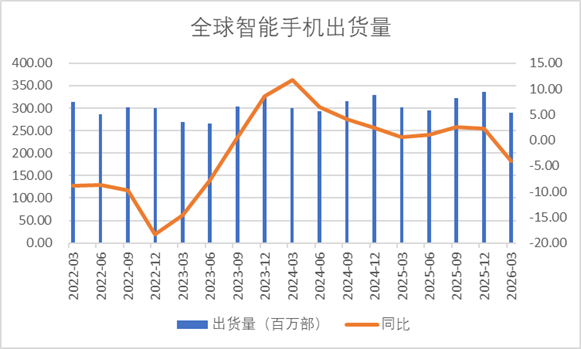
After a weak recovery lasting ten quarters, the global smartphone market suffered a "cold snap" in Q1 2026. According to comprehensive IDC data, global shipments reached approximately 290 million units, a 4.1% year-on-year decrease, with an absolute reduction of roughly 13 million units.
2. Brand Landscape: Samsung's Ascent Versus Xiaomi's Setback
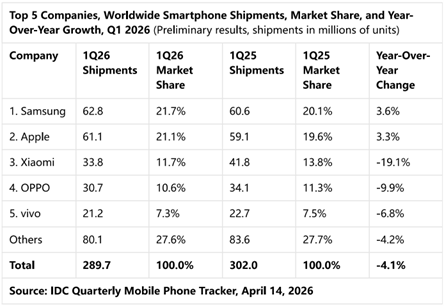
In Q1, brand competition showed a K-shaped divergence. IDC data reveals that Samsung ranked first with 62.8 million units shipped, raising its market share to 21.7%, an increase of 1.6 percentage points compared to the same period in 2025; Apple came in second with 61.1 million units, with a market share of 21.1%, up 1.5 percentage points year-on-year.
Apple: In Q1, global shipments grew against the trend by 3.3%, and in the Chinese market, there was an impressive 20% increase. The core driver was that the iPhone 17 series did not pass rising memory costs onto consumers, but instead absorbed them internally using its over 40% hardware gross margin, aggressively capturing high-end users overflowing from the Android camp due to price hikes.
Samsung: By prepping inventory for the S26 Ultra in advance, and leveraging its dual identity as both memory supplier and device brand, Samsung effectively hedged part of the cost pressure and maintained a solid position in the $600+ price segment.
Xiaomi: Global shipments stood at 33.8 million units, down 19% year-on-year, with market share dropping by 2.1 percentage points in a single year. Notably, the China segment saw a plunge of up to 35%, with the Redmi series facing a dilemma of “losing money on every sale.” The main reason was a proactive, strategic contraction in low-end model shipments, but this also exposed a supply gap as the transition toward high-end was not yet complete.
3. China Review: Huawei Reclaims the Throne, Android Vendors Lose Ground
As the world’s most fiercely competitive red ocean, the China market saw Q1 shipments of approximately 69.01 million units, a year-on-year decline of 3.3% according to IDC. Beneath the seemingly mild drop, significant shifts occurred:
……
Disclaimer: The content of this article solely reflects the author's opinion and does not represent the platform in any capacity. This article is not intended to serve as a reference for making investment decisions.
You may also like
Cerebras (CBRS.US) Cloud Business Soars, Masking Hardware Decline; OpenAI Supports Half of Cloud Revenue
Cerebras achieved record Q3 revenue, but hardware income dropped by nearly 30%, while cloud business accounted for two-thirds of total revenue. OpenAI contributed $72.4 million. The company raised its full-year guidance and expects Q4 to be close to breakeven.
Microsoft (MSFT.US) offers voluntary buyout packages to about 60,000 employees: Structural divergence in U.S. employment under AI transformation
In 2026, the U.S. labor market is characterized by both low layoffs and weak hiring. Companies like Microsoft and American Express are leveraging AI to optimize their workforce, while data centers are driving growth in the construction sector. However, entry-level white-collar jobs face increasing pressure, with real wages experiencing negative growth and structural transformation risks becoming more prominent.
"Inflation is really too high"! Federal Reserve "third-in-command": The Fed must continue to take action and promptly bring the price level back to 2%
John Williams, President of the New York Federal Reserve and the “number three” official at the Federal Reserve with a permanent voting right, stated that U.S. inflation remains high and policymakers must take further action to curb price pressures.

Crypto prices
More


