
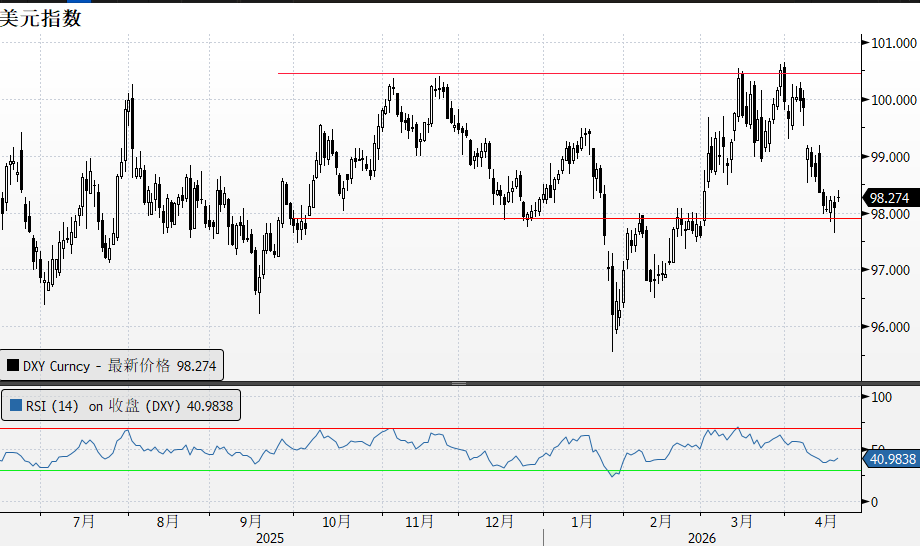
The US dollar index has already erased the gains since the start of the war.

Morning FX
Since last Friday, market sentiment has seen another V-shaped reversal. Over the weekend, Iran closed the Strait of Hormuz, while the US blockade against Iran remains in place. The United States seized an Iranian cargo ship, and Trump stated that he would threaten to destroy Iran’s power plants and bridges. In early Monday trading, oil and natural gas prices rebounded sharply, but the forex market remained relatively calm, with Asian equities also performing strongly.
I. Why are risk assets performing so optimistically?
Since the US and Iran reached a ceasefire agreement, US stocks have continued to rise, with the S&P 500 setting fresh all-time highs. The strong performance of risk assets is primarily driven by a short-term, passive rebound led by position covering. After the conflict broke out, investors sharply reduced exposure to risk assets, leaving the market in an overall underweight position. Once even moderately positive news emerges, the market, driven by FOMO sentiment, selectively trades positive developments while ignoring negatives, leading to concentrated position covering and a rapid rally in risk assets.
Chart 1: The Bank of America Investor Survey shows that going long risk assets was the most crowded trade in February, but positions were sharply reduced in March
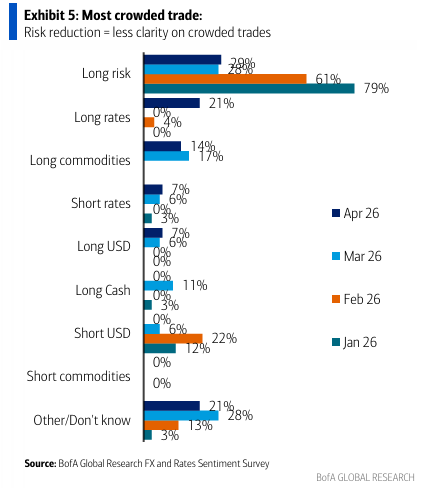
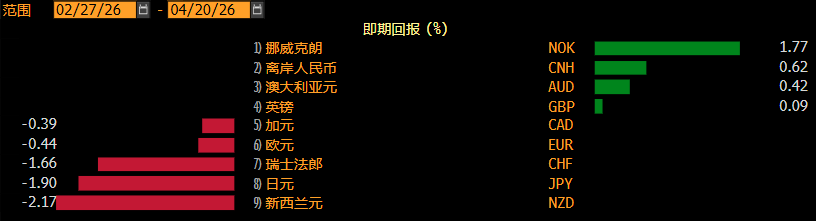
Similarly, in the forex market, shorting the US dollar at the start of 2026 was among the top trades, but after the war broke out the crowded short USD positions were significantly covered, leading to a rebound in the US Dollar Index. Now, the DXY has basically returned to pre-conflict levels. NOK, AUD, and CNH are even higher than they were before the conflict, while GBP, CAD, and EUR have also recovered their losses since the war started. Low-yield currencies like CHF and JPY have performed weaker.
Chart 2: Performance of major currencies since the US-Iran war
II. With the ceasefire deal about to expire, what’s next?
The 14-day temporary ceasefire agreement between the US and Iran is due to expire on April 22 and the final countdown has begun. Judging from the current interest structure of all parties, an escalation of the conflict would not benefit either the US or Iran.
For the United States, Trump’s conservative voters are generally opposed to continued conflict, and he himself is eager to reach reconciliation through diplomatic means.
For Iran's Revolutionary Guard, consolidating the regime is the top priority; continued warfare damages infrastructure and increases economic pressure at home, and in the long run, may stir risks of internal social unrest.
For Israel, the strategic focus is on weakening Hezbollah in Lebanon, so it does not obstruct US-Iran reconciliation efforts.
Thus, the conflict will most likely move towards de-escalation, with a cessation or continuation of the ceasefire tug-of-war. However, since current positive factors have already been fully priced into risk assets, if the Trump administration continues to apply extreme pressure, there could be potential downside risks for a rebound.
III. Summary
1. Since the ceasefire agreement, risk assets have been overly optimistic, with the market selectively trading on good news and ignoring negatives, mainly because positioning has dominated.
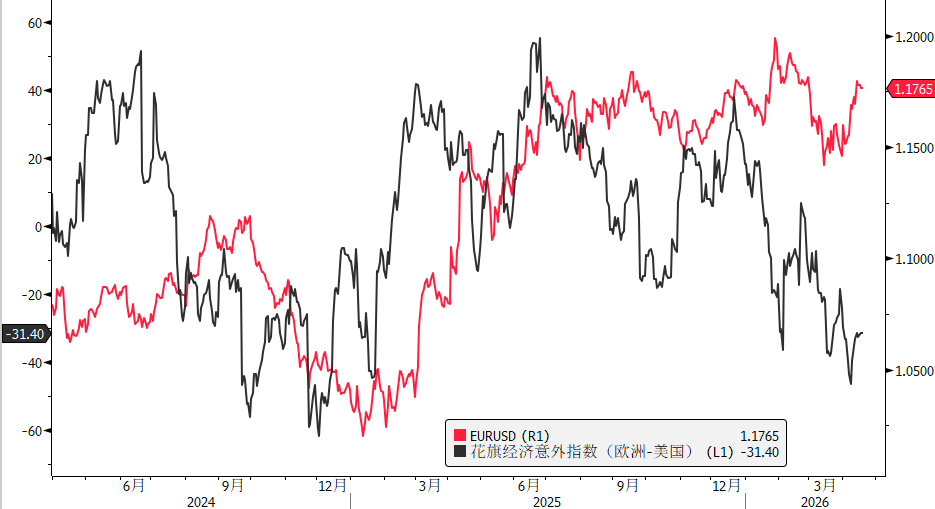
2. Aside from geopolitics, the market may re-focus on previously overlooked fundamentals; the difference in the Citi Economic Surprise Index between Europe and the US indicates EUR/USD is relatively overvalued. Key data this week include: US retail sales, various countries' PMIs, Germany’s ZEW Economic Sentiment Index, and Kevin Walsh’s stance on rate cuts at the Federal Reserve Board nomination hearing.
3. In terms of trading, there is short-term support near 98 for the US Dollar Index. If no substantial positive news emerges from the ceasefire, the DXY is expected to remain in the 98-100 range and fluctuate. The Renminbi is likely to show resilience among major currencies, and a possible strategy is to short EURCNY above 8.05.
Disclaimer: The content of this article solely reflects the author's opinion and does not represent the platform in any capacity. This article is not intended to serve as a reference for making investment decisions.
You may also like
Gold recovers from YTD low, retakes $3,900; Fed hike bets and bullish USD to cap gains
Cerebras (CBRS.US) Cloud Business Soars, Masking Hardware Decline; OpenAI Supports Half of Cloud Revenue
Cerebras achieved record Q3 revenue, but hardware income dropped by nearly 30%, while cloud business accounted for two-thirds of total revenue. OpenAI contributed $72.4 million. The company raised its full-year guidance and expects Q4 to be close to breakeven.
Microsoft (MSFT.US) offers voluntary buyout packages to about 60,000 employees: Structural divergence in U.S. employment under AI transformation
In 2026, the U.S. labor market is characterized by both low layoffs and weak hiring. Companies like Microsoft and American Express are leveraging AI to optimize their workforce, while data centers are driving growth in the construction sector. However, entry-level white-collar jobs face increasing pressure, with real wages experiencing negative growth and structural transformation risks becoming more prominent.
Crypto prices
More


