
Space X's New Numbers: Starlink Becomes the Only Profit Engine, $2 Trillion Valuation IPO Faces Major Cash-Burning Test

SpaceX is about to see a potential record-breaking IPO, and its latest disclosed financial data reveals a highly polarized fundamental picture: the Starlink satellite internet service has become the company's only profit engine, while rocket launches and artificial intelligence (AI) businesses are deep in massive cash burn.
On April 13, according to tech outlet The Information, undisclosed financial data shows SpaceX’s overall capital expenditures soared to $20.7 billion last year, outstripping its total annual revenue. Net losses approached $5 billion. Starlink generated about $3 billion in free cash flow, which is far from enough to offset the roughly $17 billion cash burn from the rocket and AI businesses combined.
Market analysis points out that this unconventional IPO is essentially Elon Musk financing his ambitions in space exploration and AI. Investors need to remain sober to the potential financial risks before participating. Whether SpaceX’s current $2 trillion valuation can be justified by the market will largely depend on whether investors are prepared to pay a premium for Starlink’s rapid growth, as well as the company’s long-term visions around space data centers and AI competition.
Starlink: The Only Profitable Engine with Strong Growth Momentum
SpaceX’s financial fundamentals show significant internal divergence.
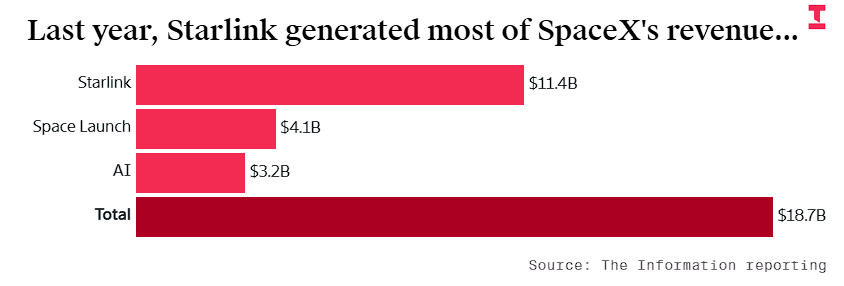
According to data disclosed by The Information, Starlink generated $11.4 billion in revenue last year, a 50% year-on-year increase, accounting for 61% of the company’s total sales. This business is the only cash-generating segment for SpaceX, with adjusted EBITDA (Earnings Before Interest, Taxes, Depreciation, and Amortization) reaching $7.2 billion, and profit margin jumping from 41% in 2023 to 63%.
Chris Quilty, satellite and space analyst at Quilty Space, said Starlink is providing data capacity previously unattainable to the public, attracting a wide customer base, including urban users.
However, the cash generated by Starlink is far from sufficient to support SpaceX’s other businesses. Data shows SpaceX’s capital expenditures hit $20.7 billion last year, with overall cash burn of about $14 billion.
Of this, the rocket launch business saw revenue grow only 8% to $4.1 billion, resulting in about $3 billion in negative free cash flow; meanwhile, the AI business—which includes social media X and model developer xAI—generated only $3.2 billion in revenue but burned nearly $14 billion in cash.
The report notes that despite Starlink’s strong performance, SpaceX overall remains a “money pit,” with massive AI development costs becoming its largest source of losses.
Doubts Over the $2 Trillion IPO Valuation Logic
The report states that SpaceX’s listing will severely test the public markets’ ability to price extreme growth stories, because the company’s current valuation logic demands highly optimistic sentiment from investors. The company’s most recent valuation was $1.25 trillion, which equals 266 times last year’s EBITDA.
This multiple is significantly higher than the 16 to 36 times valuation ratios seen in tech giants like Meta, Alphabet, and Nvidia, and even exceeds Elon Musk’s other company Tesla’s 119x multiple.
Additionally, according to The Information, some bankers are even hoping to assign SpaceX a valuation of $2 trillion, which has gone far beyond the scope of traditional financial analysis.
To justify this valuation, SpaceX is attempting to outline a blueprint to investors of three major synergistic business developments, such as leveraging its advantage in rocket launches to deploy data centers in space to drive the AI business. However, it cannot be denied that AI development costs are extremely high, and investments in rockets and data centers are continuously compressing the company’s profit margins.
The Information’s analysis points out that this is not a conventional stock offering, but rather Musk calling on the public to fund his grand ambitions for AI competition, building orbital data centers, and space travel. While these goals are lofty, they may not necessarily be the foundation of a profitable company.
For potential investors, the key is to remain sober and clearly recognize that investing in SpaceX means bearing the very real risk of capital loss. The final investment decision will depend entirely on their risk appetite for the company’s future visions.
Disclaimer: The content of this article solely reflects the author's opinion and does not represent the platform in any capacity. This article is not intended to serve as a reference for making investment decisions.
You may also like
Microsoft (MSFT.US) 365 services experience second major outage this year, affecting multiple government agencies and enterprises worldwide
Despite a "partial recovery," the latest Microsoft service outage continued into Asia-Pacific business hours.
Nvidia (NVDA.US) New CEO Candidates and Market Predictions: Trump Nominates Cook as Successor
As the successor remains uncertain, external voices have already begun to "make choices" for Nvidia.
Safe haven halo fails? US Treasury sell-off returns, Wall Street just breathed a sigh of relief and is startled again
Just as global bond investors began to believe that the worst phase of this year's sell-off had passed, the surge in U.S. Treasury yields has forced them to reassess that judgment.

Before the Jensen Huang scandal broke out, the Quant King precisely cleared out Nvidia!
The latest 13F filing shows that quantitative giant Renaissance Technologies almost completely sold off its holdings in Nvidia (reduced by 99.7%), Meta (reduced by 99.9%), as well as other tech giants like Apple and Amazon in the third quarter, and significantly reduced its position in Palantir. At the same time, it heavily increased its holdings in Micron Technology (up by 618.7%), AMD, and SanDisk, as well as other storage and chip stocks.
Crypto prices
More


