
3 Reasons to Buy the Dip on Peabody Energy Stock

Clean coal stock Peabody Energy Corp (NYSE:BTU) is trading at $28.34, down 13.8% this month already and 45% off its March 19, eight-year high of $41.14. The energy crisis brought on by high oil prices and the U.S.-Iran conflict have not been kind to stocks like Peabody. The upside for contrarians is that his drawdown has BTU testing a historically bullish trendline.
Per Schaeffer's Senior Quantitative Analyst Rocky White, the stock is now within 0.75 of its 200-day moving average's 20-day average true range (ATR), after remaining above it 80% of the time in the last two weeks and in 80% of the last 42 trading sessions. This signal has occurred seven other times over the past 10 years, after which the security was higher one month later 86% of the time, with an average 9.6% return over that timeframe. From its current perch, this lift would put the shares back above $30.
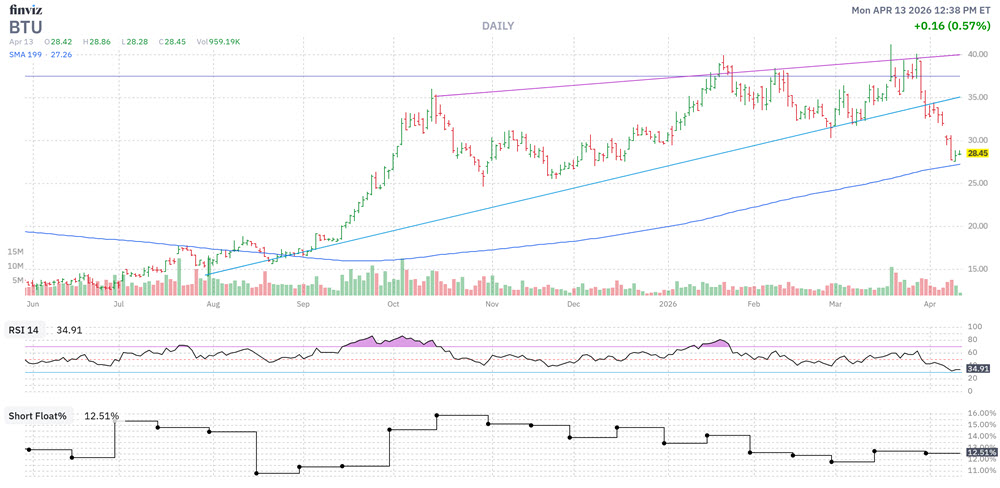
Keep an eye on BTU's 14-Day Relative Strength Index (RSI) as well, which is near "oversold" territory at 35. Previous forays this low often preceded rallies on the charts.
A short squeeze is also in play. While short interest tapered off in the most recent reporting period, a healthy 11.8% of the stock's total available float is still sold short. At BTU's average pace of trading, it would take shorts four days to buy back their bearish bets.
Disclaimer: The content of this article solely reflects the author's opinion and does not represent the platform in any capacity. This article is not intended to serve as a reference for making investment decisions.
You may also like
Nifty 50 Is Still Down 4.91% in 2026, So Why Does Citi See 13% Upside?

US Dollar Index: Fed path and CPI focus – Deutsche Bank

 VIPMidterm Elections Conclude, Anthropic Initiates IPO
1. Cross-asset performance diverged this week. Between the October 30 and November 6 closes, the S&P 500 fell 2.68%, the Nasdaq 100 dropped 4.91%, and BTC lost 1.88%. Gold and silver rose 4.51% and 5.79%, respectively, while the Hang Seng gained 5.10%. Sharp declines in crude oil and some Asian equity indexes showed how differently assets responded to growth, policy, and event risks. 2. Democrats won majorities in both chambers of Congress in the US midterm elections, and markets rallied before reversing. We focus on actual changes in fiscal negotiations, key committee arrangements, and local industrial policy, especially data-center approvals, energy costs, and the pace of capital expenditure. We do not map party outcomes directly to asset direction. 3. The pullback in technology stocks has put returns on AI investment under renewed scrutiny. Whether rapid growth can cover financing, construction, and ongoing compute costs is becoming a key valuation test. For related positions, monitor policy implementation, customer capital expenditure, and cash collection together, and do not read a one-day rebound as a sign that the pressure has passed. 4. Anthropic's IPO preparations are putting the growth quality, operating profitability, and funding needs of AI model companies under public-market scrutiny. Valuations discussed for the offering are not final pricing, and participating in related products also requires assessing fees, allocation methods, asset rights, and trading restrictions. Assets in focus: BTC, the Nasdaq 100, crude oil, and gold, along with key earnings from companies including CSCO, AMAT, and CEG

Asian Stocks Rebound, Nikkei Up 3.4%, but Can They Lead Wall Street?

Crypto prices
More


