
Gold price pullback triggers "bottom fishing" spree by central banks! Poland and other countries continued to increase holdings in March, while this country sold 69.1 tons

Krishan Gopaul, Senior Analyst for Europe, Middle East, and Africa (EMEA) at the World Gold Council (WGC), stated that as gold prices fell last month to levels unseen since last year, central banks globally have clearly accelerated their gold purchases. Relevant data indicates that sovereign institutions are taking advantage of the gold price correction to increase their allocation to gold, while after the outbreak of the Iran war, official gold market operations have also shown greater volatility.
Gopaul summarized recent sovereign gold buying activity in a series of social media posts. According to data released by the Czech National Bank, the country's gold reserves increased by another 2 tons in March, bringing its net purchase in the first quarter of this year to 5 tons and total gold holdings to 77 tons. At the same time, the Central Bank of Guatemala also increased its gold holdings by 2 tons last month. Gopaul pointed out that this amount is 19% higher than the previous month and marks the first time since September last year that Guatemala has increased its gold reserves, now totaling 16 tons.
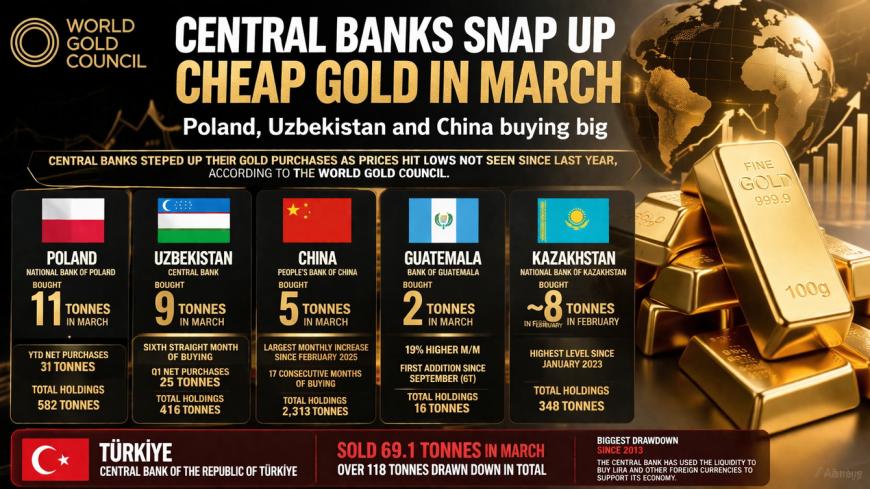
Data from the International Monetary Fund (IMF) also shows that Poland, the leading sovereign gold buyer in 2024 and 2025, made further significant purchases in March. Gopaul stated that the National Bank of Poland increased its gold holdings by 11 tons that month, bringing its net gold purchases for the year to 31 tons and total gold reserves to 582 tons. At the same time, the Central Bank of Uzbekistan also added 9 tons of gold in March, marking its sixth consecutive month of gold purchases. Gopaul noted that Uzbekistan's net purchases in the first quarter totaled 25 tons, pushing its total gold holdings to 416 tons.
Data released earlier this week by the People’s Bank of China shows that China’s gold reserves increased by 5 tons in March. This is the largest monthly increase since February 2025 and also means that China’s official gold purchases have continued unabated for 17 consecutive months. China’s official gold reserves now total 2,313 tons. In addition, Gopaul supplemented data from Kazakhstan for the previous month. He noted that the data from the National Bank of Kazakhstan showed that gold reserves increased by nearly 8 tons in February, raising the country's total gold reserves to 348 tons, the highest level since January 2023. This adjustment means that the net global central bank gold purchases for February were revised up to 27 tons.
Official gold operations diverge as Turkey sharply reduces reserves
However, not all central banks are increasing gold holdings. Since the outbreak of the Iran war, official sector transactions in the gold market have become noticeably more volatile. Market analysts speculate that some central banks, in order to protect their economies, may have to liquidate gold reserves in exchange for liquidity support.
So far, the Central Bank of Turkey remains one of the most transparent in its reserve operations. According to its published data, Turkey’s gold holdings fell by another 69.1 tons in March, bringing the cumulative decline for the latest month to more than 118 tons. According to reports, this is the largest decrease in Turkish gold reserves since 2013.
The Central Bank of Turkey stated that although it did sell some gold, much of the gold was "monetized" through gold swap agreements. The liquidity obtained from these operations was used to purchase lira and other foreign currencies to support the domestic economy.
Overall, as gold prices retreated to interim lows, most central banks continued to absorb gold, indicating that official institutions still view gold as an important reserve asset and a long-term allocation tool. The continued purchases by countries such as Poland, China, Uzbekistan, Czech Republic, Guatemala, and Kazakhstan highlight that "buying the dip" remains a key theme in today’s official gold market.
On the other hand, the sharp reduction in gold reserves by the Central Bank of Turkey also reflects that against the backdrop of war, exchange rate volatility, and financial pressures, some countries are increasingly treating gold as a strategic asset that can be quickly converted to liquidity. This means the global official gold market is no longer just a simple story of "continuous accumulation," but is gradually showing a more distinct divergence in strategies.
Disclaimer: The content of this article solely reflects the author's opinion and does not represent the platform in any capacity. This article is not intended to serve as a reference for making investment decisions.
You may also like
Anthropic IPO Roadshow: CEO Says "Doesn't Care About Market Conditions", Hopes to "Underpromise and Overdeliver"
As Anthropic gears up for its IPO, CEO Amodei remains deliberately low-key during the roadshow, emphasizing "under-promise and over-deliver," and appears calm regarding market volatility at the time of listing. In response to fluctuations in the AI sector and the Nvidia situation, Amodei stated he is not particularly concerned about the specific month of listing or market conditions, and frankly admits that allocation of computing power is "the most fundamental business challenge."
SpaceX (SPCX.US) Starship's 15th Test Flight: Booster recovery failed for unknown reasons; first orbital round-trip mission still awaits upper stage "tower catch" landing
On Friday local time, SpaceX conducted its 15th Starship flight mission in Texas.

Unlike Elon Musk’s “One Price” Approach: Anthropic (ANT.US) Roadshow Pricing Inquiry at $70-78, Institutional Investors Become the True Decision Makers in IPO Pricing
Anthropic will launch what is set to be the largest IPO in history next week, aiming to take this title from SpaceX. However, unlike Elon Musk’s conglomerate, large investors will have greater influence over its IPO pricing amid the ongoing turbulence in the artificial intelligence (AI) market.
Both are Tech Giant IPOs, Why is Anthropic's Listing Valuation More Conservative Than SpaceX?
Unlike SpaceX's fixed pricing model, Anthropic adopts the traditional roadshow approach, granting more pricing power to institutional investors. Due to factors such as the Nasdaq downturn, Federal Reserve rate hikes, and AI oversupply, the market environment is under pressure, and previous expectations for a $2 trillion valuation have faded. Analysts point out that the difference in pricing strategies between the two companies essentially reflects the depth of their relationships with the Wall Street capital markets.
Crypto prices
More


