
Solana Foundation looks to beef up DeFi security as attacks continue

The Solana Foundation on Monday announced a new security auditing framework for Solana-based protocols in addition to an incident-response network, warning that “adversaries are rapidly innovating.”
The Solana Foundation, a Swiss organization that supports the adoption and security of Solana, and Web3 security firm Asymmetric Research unveiled the Solana Trust, Resilience and Infrastructure for DeFi Enterprises (STRIDE), stating that it was a “structured program for evaluating, monitoring and escalating security across Solana projects.”
The initiative works to evaluate the security of protocols across eight pillars: program security, governance and access control, oracle and dependency risk, infrastructure security, supply chain security, operational security, monitoring and incident response, as well as log management and forensics.
Protocols are independently assessed against these requirements, with findings published publicly, said Asymmetric Research. “This gives users, investors, and the broader ecosystem real transparency into the security posture of the protocols they interact with.”
The announcement comes just a week after one of the largest DeFi exploits this year, with the Drift Protocol losing around $280 million following a social engineering attack from North Korean-linked threat actors.
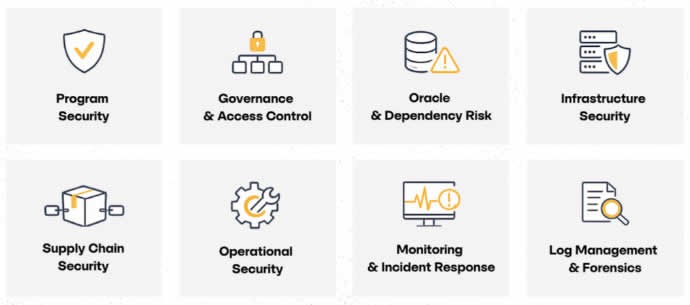 STRIDE’s eight pillars of security. Source:
Solana Incident Response Network
The Solana Foundation also announced the Solana Incident Response Network (SIRN), a network of security firms for real-time incident response across the Solana ecosystem.
“Members will share threat intelligence, coordinate responses to active incidents, and contribute to the ongoing evolution of the STRIDE framework,” it stated.
The foundation did not mention artificial-intelligence agents directly, but the announcement comes at a time when they are becoming an increasing threat to crypto protocols.
In January, $40 million was drained from the Solana DeFi platform Step Finance, with AI agents amplifying the damage by executing large transfers autonomously, last week.
Attackers hit 34 DeFi protocols in Q1
Malicious actors stole over $168 million in cryptocurrency from 34 DeFi protocols in the first quarter of 2026, according to data from DefiLlama.
However, the figure has fallen significantly from the same period last year, when $1.58 billion was pilfered in Q1, 2025.
The largest exploit for the period was the private key compromise of Step Finance.
Disclaimer: The content of this article solely reflects the author's opinion and does not represent the platform in any capacity. This article is not intended to serve as a reference for making investment decisions.
You may also like
AI trading retreats and corporate profit growth boost European stocks! Four-day winning streak halted but still on track for biggest weekly gain since July
European stock markets had previously risen for four consecutive trading days and reached record highs, but this rally could not be sustained. The Stoxx Europe 600 Index has climbed 2.2% this week and is on track for its largest weekly gain since July.
Nebius (NBIS.US) Q3 Conference Call: CEO Says AI “Demand Is Real and Huge”, Expects Pre-tax Break-even by Q4 2027
Nebius Group (NBIS.US) will release its Q3 2026 financial results before the market opens on November 12 (US Eastern Time) and hold a conference call on the same day.
Jensen Huang's resignation drags down AI trading, US three major stock index futures collectively fall, Nvidia stabilizes pre-market, Brent crude rebounds and breaks through $96
Nasdaq 100 index futures fell over 0.3%, and S&P 500 index futures declined 0.14%. Brent crude oil rose 0.37% to $96 per barrel. Spot gold increased 0.4% to $3,893.48 per ounce. Investors are now focusing on the US PPI data to be released tonight.
Invesco's Q3 Holdings Shuffle: Reduced Nvidia (NVDA.US) and Semiconductor Equipment Positions, SpaceX (SPCX.US) Holdings Surge to Over $10 Billion
Invesco has submitted its Q3 holdings report (13F) for the period ending September 30, 2026.
Crypto prices
More


