
AUD: From strongest to weakest

Morning FX
Since the beginning of this year, the Australian dollar has been the best-performing currency. Even after the US-Iran conflict in March, AUDUSD hit new highs in a tough environment, approaching 0.72, with a year-to-date gain of over 6%. However, since last week, AUDUSD has posted six consecutive losses, falling from above 0.7 to as low as 0.6830, marking its worst monthly performance since December 2024.
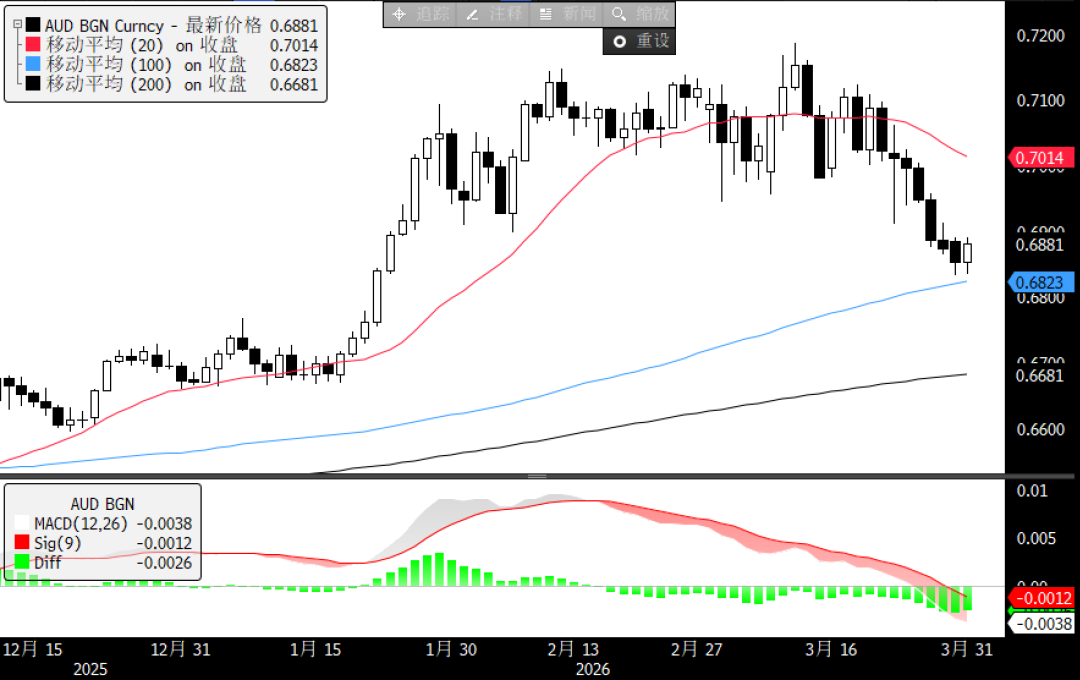
1. Why did the AUD experience a rapid shift from “strongest” to “weakest”?
Risk-off sentiment: Continued escalation of tensions in the Middle East and poor performance in global stock markets have fueled risk-off sentiment, which is the primary driver for AUD's retreat from its highs.
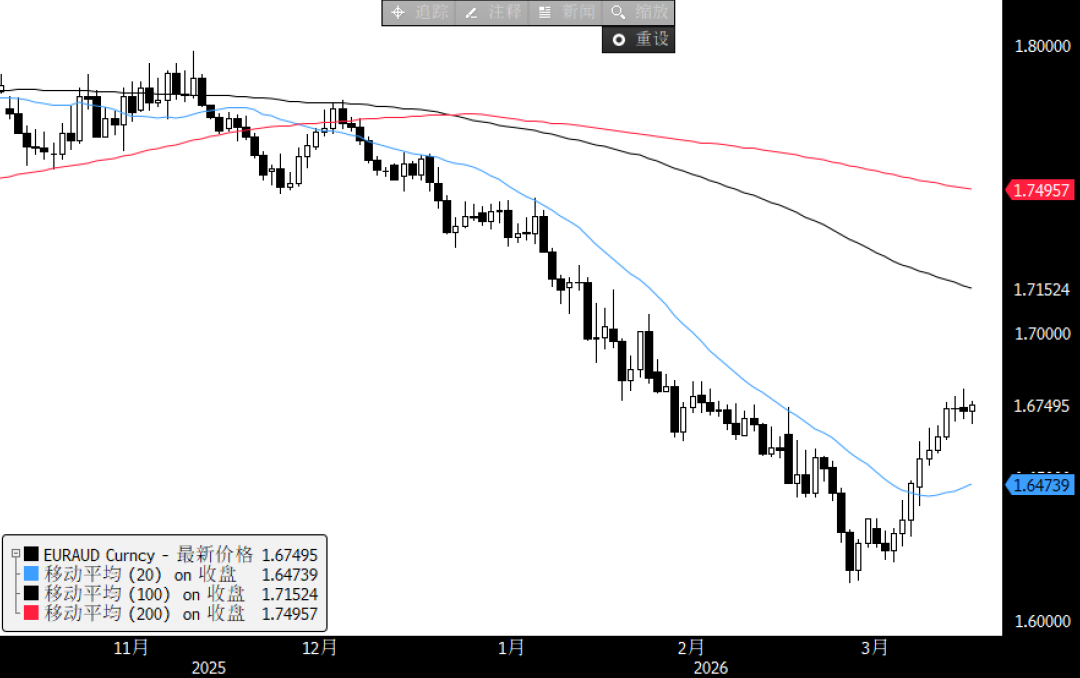
Weakened fundamental advantage: Previously, the strong performance of AUD was supported by robust domestic fundamentals and the Reserve Bank of Australia's hawkish stance. However, in March, the RBA raised rates by a narrow 5-4 margin, revealing increased division within the committee. In addition, February's Australian CPI fell short of expectations, further eroding market confidence in the RBA's ability to continue raising rates. More crucially, major central banks in the US and Europe have recently turned more hawkish, significantly reducing the RBA's relative hawkish advantage. The most evident impact is the sharp rebound of EURAUD after the European Central Bank turned hawkish.
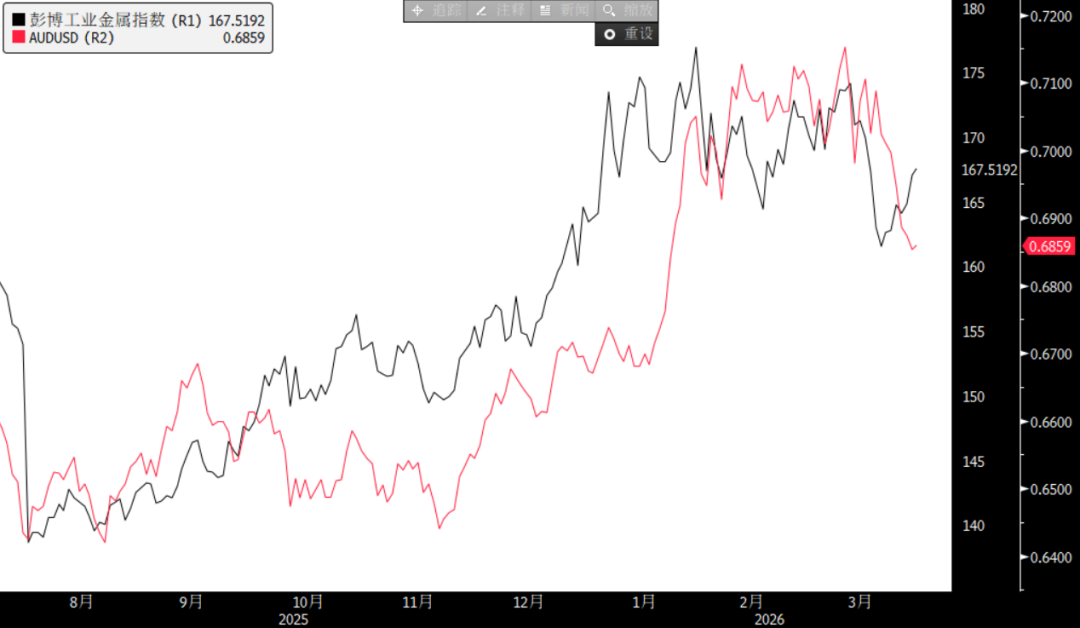
Commodity effects: The recent sharp downturn in industrial metals has had a clear negative impact on the Australian dollar. However, this week, the weakness in AUD has exceeded the impact of industrial metals alone, as the divergence between AUDUSD and the Bloomberg Industrial Metals Index shows.
2. Outlook: How could AUD turn things around?
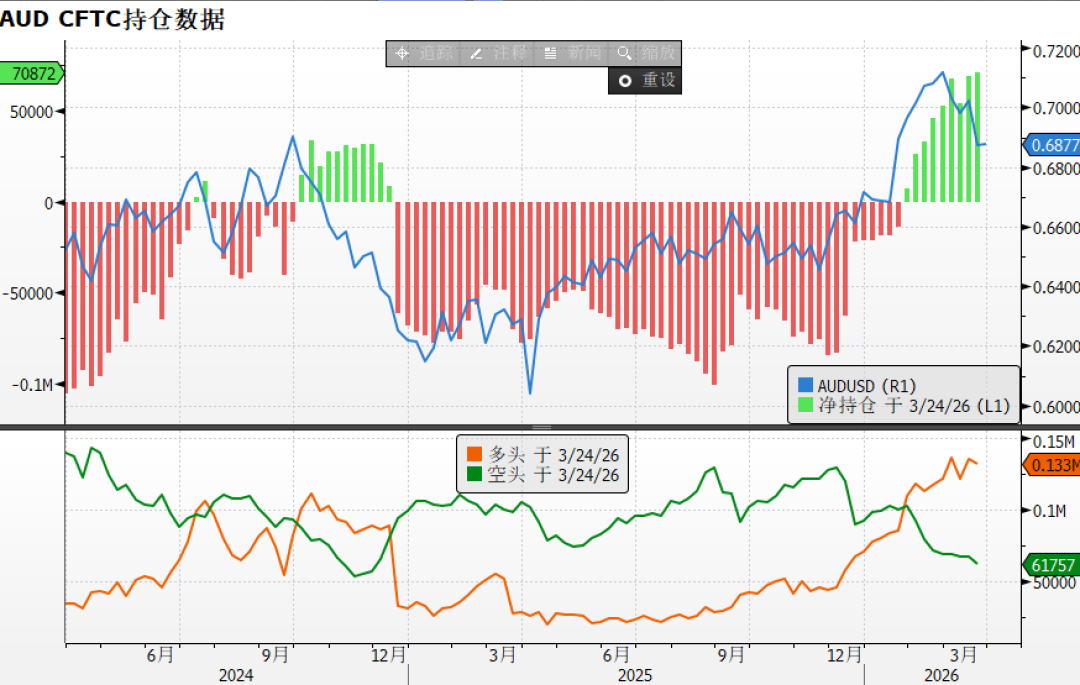
Although AUDUSD has already pulled back more than 300 pips from its highs, CFTC positioning shows AUD is still net long, suggesting that both AUD pairs and crosses might still have room to fall further.
In the short term, from a technical perspective, the 0.68 level, which was a previous resistance now breached, will provide some support for AUDUSD. However, until there is greater clarity in the Middle East and global risk sentiment improves, it will be difficult for AUDUSD to achieve a strong rebound. The expected trading range is likely to be between 0.68 and 0.7.
In the medium and long term, once the US-Iran conflict approaches its end, the combination of a rebound in risk sentiment and falling rate hike expectations in the US and Europe would be positive for the Australian dollar. It is expected to outperform other non-USD currencies such as the euro and the yuan. Therefore, I still tend to build some medium- to long-term bullish AUDUSD positions when it approaches 0.68, from a left-hand layout perspective.
Disclaimer: The content of this article solely reflects the author's opinion and does not represent the platform in any capacity. This article is not intended to serve as a reference for making investment decisions.
You may also like
From SpaceX to Anthropic, the market has new strategies for dealing with tech giants' IPOs
The market's response strategies to major listings are currently centered around "index inclusion expectations": the new regulations allow mega IPOs to be included in the six major indices within 15 days, triggering concentrated buying by passive funds. Investors are positioning themselves in advance and using options to hedge and amplify buying power. However, Anthropic has a free float of only about 6%; shares available for sale by employees on the first day and privately placed shares with no lock-up period may create supply pressure. On the other hand, index arbitrageurs are facing a rare opportunity.
Nvidia Q3 Earnings Preview: Revenue Expectations and Key Metrics to Watch
AI trading retreats and corporate profit growth boost European stocks! Four-day winning streak halted but still on track for biggest weekly gain since July
European stock markets had previously risen for four consecutive trading days and reached record highs, but this rally could not be sustained. The Stoxx Europe 600 Index has climbed 2.2% this week and is on track for its largest weekly gain since July.
Nebius (NBIS.US) Q3 Conference Call: CEO Says AI “Demand Is Real and Huge”, Expects Pre-tax Break-even by Q4 2027
Nebius Group (NBIS.US) will release its Q3 2026 financial results before the market opens on November 12 (US Eastern Time) and hold a conference call on the same day.
Crypto prices
More


