
Trump's “Verbal Easing” Fails, Crude Oil “Spot Shock” Approaches, Is the US Stock Market Really Panicking?

The ongoing US-Iran conflict continues to weigh on market sentiment, with the S&P 500 Index posting five consecutive weeks of losses, and Trump’s “verbal easing” is losing its effect.
On Friday Eastern Time, all three major US stock indices closed lower. The Dow Jones Industrial Average fell into correction territory, and the Nasdaq Composite expanded its drop to over 10%. The oil market's “spot shock” is now passing from futures prices through to physical supply, while market trust in Trump’s verbal statements is continually eroding.
Brent crude closed at $112.57 per barrel on Friday, marking its highest closing price since July 2022. Out of the past 13 trading days, Brent crude and the S&P 500 Index have moved in opposite directions for 12 of them. The Hormuz Strait remains blocked; according to analyst estimates, the actual daily throughput of oil passing through the strait—about 10 million barrels or more—has halted.
On Thursday, Trump posted on social media, claiming that Iran had allowed some commercial vessels to transit the Hormuz Strait. However, this did not stop oil prices from continuing to climb on Friday. According to Iranian media reports, all ships entering or exiting the ports of countries that support the US and Israel are now banned from passage.

Trump's “Verbal Easing” Fails
In recent weeks, the expectation that “Trump could hit the brakes at any time” has been a key support preventing even larger market declines. However, as the conflict drags on, this support is weakening.
Barclays analysts wrote in a Friday report, "Ongoing flip-flopping and headline fatigue are seriously weakening the effectiveness of the ‘Trump put option’; the situation remains fluid and quite chaotic." The so-called "Trump put option" refers to the market's confidence in Trump's ability to bolster market sentiment through policy signals.
StoneX market analyst Fawad Razaqzada stated in a report, "Trump’s grip on the market is weakening. Investors appear increasingly skeptical of his statements, and are even starting to trade against them—they’re waiting for tangible evidence, not just words."
Alpine Macro’s Chief Geopolitical Strategist Dan Alamariu also pointed out that this crisis is fundamentally different from Trump’s previous “threat then retreat” pattern: “This time, Iran holds veto power, or at least has a say—you can’t just TAC (referring to Trump’s usual threat-and-withdraw pattern) the situation.”
Despite Trump’s three attempts to talk down oil prices (5-day extension, “ceasefire” proposal, and a 10-day extension), WTI crude still ended the week flat, with prices rising back to levels seen before Trump’s verbal interventions.
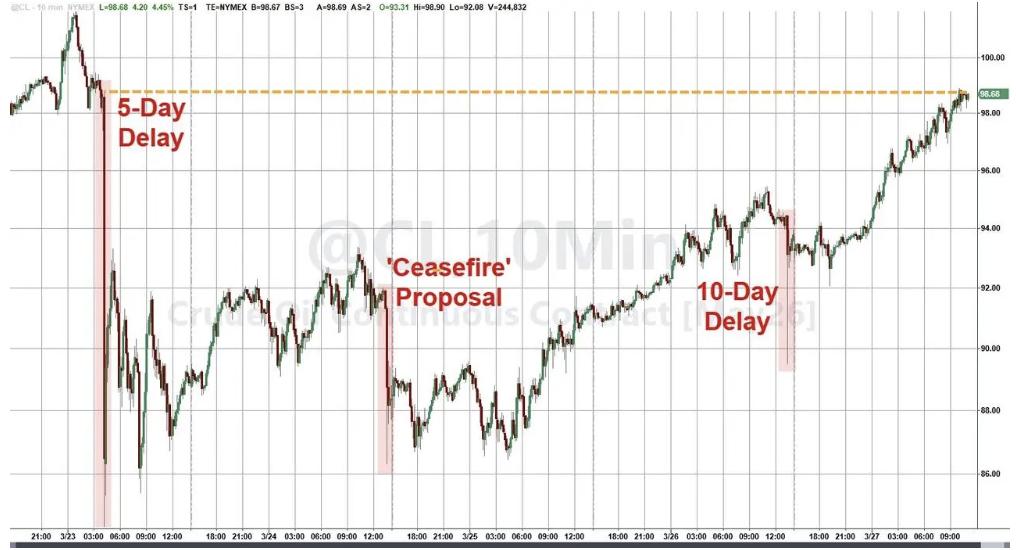
Straight Blockade: Buffer Inventories Depleted, Physical Shock Approaches
The market’s core fear is shifting from “potential oil shortages in the future” to “actual shortages in the present”.
In the preceding weeks, when the US-Iran conflict first broke out, oil tankers departing from the Persian Gulf had mostly completed loading and left before the conflict further escalated, providing the market with some buffer. According to Saxo Bank's Head of Commodity Strategy, Ole Hansen:
"Most vessels that left the Persian Gulf before the conflict intensified have now completed their voyages and offloaded, and with limited new supply, the buffer that initially restrained oil price spikes is being rapidly depleted."
It’s noteworthy that spot prices for Middle Eastern crude are now far above financial benchmarks like Brent and WTI—this differential is seen as an early indicator of physical supply shortages spreading to the rest of the world, putting investors on high alert.
According to a previously published WallstreetCN article, the Hormuz Strait blockade is triggering a mounting “East-to-West” oil shock: Asian inventories are now at the brink, the Philippines has declared an energy emergency, and Africa and Europe have come under pressure in early and mid-April, respectively.
This means the “grinding, slow upward move” in oil prices is still underway. Macnamara commented, “As reality gradually replaces headline effects, oil prices are climbing slowly but steadily.”

The Story Behind Five Weeks of Loss: Panic Not Yet Peaked
Technically, the three major indices are in a dire position.
The S&P 500 Index has fallen for five consecutive weeks, marking its longest losing streak since the Russia-Ukraine war roiled global markets in 2022. The total decline in March has reached 7.4%. The Dow Jones Index plunged 1.7% (a drop of 793 points) on Friday, entering correction territory; the Nasdaq fell 2.1% on Friday, after confirming correction the previous day.

Sentiment indicators are also flashing warnings. The Cboe Volatility Index (VIX) surged above 31 on Friday, far above the long-term average of around 20. According to Citadel Securities data, demand for protective puts on the S&P 500 has spiked, and the “skew” metric—measuring the market’s risk bias—is now near a five-year high.

Carol Schleif, Chief Investment Strategist at BMO Wealth Management, said, "Psychologically, this drawn-out battle is exhausting; markets are struggling to digest a crisis initially expected to be short-lived."
Alamariu described the current market state even more bluntly: “The peak of panic has not yet arrived. Panic, by definition, is irrational—markets don’t know how to price it.”
Macroeconomic Transmission: Inflation Expectations Heat Up, Rate Cut Bets Retreat
Rising energy prices are feeding through to the macroeconomy via several channels. Wall Street has generally raised its inflation forecasts and reduced bets on Fed rate cuts for this year.
Nationwide Chief Market Strategist Mark Hackett said, although the US economy remains fundamentally solid for now, “If the conflict fails to see clear resolution and the energy market fails to stabilize, a sustained rally will be hard to achieve.”
Barclays analysts also cautioned, "Meanwhile, the war drags on, and the longer oil shocks persist, the more severe the stagflation shock becomes." Currently, there’s no sign Iran is eager to compromise; Israel is intensifying airstrikes, and the US is reportedly deploying more troops to the region.
BMO’s Schleif summarized what the market wants: “The market wants to see a framework for stability in the Middle East, as well as the reopening of the Hormuz Strait for key tanker shipments. The market wants a way out of this predicament.”
Disclaimer: The content of this article solely reflects the author's opinion and does not represent the platform in any capacity. This article is not intended to serve as a reference for making investment decisions.
You may also like
Nvidia falls to its lowest valuation in 14 years! "Super bull" Tom Lee calls for bottom fishing, retail investors are buying more as it drops, but Wall Street is divided
After the market opened on Thursday, retail investors went against the trend and bought up Nvidia, with net purchases reaching $111 million in just half an hour, setting a record for the same period. Investors such as Tom Lee have publicly supported the company, with institutions optimistic about strong order backlogs extending to 2028, robust revenue growth, and opportunities created by declining valuations. Meanwhile, institutions like Bernstein and Goldman Sachs have become more cautious about Nvidia's outlook, with concerns focusing on management succession and technological leadership following Jensen Huang's departure.

Jane Street boosts Fidelity Bitcoin ETF stake 8x in Q3, trims BlackRock IBIT

From SpaceX to Anthropic, the market has new strategies for dealing with tech giants' IPOs
The market's response strategies to major listings are currently centered around "index inclusion expectations": the new regulations allow mega IPOs to be included in the six major indices within 15 days, triggering concentrated buying by passive funds. Investors are positioning themselves in advance and using options to hedge and amplify buying power. However, Anthropic has a free float of only about 6%; shares available for sale by employees on the first day and privately placed shares with no lock-up period may create supply pressure. On the other hand, index arbitrageurs are facing a rare opportunity.

Nvidia Q3 Earnings Preview: Revenue Expectations and Key Metrics to Watch
Crypto prices
More


