
US lawmakers publish crypto tax proposal without Bitcoin tax exemption

US Representatives Max Miller and Steven Horsford published a discussion draft bill on Thursday titled the ‘‘Digital Asset Protection, Accountability, Regulation, Innovation, Taxation, and Yields Act’’ or the ‘‘Digital Asset PARITY Act,” to overhaul the tax code for digital assets.
The Digital Asset PARITY Act seeks to overhaul the Internal Revenue Code of 1986 by adding provisions that would clarify the tax treatment of digital assets.
The legislation said that stablecoins are not subject to gains if the cost basis, or the amount paid by the investor, does not fluctuate by more than 1% of $1 or $0.01, according to the discussion draft.
Transaction costs incurred to acquire or move regulated dollar-pegged stablecoins cannot be counted toward an investor’s cost basis, according to the bill.
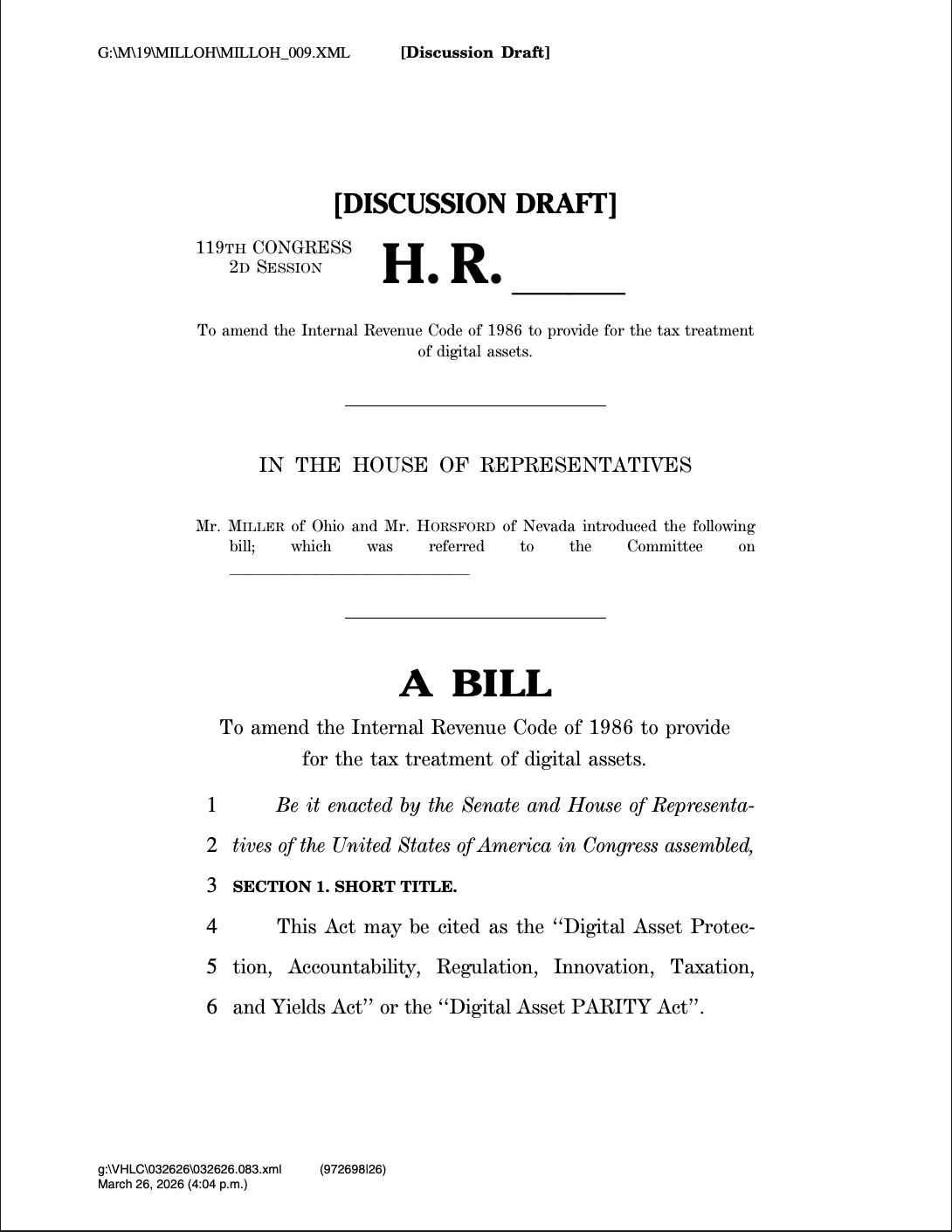 The Digital Asset PARITY Act. Source:
Digital Chamber
The bill also introduces a de minimis tax exemption for stablecoin transactions below $200, meaning that stablecoin transactions below the $200 threshold do not trigger tax or reporting requirements. A total annual exemption cap is yet to be determined.
Income from lending, staking or income earned through “passive” validator services is treated as part of the recipient's gross income every year, and calculated using “fair market” value, the draft said.
The Digital Asset PARITY Act has not yet been introduced to Congress; it was published as a discussion draft to open up debate between lawmakers, stakeholders and the crypto industry about how to overhaul crypto tax policy in the US.
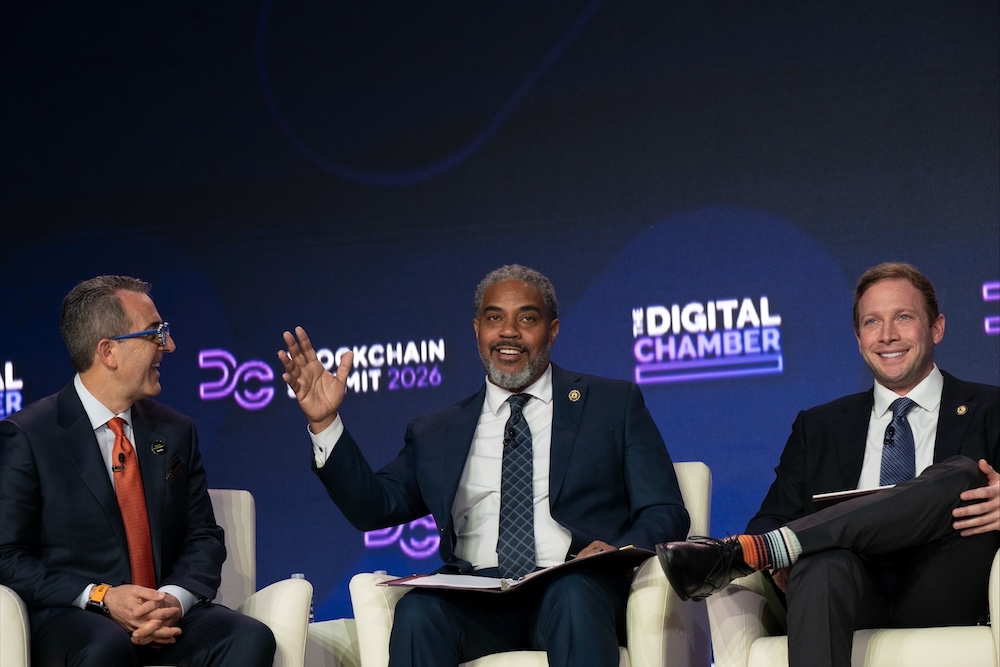 Rep. Steven Horsford, pictured center, and Rep. Max Miller, pictured right, speak about the future of crypto policy at the DC Blockchain Summit. Source:
Digital Chamber
Crypto tax proposal highlights schism in the crypto industry
“We need digital asset tax clarity or activity will never fully onshore,” Cody Carbone, the CEO of crypto advocacy organization Digital Chamber, said in response to the discussion draft.
However, Bitcoiners noted that the bill includes only a de minimis tax exemption for stablecoins, not Bitcoin (BTC), similar to pending legislation, including the CLARITY crypto market structure bill, which also lacks a BTC de minimis tax exemption.
“This is the wrong direction to go in,” Pierre Rochard, CEO of The Bitcoin Bond Company, a BTC financial product issuer, said about the draft.
“It’s Bitcoin that should have a de minimis tax exemption. Stablecoins are not decentralized, and they are not permissionless. They’re not real money; they’re just fiat,” he added.
Disclaimer: The content of this article solely reflects the author's opinion and does not represent the platform in any capacity. This article is not intended to serve as a reference for making investment decisions.
You may also like
Nvidia falls to its lowest valuation in 14 years! "Super bull" Tom Lee calls for bottom fishing, retail investors are buying more as it drops, but Wall Street is divided
After the market opened on Thursday, retail investors went against the trend and bought up Nvidia, with net purchases reaching $111 million in just half an hour, setting a record for the same period. Investors such as Tom Lee have publicly supported the company, with institutions optimistic about strong order backlogs extending to 2028, robust revenue growth, and opportunities created by declining valuations. Meanwhile, institutions like Bernstein and Goldman Sachs have become more cautious about Nvidia's outlook, with concerns focusing on management succession and technological leadership following Jensen Huang's departure.

Jane Street boosts Fidelity Bitcoin ETF stake 8x in Q3, trims BlackRock IBIT

From SpaceX to Anthropic, the market has new strategies for dealing with tech giants' IPOs
The market's response strategies to major listings are currently centered around "index inclusion expectations": the new regulations allow mega IPOs to be included in the six major indices within 15 days, triggering concentrated buying by passive funds. Investors are positioning themselves in advance and using options to hedge and amplify buying power. However, Anthropic has a free float of only about 6%; shares available for sale by employees on the first day and privately placed shares with no lock-up period may create supply pressure. On the other hand, index arbitrageurs are facing a rare opportunity.

Nvidia Q3 Earnings Preview: Revenue Expectations and Key Metrics to Watch
Crypto prices
More


