
Crypto industry ties were a liability in Illinois primary

Not all voters are sold on crypto, and in Illinois, the crypto industry lobby failed to secure a victory, despite spending millions.
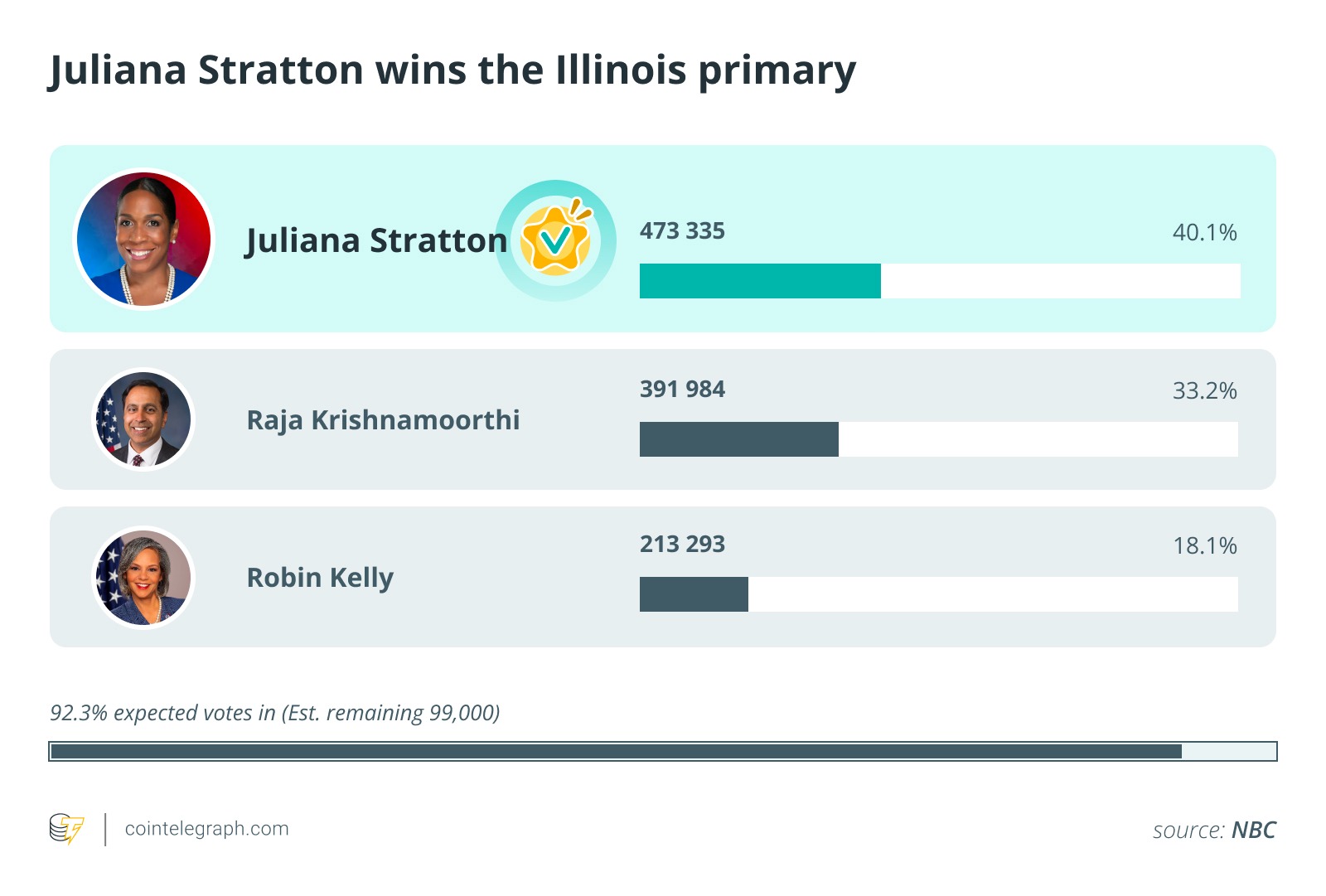
On Tuesday, Illinois Lieutenant Governor Juliana Stratton won a primary election for a rare open US Senate seat in her state. She is expected to win in the general election and take the seat of retiring Democratic Senator Dick Durbin.
In the primary, she won over two other candidates, Representative Raja Krishnamoorthi, who currently represents Illinois’ 8th Congressional district, and Representative Robin Kelly from Illinois’ 2nd.
The crypto lobby spent millions on ads supporting Krishnamoorthi. But ties to the industry may have been more of a liability among progressive voters.
“MAGA-backed crypto bros” finance Krishnamoorthi
In the months leading up to the election, Stratton ran on a progressive platform to oppose US President Donald Trump and, according to the Chicago Sun-Times, was the only candidate to openly oppose Immigration and Customs Enforcement (ICE). She also supported a higher minimum wage than Krishnamoorthi or Kelly.
As the primary race got closer, political action committees (PACs), notably Fairshake and Protect Progress, began to pour millions of dollars into the election.
Their motivations were clear. Ensuring that the industry has another crypto-friendly senator could be crucial as the Senate continues to work on the CLARITY Act.
Krishnamoorthi was a strong supporter of the GENIUS Act, which provided favorable regulations for stablecoins. He also voted for the CLARITY Act and the Financial Innovation and Technology for the 21st Century Act. This earned him an “A” rating with Stand With Crypto, a cryptocurrency advocacy organization tracking legislative records and attitudes.
Stratton’s campaign drew particular attention to the crypto dollars in the final weeks of the election. The Chicago Sun-Times estimated that Fairshake spent over $8 million.
In a March 3 video posted to X, Stratton said that Krishnamoorthi was “relying on his Trump-aligned allies” to tear her down with millions of dollars in attack ads. “His MAGA-backed crypto bros are dumping $7 million into this race to try to stop me. Illinoisans aren't buying it,” she wrote.
The connection of crypto with Trump and Republicans more broadly is understandable. Marc Andreessen, one of the founders and major donors to Fairshake, has previously expressed his support for Trump, and said he’d be voting for him in 2024. Trump and his family members are themselves part of crypto investment schemes.
And the money doesn’t lie. Fairshake is technically non-partisan, but it has spent more in support of Republican candidates. According to Open Secrets, some 62% of its expenditures support Republicans and oppose Democrats, while 37% of its expenditures support Democrats and oppose Republicans.
This didn’t appear to sit well with voters, nor with other officials representing Illinois. Senator Tammy Duckworth claimed that Krishnamoorthi could be "compromised" by industry interests, an idea the representative denied.
A 2025 poll found that Illinois voters held largely favorable opinions about cryptocurrencies, but many also supported restrictions. Some 47% of Democratic voters would support “policies restricting the growth of cryptocurrency and blockchain technology.”
Overall, 36% of Illinois voters “would be more likely to support elected officials who support restrictions on cryptocurrency and blockchain technology.”
Some election observers pointed out that Stratton had taken significant donations from current Illinois Governor JB Pritzker. But one Chicago voter told The Washington Post, “How many billionaires are supporting Raja?” The governor, by contrast, was “supporting his own lieutenant governor. That’s a non-issue for me. He should be doing it.”
Crypto lobby ramps up as midterms approach
The Illinois primary is just one of many races in which the crypto industry will spend money on ads and other support materials this year.
At the end of 2025, Fairshake alone had $190 million in cash on hand, $131 million of which it raised in the last half of the year.
Lawmakers and activists alike are concerned about the undue influence this could have on the midterm election outcomes. Senator Elizabeth Warren, a noted skeptic of the crypto industry, said that the Illinois primary would be “the test case for whether or not they can buy whatever candidate they want for Senate in Illinois and many of the congressional seats.”
Saurav Ghosh, the director of the Campaign Legal Center, previously told Cointelegraph, “This kind of influence buying ultimately undermines the democratic process by marginalizing everyday Americans, ensuring that their voices and interests take a backseat to the crypto industry’s deregulatory desires.”
The increasing association with crypto, MAGA and Trump could also prove problematic for keeping industry interests in Washington. Trump has negative approval ratings in all but 8 of the 50 states. Republicans are also facing predominant disapproval in the polls. If crypto becomes a byword for a Republican economic agenda, it may not work favorably in the midterms.
Political operatives have noted that, for the crypto lobby to retain influence, it needs to remain bipartisan. Democratic Representative Sam Liccardo told Politico last year, “I don’t think anybody in this town would recommend that an industry put their eggs in one party’s basket.”
In Congress, there are still a significant number of Democrats who are pro-crypto, or at the very least, not entirely opposed to the blockchain industry.
Filecoin Foundation chair Marta Belcher said, “Many policymakers on both sides of the aisle support crypto. I don’t think crypto is a partisan issue, just like ‘the internet’ isn’t a partisan issue. I don’t think, in 2025, either party can be ‘anti’ an entire technology if they’re thinking seriously about America’s future.”
Disclaimer: The content of this article solely reflects the author's opinion and does not represent the platform in any capacity. This article is not intended to serve as a reference for making investment decisions.
You may also like
Nvidia falls to its lowest valuation in 14 years! "Super bull" Tom Lee calls for bottom fishing, retail investors are buying more as it drops, but Wall Street is divided
After the market opened on Thursday, retail investors went against the trend and bought up Nvidia, with net purchases reaching $111 million in just half an hour, setting a record for the same period. Investors such as Tom Lee have publicly supported the company, with institutions optimistic about strong order backlogs extending to 2028, robust revenue growth, and opportunities created by declining valuations. Meanwhile, institutions like Bernstein and Goldman Sachs have become more cautious about Nvidia's outlook, with concerns focusing on management succession and technological leadership following Jensen Huang's departure.

Jane Street boosts Fidelity Bitcoin ETF stake 8x in Q3, trims BlackRock IBIT

From SpaceX to Anthropic, the market has new strategies for dealing with tech giants' IPOs
The market's response strategies to major listings are currently centered around "index inclusion expectations": the new regulations allow mega IPOs to be included in the six major indices within 15 days, triggering concentrated buying by passive funds. Investors are positioning themselves in advance and using options to hedge and amplify buying power. However, Anthropic has a free float of only about 6%; shares available for sale by employees on the first day and privately placed shares with no lock-up period may create supply pressure. On the other hand, index arbitrageurs are facing a rare opportunity.

Nvidia Q3 Earnings Preview: Revenue Expectations and Key Metrics to Watch
Crypto prices
More


