
Renminbi: A New Normal of Enhanced Flexibility and Unwavering Resilience

Morning FX
Since the US-Iran conflict erupted in March, global financial markets have been highly volatile, with sentiment-driven swings happening multiple times a day. The volatility of the onshore RMB has also significantly increased compared to before. However, looking back over the past four weeks, the RMB has actually exhibited a clear range-bound pattern, and its fluctuations are much milder compared to other currencies and products. In short, the RMB exchange rate has become more flexible, yet its resilience remains unchanged.
1. Manifestation of Flexibility and Resilience
Since the outbreak of the US-Iran conflict, RMB exchange rates have intensified in their fluctuations in tandem with the back-and-forth of market sentiment. Intraday volatility has increased both in speed and in magnitude, with bilateral flexibility becoming more evident. The most straightforward sign of this is the noticeably taller candlestick boxes on daily charts.
Moreover, the daily fixing for the RMB has also shown significant increases in flexibility, and this is bidirectional—adjustments upwards are more flexible and market-driven as well.
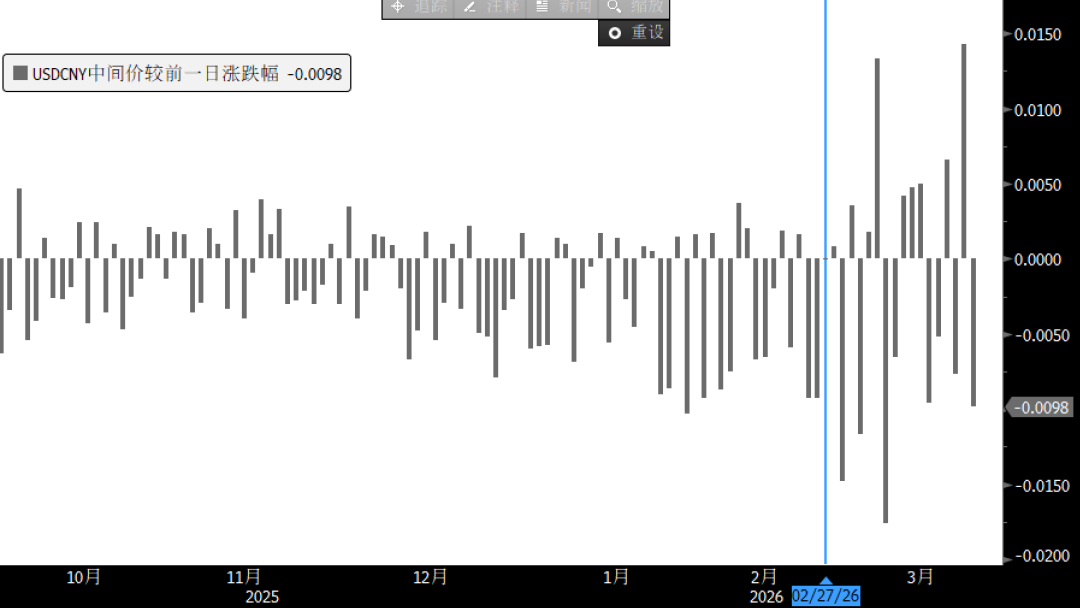
However, taking a step back at the end of March and reviewing the past four weeks, it’s clear that the RMB has actually remained within a relatively narrow range, especially considering that the US Dollar Index has increased by 1.73% so far this month, peaking at a 2.99% rise. The euro, Australian dollar, and Japanese yen have all seen three to four hundred points of volatility within the month, and the Korean won as well as many emerging market currencies have experienced sharp drops. Compared with other currencies, the RMB still stands as a symbol of stability and strong resilience.

This may explain why RMB option volatility exhibited a “spike–pullback–steady rebound” trajectory in March: the initial spike was driven by peak anxiety, the subsequent pullback by the range-bound pattern, and the steady rebound was due to the still-high intraday volatility.

2. Sources of RMB’s Flexibility and Resilience
First, talking about resilience. Undeniably, China’s net energy import status exposes the RMB to negative impacts when energy prices surge. Combined with increased corporate demand for forex purchases following the recent removal of forward purchase settlement ratios, and weak market sentiment in the stock market, the RMB exchange rate is indeed feeling the pressure.

However, a robust trade surplus and substantial corporate FX-settlement demand provide the utmost solid support for the RMB. In March, this was evident in the market: above 6.9, there is strong corporate FX-settlement support for the RMB. In addition, compared to Europe and Southeast Asia, China’s energy strategic reserve is better, also supporting the RMB exchange rate.
Against this backdrop, the improvement in flexibility of the exchange rate and daily fixing is not only a result of market sentiment tug-of-war, but also a reflection of composure—the RMB stands resilient amid external turmoil, like unyielding bamboo.
3. Summary
In the short term, I believe the RMB will continue to fluctuate within the 6.86-6.94 range, with no clear directional trend for the moment. Clients with imminent FX settlement or purchase needs can set up hedging positions within this range. Looking ahead, if the US-Iran conflict eases, the market will revert to the pre-conflict logic and the RMB may continue to appreciate moderately.
Disclaimer: The content of this article solely reflects the author's opinion and does not represent the platform in any capacity. This article is not intended to serve as a reference for making investment decisions.
You may also like
Nvidia falls to its lowest valuation in 14 years! "Super bull" Tom Lee calls for bottom fishing, retail investors are buying more as it drops, but Wall Street is divided
After the market opened on Thursday, retail investors went against the trend and bought up Nvidia, with net purchases reaching $111 million in just half an hour, setting a record for the same period. Investors such as Tom Lee have publicly supported the company, with institutions optimistic about strong order backlogs extending to 2028, robust revenue growth, and opportunities created by declining valuations. Meanwhile, institutions like Bernstein and Goldman Sachs have become more cautious about Nvidia's outlook, with concerns focusing on management succession and technological leadership following Jensen Huang's departure.

Jane Street boosts Fidelity Bitcoin ETF stake 8x in Q3, trims BlackRock IBIT

From SpaceX to Anthropic, the market has new strategies for dealing with tech giants' IPOs
The market's response strategies to major listings are currently centered around "index inclusion expectations": the new regulations allow mega IPOs to be included in the six major indices within 15 days, triggering concentrated buying by passive funds. Investors are positioning themselves in advance and using options to hedge and amplify buying power. However, Anthropic has a free float of only about 6%; shares available for sale by employees on the first day and privately placed shares with no lock-up period may create supply pressure. On the other hand, index arbitrageurs are facing a rare opportunity.

Nvidia Q3 Earnings Preview: Revenue Expectations and Key Metrics to Watch
Crypto prices
More


