
Appeals court denies Kalshi’s bid to stave off ban in Nevada

A federal appeals court has cleared Nevada state authorities to enforce a temporary restraining order on Kalshi to block its sports event contracts.
The Ninth Circuit Appeals Court on Thursday denied Kalshi’s emergency request to stay a lower court proceeding, meaning the case will be sent back to federal court and will allow Nevada’s regulators to take action.
Gaming lawyer Daniel Wallach said a temporary restraining order (TRO) against Kalshi now appears imminent, and added that it wouldn’t be able to operate in Nevada for at least 14 days until a preliminary injunction hearing is held:
“Since a TRO is not appealable under Nevada law, Kalshi would be required to exit the state in the interim.”
The Nevada Gaming Control Board sent Kalshi a cease-and-desist in March over its offering of sports event contracts, arguing they are unlicensed sports betting under Nevada law.
Kalshi has argued in court that its event contracts are under the sole federal jurisdiction of the Commodity Futures Trading Commission and any block on its event contracts would cause it “imminent harm.”
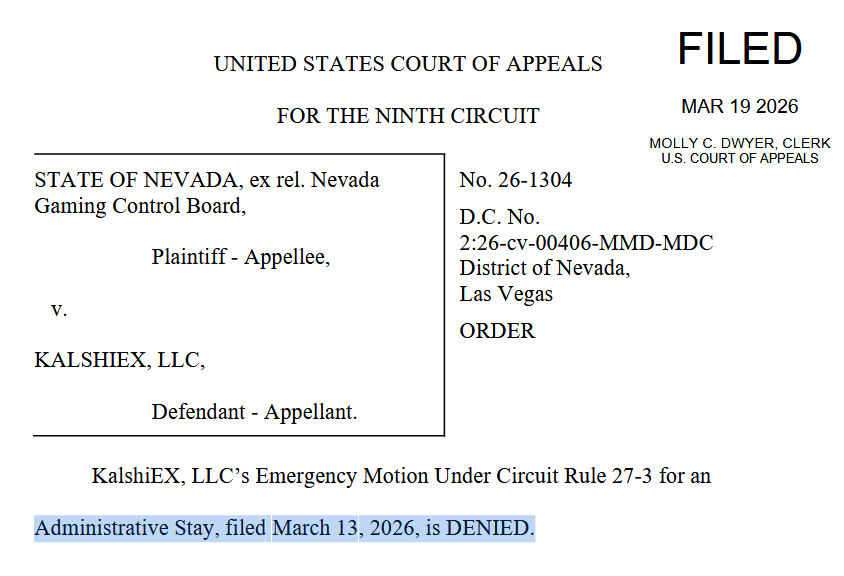 US Court of Appeals order dismissing Kalshi’s emergency motion. Source:
Prediction markets such as Kalshi and Polymarket have recently surged with weekly trading volumes now consistently exceeding $2 billion, which has also attracted increased scrutiny from lawmakers with concerns over insider trading and market manipulation.
Related: SEC interpretation on crypto laws ‘a beginning, not an end,‘ says Atkins
State regulators in Connecticut, New York, New Jersey and other states have also sought to take action over sports event contracts, with Kalshi and rival prediction market platforms Crypto.com, Polymarket and Coinbase in legal battles with multiple states.
Kalshi foresees conflict between courts
In a motion on March 13, Kalshi argued that letting Nevada proceed with its temporary restraining order while federal litigation is still pending creates a serious risk of conflicting rulings.
Kalshi said the courts could arrive at “exactly the opposite conclusion” as to whether federal commodities law preempts state gambling laws, adding that it could “create jurisdictional chaos.”
Magazine: Are DeFi devs liable for the illegal activity of others on their platforms?
Disclaimer: The content of this article solely reflects the author's opinion and does not represent the platform in any capacity. This article is not intended to serve as a reference for making investment decisions.
You may also like
US PPI report to test Bitcoin, gold and Nasdaq as December rate hike looms
Nvidia falls to its lowest valuation in 14 years! "Super bull" Tom Lee calls for bottom fishing, retail investors are buying more as it drops, but Wall Street is divided
After the market opened on Thursday, retail investors went against the trend and bought up Nvidia, with net purchases reaching $111 million in just half an hour, setting a record for the same period. Investors such as Tom Lee have publicly supported the company, with institutions optimistic about strong order backlogs extending to 2028, robust revenue growth, and opportunities created by declining valuations. Meanwhile, institutions like Bernstein and Goldman Sachs have become more cautious about Nvidia's outlook, with concerns focusing on management succession and technological leadership following Jensen Huang's departure.
Jane Street boosts Fidelity Bitcoin ETF stake 8x in Q3, trims BlackRock IBIT
From SpaceX to Anthropic, the market has new strategies for dealing with tech giants' IPOs
The market's response strategies to major listings are currently centered around "index inclusion expectations": the new regulations allow mega IPOs to be included in the six major indices within 15 days, triggering concentrated buying by passive funds. Investors are positioning themselves in advance and using options to hedge and amplify buying power. However, Anthropic has a free float of only about 6%; shares available for sale by employees on the first day and privately placed shares with no lock-up period may create supply pressure. On the other hand, index arbitrageurs are facing a rare opportunity.
Crypto prices
More


