
Hacked crypto tokens drop 61% on average and rarely recover, Immune report says

A new security report from Immunefi finds that crypto hacks continue at a steady pace while losses are becoming more concentrated in a small number of massive exploits.
Analyzing 425 publicly known incidents between 2021 and 2025, the report estimates that the average hack now results in about $25 million in stolen funds. In 2024 and 2025 alone, 191 hacks led to $4.67 billion in losses, with just five incidents accounting for 62% of the total.
Despite representing fewer incidents, centralized exchange breaches drove the majority of losses. Twenty exchange hacks accounted for roughly $2.55 billion, or about 55% of the total, reflecting how large pools of user funds are concentrated behind fewer points of failure.
Token markets also appear to be reacting more harshly to breaches. Across 82 hacked tokens tracked in the study, prices fell a median 61% within six months, with 83.9% remaining below their hack-day price over that period.
“The market has become less forgiving because expectations have changed,” Immunefi CEO Mitchell Amador told Cointelegraph, adding that breaches are now seen as signals of deeper issues in engineering, governance and operational resilience.
Amador said the long-term impact of exploits often extends well beyond the initial loss:
The stolen funds are only the first layer of damage. What follows is often more destructive: sustained token price suppression, reduced treasury capacity, leadership disruption, lost development time, and erosion of user trust.
The report also highlighted how interconnected DeFi systems can amplify the fallout from a single incident, with failures cascading across lending, collateral and liquidity networks.
One example involved the collapse of Elixir’s deUSD stablecoin in November 2025. Elixir had parked roughly 65% of deUSD’s collateral with Stream Finance, which disclosed a $93 million loss from an external fund manager. As Stream’s stablecoin xUSD fell 77%, deUSD’s backing deteriorated, redemptions halted and panic selling hit Curve pools, ultimately pushing deUSD down more than 97%.
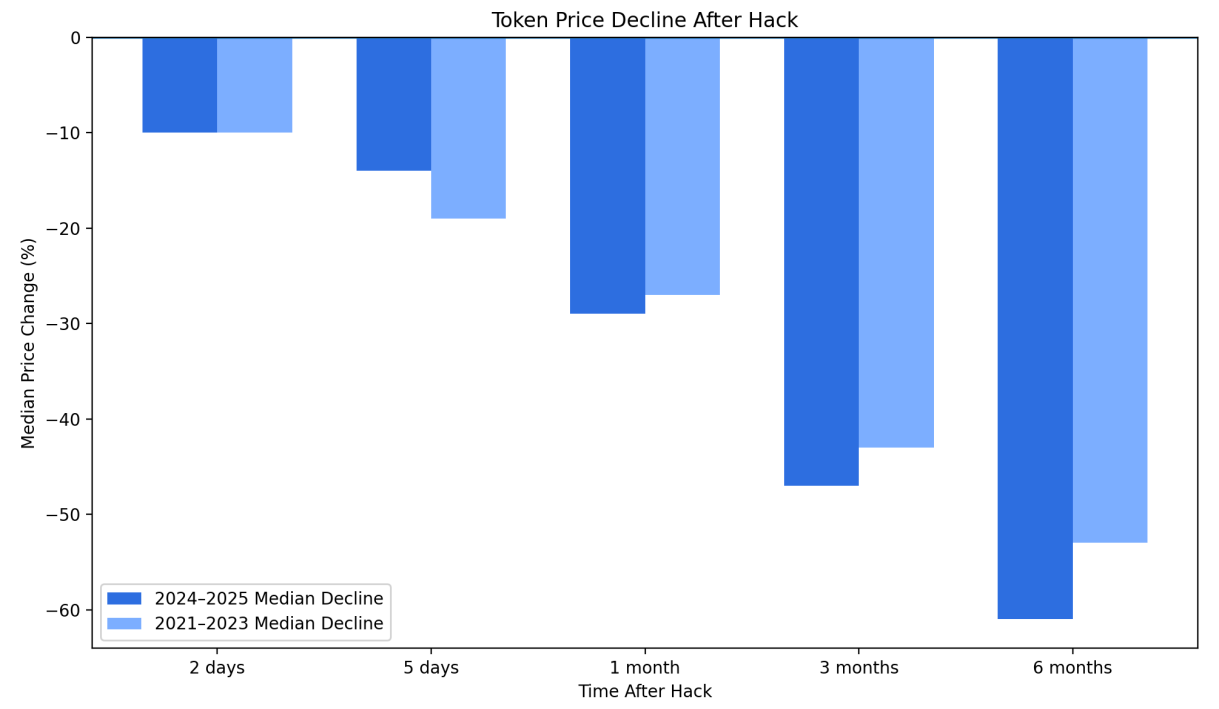 Source: Immunefi report
Recent exploits highlight ongoing security risks in crypto
While crypto-related hack losses fell to $26.5 million in February, the lowest monthly total in nearly a year, according to PeckShield, several security incidents have already surfaced in March.
Researchers at Google reported a new exploit kit targeting Apple iPhone users that is designed to steal cryptocurrency wallet seed phrases. The toolkit, known as Coruna, contains multiple exploit chains capable of targeting devices running various versions of Apple’s iOS and has been linked to phishing websites posing as crypto platforms.
The Bitcoin-based DeFi platform Solv Protocol also reported that one of its token vaults was exploited for roughly $2.7 million, affecting fewer than 10 users. The project said it would cover the losses and offered the attacker a 10% bounty in exchange for returning the funds while security firms investigate the breach.
Separately, the domain of Bonk.fun was hijacked after attackers gained access to a team account and deployed a wallet-draining scheme through the site. The project warned users not to interact with the platform while the team worked to regain control of the domain.
Meanwhile, NFT lending platform Gondi disabled a faulty smart contract after an exploit allowed an attacker to steal roughly $230,000 worth of NFTs. The project said it is compensating affected users while investigating the vulnerability, which involved a contract used to sell escrowed NFTs and repay loans.
Disclaimer: The content of this article solely reflects the author's opinion and does not represent the platform in any capacity. This article is not intended to serve as a reference for making investment decisions.
You may also like
US PPI report to test Bitcoin, gold and Nasdaq as December rate hike looms
Nvidia falls to its lowest valuation in 14 years! "Super bull" Tom Lee calls for bottom fishing, retail investors are buying more as it drops, but Wall Street is divided
After the market opened on Thursday, retail investors went against the trend and bought up Nvidia, with net purchases reaching $111 million in just half an hour, setting a record for the same period. Investors such as Tom Lee have publicly supported the company, with institutions optimistic about strong order backlogs extending to 2028, robust revenue growth, and opportunities created by declining valuations. Meanwhile, institutions like Bernstein and Goldman Sachs have become more cautious about Nvidia's outlook, with concerns focusing on management succession and technological leadership following Jensen Huang's departure.

Jane Street boosts Fidelity Bitcoin ETF stake 8x in Q3, trims BlackRock IBIT

From SpaceX to Anthropic, the market has new strategies for dealing with tech giants' IPOs
The market's response strategies to major listings are currently centered around "index inclusion expectations": the new regulations allow mega IPOs to be included in the six major indices within 15 days, triggering concentrated buying by passive funds. Investors are positioning themselves in advance and using options to hedge and amplify buying power. However, Anthropic has a free float of only about 6%; shares available for sale by employees on the first day and privately placed shares with no lock-up period may create supply pressure. On the other hand, index arbitrageurs are facing a rare opportunity.

Crypto prices
More


