
From Redemption Restrictions to Total Run, Why Are Global Asset Prices Losing Momentum?

Forex Network March 16 — The $1.8 trillion private credit market is triggering a wave of redemptions, and from redemption runs to bank runs, are the risks exposed by private banks recently quietly affecting the global appetite for risk assets?
Once seen as the core pillar of the “shadow banking” sector, the U.S. private credit market is now experiencing unprecedented turmoil.
This $1.8 trillion market is now under triple pressure from redemptions, regulatory scrutiny, and technological changes. The crisis has spread from non-bank institutions to traditional banking. Deutsche Bank's $30 billion risk exposure-induced share price plunge is a clear illustration of the transmission trend.
The trigger for this crisis began with credit issues in the technology sector.
With breakthroughs in AI technology, the market has raised severe doubts about the survival and cash flow stability of traditional software companies, leading to sharp falls in asset prices and triggering panic redemptions by investors.
Domino Effect Triggered by Redemption Rush
The transmission of the crisis is showing a clear chain reaction: Blue Owl Capital, with over $300 billion in assets under management, was hit first and was forced to sell $140 million in loan assets at a discount to meet redemptions, exposing the reality of dried-up liquidity in the secondary market;
Next, Blackstone’s BCRED fund faced massive redemption pressure, forcing senior partners to inject $150 million of their own capital to fill the gap in a desperate attempt to avoid activating redemption limits;
BlackRock’s actions then delivered the final blow to market confidence—the company announced a full write-off of $25 million in subordinated debt and imposed a 5% redemption cap on its $2.6 billion HPS fund, well below the actual redemption request ratio of 9.3%.
BlackRock’s move sparked industry-wide panic. Well-known financial blog Zerohedge pointed out this is exactly the maneuver Blue Owl and Blackstone desperately sought to avoid, because it would trigger the vicious “forced selling–asset devaluation–further redemptions” cycle.
Analysts compare the current situation to the real estate fund crisis of 2022, believing that although redemption limits can prevent a short-term collapse, capital outflow pressure will remain high in the coming months, and the industry may take years to recover.
Risks Penetrating the Traditional Banking System
More concerning, the crisis has breached the shadow banking perimeter and is spreading deeply into the traditional banking industry.
Deutsche Bank's annual report reveals its private credit risk exposure has risen to €25.9 billion (about $30 billion), accounting for 5% of total loans, with €15.8 billion exposure to the technology industry—news that caused the bank's share price to plunge nearly 7% in a single day.
According to Moody's, by mid-2025, U.S. banks’ loans to non-deposit financial institutions reached $1.2 trillion, nearly double a decade ago;
FDIC further disclosed that as of end-2025, U.S. banks’ loan balances to these institutions were $1.4 trillion, and when including undrawn loan commitments, the potential risk exposure could be as high as $4.2 trillion.
Facing the risks, JPMorgan Chase has taken the lead in downgrading some private credit fund asset valuations and reducing credit lines;
Several major banks have also launched comprehensive reviews of their private credit exposures, covering core indicators like loan structure and collateral prepayment rates.
Meanwhile, the crisis has also impacted the collateralized loan obligation (CLO) market. Data from Santander U.S. Capital Markets show that in February 2026, the high-yield CLO bonds held by private credit funds fell 4.1%, in sharp contrast to the 1% rise in the previous two months—a sign of a complete reversal in market sentiment.
Market Debate and Cautionary Significance
There are obvious divisions regarding the nature of the current crisis. Veteran private credit participants believe the market is overreacting; Cliffwater CEO Stephen L. Sbeit noted that the full-year return on private debt in 2025 reached 9.33%, with an actual loss rate of 0.70%, much lower than historical levels, and credit losses have little association with the current economic environment.
Tom Stark of Cambridge Associates also believes that default cases like Tricolor are isolated events caused by fraud or unique business models, not systemic industry problems.
But dissenting voices are equally strong. JPMorgan CEO Jamie Dimon once mocked private credit funds as “cockroaches,” implying that their risks are hidden and highly contagious; Allianz Group’s Chief Economic Advisor Mohamed El-Erian warned that the current liquidity plight is brewing “classic risk contagion,” which could force investors into a passive situation where “high-quality assets are hard to liquidate and a forced sale of liquid assets” occurs.
The IMF already called for stronger regulation of private credit in April 2024, with attention to leverage, interconnectedness, and risk concentration.
The essence of this crisis is the inevitable outcome of capital flowing chaotically into shadow banking in the ultra-low rate environment following the 2008 financial crisis. At that time, tightening bank capital rules shifted credit demand to non-bank institutions, and private credit, with its high yields, attracted massive capital, even opening up to retail investors under policy encouragement.
Conclusion and Technical Analysis:
Now, as the global economy cools and interest rates change, long-standing issues such as lack of transparency and inadequate regulation in the sector are erupting at once.
No matter the final outcome of the crisis, it rings a clear alarm for the market: the $1.8 trillion private credit market is now deeply intertwined with the traditional financial system, and its risks are no longer isolated.
Even for top investors, high yields are inevitably accompanied by high risks, especially non-listed instruments with specific redemption rules, which are not suitable for all “mainstream” investors;
For policymakers and regulators, how to bridge the regulatory gap between shadow banks and traditional banks and balance financial innovation with risk control has become an urgent issue to maintain financial stability.
As the market warns, any sector branded as “shadow” must be approached with extreme caution.
As previously mentioned in the article, the recent unattractive gold price and the long-duration tech stocks with their similar characteristics—both being sensitive to interest rates—led to gold’s adjustment being affected by the stampede out of equity markets. Once risks are fully released, gold prices may rebound.
Technically, gold prices have found support at the lower edge of the upward channel, with the decline expected to ease, and a cyclical low may appear.
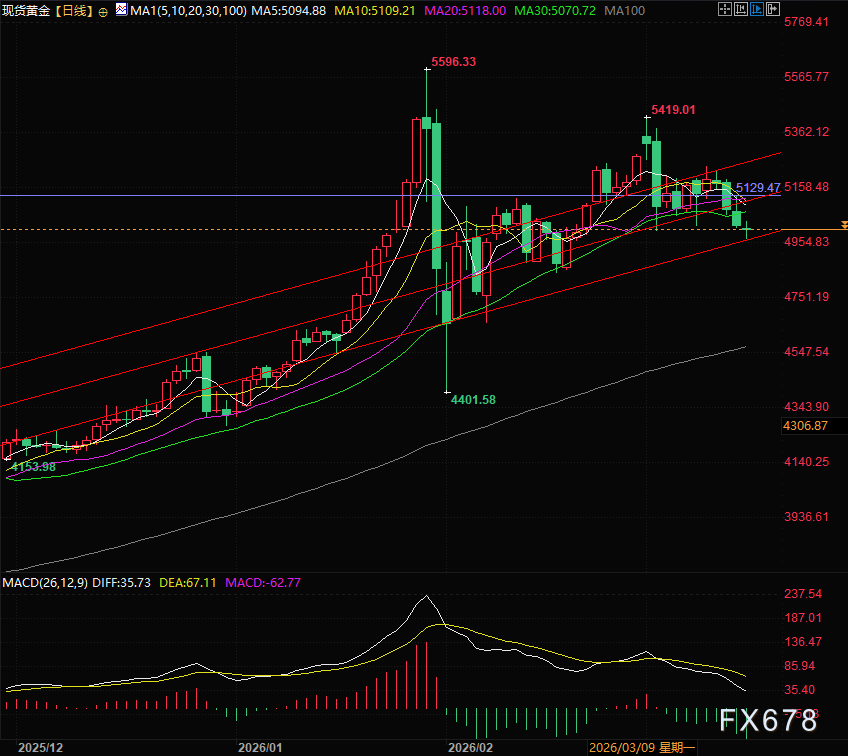
(Spot gold daily chart, source: Easy Forex Network)
At 15:16 Beijing time (UTC+8), spot gold was quoted at $5,005 per ounce.
Disclaimer: The content of this article solely reflects the author's opinion and does not represent the platform in any capacity. This article is not intended to serve as a reference for making investment decisions.
You may also like
US PPI report to test Bitcoin, gold and Nasdaq as December rate hike looms
Nvidia falls to its lowest valuation in 14 years! "Super bull" Tom Lee calls for bottom fishing, retail investors are buying more as it drops, but Wall Street is divided
After the market opened on Thursday, retail investors went against the trend and bought up Nvidia, with net purchases reaching $111 million in just half an hour, setting a record for the same period. Investors such as Tom Lee have publicly supported the company, with institutions optimistic about strong order backlogs extending to 2028, robust revenue growth, and opportunities created by declining valuations. Meanwhile, institutions like Bernstein and Goldman Sachs have become more cautious about Nvidia's outlook, with concerns focusing on management succession and technological leadership following Jensen Huang's departure.

Jane Street boosts Fidelity Bitcoin ETF stake 8x in Q3, trims BlackRock IBIT

From SpaceX to Anthropic, the market has new strategies for dealing with tech giants' IPOs
The market's response strategies to major listings are currently centered around "index inclusion expectations": the new regulations allow mega IPOs to be included in the six major indices within 15 days, triggering concentrated buying by passive funds. Investors are positioning themselves in advance and using options to hedge and amplify buying power. However, Anthropic has a free float of only about 6%; shares available for sale by employees on the first day and privately placed shares with no lock-up period may create supply pressure. On the other hand, index arbitrageurs are facing a rare opportunity.

Crypto prices
More


