
AI data center gold rush sparks debate over impact on Bitcoin

There’s a new debate over whether a continued pivot from Bitcoin miners to artificial intelligence could have an impact on Bitcoin security and its role as a store of value.
While some argue that miners fleeing the network would leave it more susceptible to a “51% attack,” others argue it will simply trigger the Bitcoin network to rebalance itself as designed, making it enticing for miners again.
“AI has killed Bitcoin forever,” said crypto trader Ran Neuner on Sunday, arguing that it has become Bitcoin mining’s biggest competitor because both industries compete for electricity.
“AI is willing to pay much more for it,” he added, explaining that Bitcoin (BTC) mining revenue per megawatt is around $57 to $129, but AI data center revenue per megawatt is up to eight times higher at $200 to $500 for the same electricity, which is why miners are starting to pivot.
Earlier this month, Core Scientific secured up to $1 billion in credit for AI hosting, MARA Holdings recently filed with the SEC to signal its intent to sell some of its BTC in an AI pivot and Hut 8 signed a $7 billion AI infrastructure agreement with Google in December, argued Neuner.
Meanwhile, Cipher Mining cut its hashrate to focus on AI compute, and Bitmain cofounder Jihan Wu has stopped mining and pivoted to AI, he added.
“So if I were a miner, it wouldn’t be a tough decision. And that’s why every day more and more miners are leaving the network.”
It sounds like a doomsday scenario for Bitcoin, but not everyone agrees.
Bitcoin pioneer and cryptographer Adam Back argued that difficulty adjustments would only force the least efficient miners out, and profitability would improve.
“What happens to Bitcoin is simple: tick tock, next block! Difficult adjusts downwards, the least efficient and AI switchers move out, and Bitcoin mining profitability converges to AI profitability. QED.”
“If AI outbids miners for electricity, miners just turn off until the difficulty adjusts and it’s profitable again, that’s literally how Bitcoin works,” added investor Fred Krueger.
Bitcoin energy demand is variable
However, Neuner argued that falling hashrates, which are down 14.5% since their October peak, mean that there are fewer miners to secure the network, and a higher potential for 51% attacks.
This has all happened before during bear markets, and automatic network difficulty adjustments usually compensate for it, “but this time is different because we don’t have the energy,” he said.
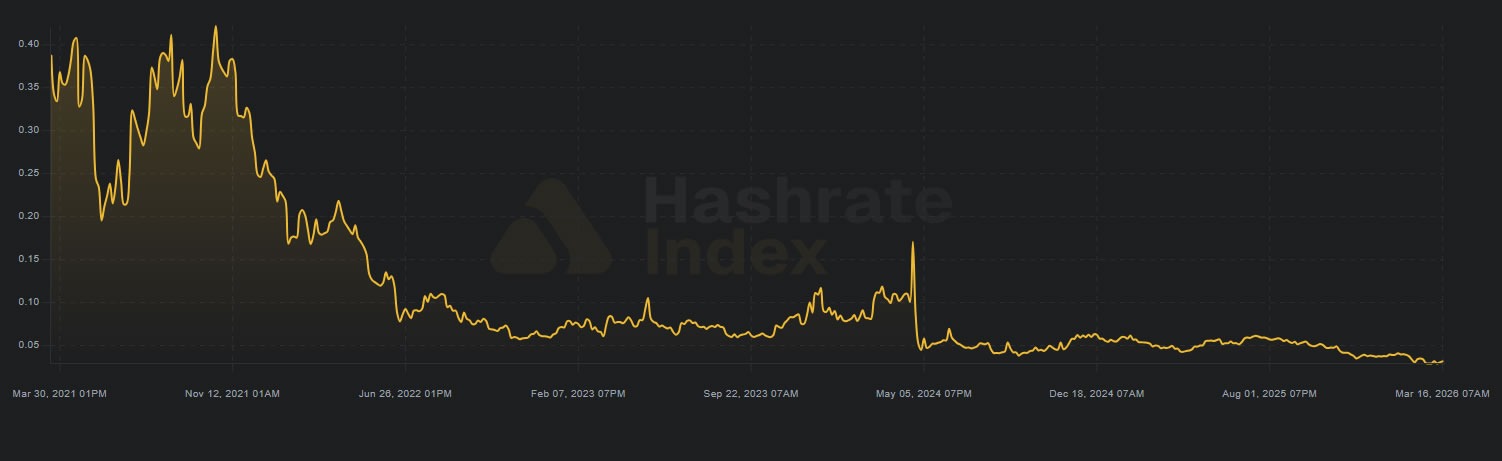 Bitcoin mining profitability, or hashprice, is near an all-time low. Source:
Bitcoin ESG specialist Daniel Batten disagreed and said it was the other way around, as “the evidence tells us that AI is dependent upon Bitcoin for its expansion.”
It wasn’t all about high demand and expensive power, as Bitcoin mining can use stranded energy, act as a flexible load balancer for energy grids, and use older equipment for cheaper energy, he argued.
One green candle to prevent AI competition doomsday
Neuner said one way to ensure AI doesn’t overshadow Bitcoin will depend on whether BTC prices go up.
“What I hope is that Bitcoin has one green candle. Maybe because of the war, maybe because of the regulation, who knows? But ultimately, if it has one green candle.”
“If you’re watching the Bitcoin price action during this war, that’s exactly what’s happening,” he said, adding that the other scenario, where Bitcoin price continues to fall, is “pretty much a Bitcoin doomsday.”
Bitcoin has seen five monthly red candles in a row, something that hasn’t happened since the 2018 bear market. However, March is currently shaping up green with the asset gaining 8% so far this month, according to CoinGlass.
Disclaimer: The content of this article solely reflects the author's opinion and does not represent the platform in any capacity. This article is not intended to serve as a reference for making investment decisions.
You may also like
US PPI report to test Bitcoin, gold and Nasdaq as December rate hike looms
Nvidia falls to its lowest valuation in 14 years! "Super bull" Tom Lee calls for bottom fishing, retail investors are buying more as it drops, but Wall Street is divided
After the market opened on Thursday, retail investors went against the trend and bought up Nvidia, with net purchases reaching $111 million in just half an hour, setting a record for the same period. Investors such as Tom Lee have publicly supported the company, with institutions optimistic about strong order backlogs extending to 2028, robust revenue growth, and opportunities created by declining valuations. Meanwhile, institutions like Bernstein and Goldman Sachs have become more cautious about Nvidia's outlook, with concerns focusing on management succession and technological leadership following Jensen Huang's departure.

Jane Street boosts Fidelity Bitcoin ETF stake 8x in Q3, trims BlackRock IBIT

From SpaceX to Anthropic, the market has new strategies for dealing with tech giants' IPOs
The market's response strategies to major listings are currently centered around "index inclusion expectations": the new regulations allow mega IPOs to be included in the six major indices within 15 days, triggering concentrated buying by passive funds. Investors are positioning themselves in advance and using options to hedge and amplify buying power. However, Anthropic has a free float of only about 6%; shares available for sale by employees on the first day and privately placed shares with no lock-up period may create supply pressure. On the other hand, index arbitrageurs are facing a rare opportunity.

Crypto prices
More


