
CLARITY Act risks handing crypto to centralized players: Gnosis exec

The regulatory provisions outlined in the US Digital Asset Market Structure Clarity Act, otherwise known as the CLARITY Act, threaten to give large financial institutions control over crypto, according to Dr. Friederike Ernst, co-founder of the Gnosis blockchain protocol.
Regulations in the CLARITY crypto market structure bill assume that activity must pass through centralized intermediaries, which risks consolidating crypto rails in the hands of a few entrenched players, Ernst told Cointelegraph.
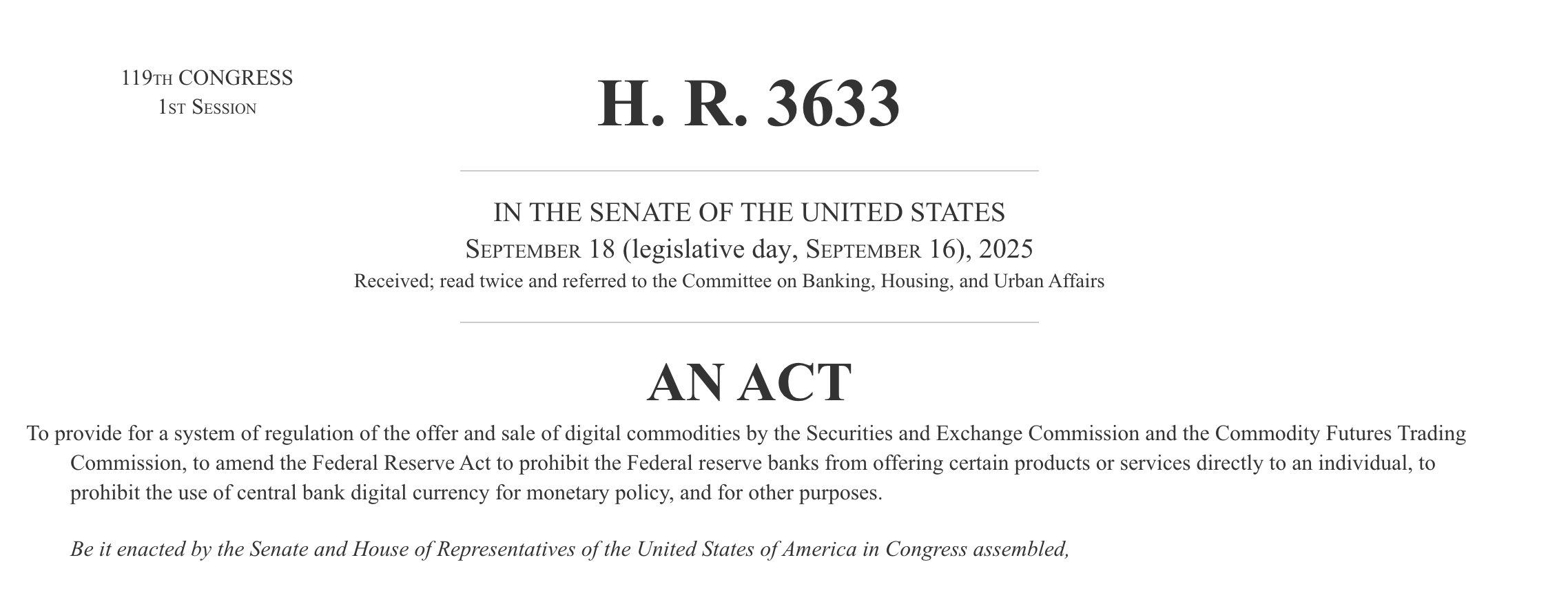 The preface of the CLARITY crypto market structure bill. Source:
“Blockchain’s real breakthrough was not just a new financial infrastructure. It was the ability for users themselves to become owners of the networks they rely on," she said. Ernst added:
“If activity is pushed back through institutional intermediaries, users risk becoming customers renting access to financial technology once again rather than stakeholders in it. The challenge is ensuring regulatory clarity does not unintentionally undermine that ownership model.”
Despite the bill’s shortcomings, the CLARITY Act does clarify regulatory jurisdiction over crypto between the Securities and Exchange Commission (SEC) and the Commodity Futures Trading Commission (CFTC), as well as protects peer-to-peer transactions and self-custody, Ernst said.
However, the failure of the market structure bill to adequately protect open, permissionless blockchain rails and decentralized finance protocols risks bringing all the same points of failure of the legacy financial system to crypto, Ernst said.
Related:
CLARITY Act stalled due to banks and traditional financial institutions
The highly anticipated CLARITY Act remains stalled in Congress over disagreement between the crypto industry and the banking industry over the issue of stablecoin yield and whether or not stablecoin issuers can share interest with holders.
In January, crypto exchange Coinbase announced it was pulling its support for the bill, citing concerns over provisions that would weaken the decentralized finance industry, prohibit stablecoin yield, and prevent the growth of the tokenized real-world asset sector.
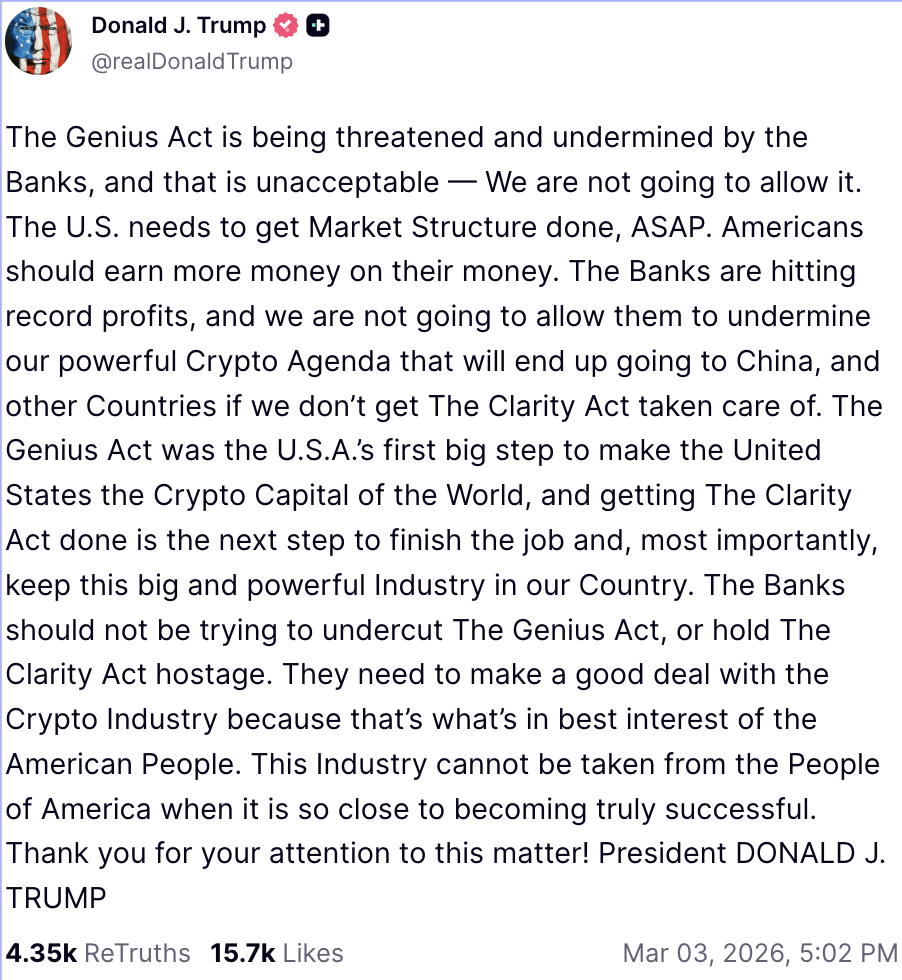 President Trump slams banks for holding up the CLARITY Act. Source:
“We’d rather have no bill than a bad bill,” Coinbase CEO Brian Armstrong said in response to reading a draft of the bill.
US Senator Bernie Moreno said he is optimistic the CLARITY bill will pass by April and head to US President Donald Trump’s desk for signing.
However, if the bill does not pass by April 2026, the odds of it becoming law in 2026 are “extremely low,” according to Alex Thorn, head of firmwide research at investment firm Galaxy.
“It's very possible that rewards are not the 'final' hurdle but instead just the current hill the bill is dying on,” Thorn said in an X post on Saturday, pointing to potential issues around DeFi, developer protections, and regulatory authority.
Magazine:
Disclaimer: The content of this article solely reflects the author's opinion and does not represent the platform in any capacity. This article is not intended to serve as a reference for making investment decisions.
You may also like
US PPI report to test Bitcoin, gold and Nasdaq as December rate hike looms
Nvidia falls to its lowest valuation in 14 years! "Super bull" Tom Lee calls for bottom fishing, retail investors are buying more as it drops, but Wall Street is divided
After the market opened on Thursday, retail investors went against the trend and bought up Nvidia, with net purchases reaching $111 million in just half an hour, setting a record for the same period. Investors such as Tom Lee have publicly supported the company, with institutions optimistic about strong order backlogs extending to 2028, robust revenue growth, and opportunities created by declining valuations. Meanwhile, institutions like Bernstein and Goldman Sachs have become more cautious about Nvidia's outlook, with concerns focusing on management succession and technological leadership following Jensen Huang's departure.

Jane Street boosts Fidelity Bitcoin ETF stake 8x in Q3, trims BlackRock IBIT

From SpaceX to Anthropic, the market has new strategies for dealing with tech giants' IPOs
The market's response strategies to major listings are currently centered around "index inclusion expectations": the new regulations allow mega IPOs to be included in the six major indices within 15 days, triggering concentrated buying by passive funds. Investors are positioning themselves in advance and using options to hedge and amplify buying power. However, Anthropic has a free float of only about 6%; shares available for sale by employees on the first day and privately placed shares with no lock-up period may create supply pressure. On the other hand, index arbitrageurs are facing a rare opportunity.

Crypto prices
More


