
Circle Stock Ticks Up as Mizuho Analyst Lifts Price Forecast as Circle’s USDC Overtakes Tether

Circle stock (CRCL) is gaining ground after a major Japanese bank raised its expectations for the company. Mizuho (MFG) analysts, Dan Dolev and Alexander Jenkin, increased their price target for Circle from $100 to $120 following a massive shift in the crypto market. The stock was up about 1% by market close on Friday, reaching $115.38. This rally comes as Circle’s main product, USDC (USDC-USD), officially begins to handle more money than its biggest rival, Tether.
Claim 70% Off TipRanks Premium
- Unlock hedge fund-level data and powerful investing tools for smarter, sharper decisions
- Stay ahead of the market with the latest news and analysis and maximize your portfolio's potential
Circle Becomes the New Volume Leader
For the first time since 2019, Circle’s USDC has overtaken Tether’s USDT (USDT-USD) in terms of actual trading activity. So far in 2026, USDC has handled a staggering $2.2 trillion in transactions, while Tether has seen about $1.3 trillion. Mizuho’s analysts pointed out that while Tether still has a larger total market cap, Circle is winning where it matters most: real-world usage. Investors are increasingly using USDC for prediction markets like “Polymarket or agentic commerce” tools where AI bots handle payments.
New Growth Targets and Future Predictions
Because of this surge in activity, Mizuho has raised its long-term forecasts for the company. Analysts now expect the number of “meaningful wallets” using Circle’s technology to hit 11.7 million by 2027. They also predict that the total value of USDC in the market will climb to $139 billion. While some experts believe the recent stock jump was caused by traders quickly closing out “short” bets, others say the steady growth of Circle’s infrastructure is the real reason for the 95% gain since February.
Circle Beats BlackRock in Treasury Race
In another big win, Circle has officially passed BlackRock (BLK) to become the leader in the “tokenized Treasury” market. Circle’s USYC token, which allows investors to earn interest on U.S. government debt through the blockchain, has grown to $2.2 billion. This move pushed it ahead of BlackRock’s BUIDL fund. Much of this growth is coming from big institutional traders on the Binance network who use Circle’s token as collateral for their trades. This whole sector has exploded to a record $11 billion this year as people look for safe places to park their cash while still earning a yield.
Is Circle Stock a Good Buy?
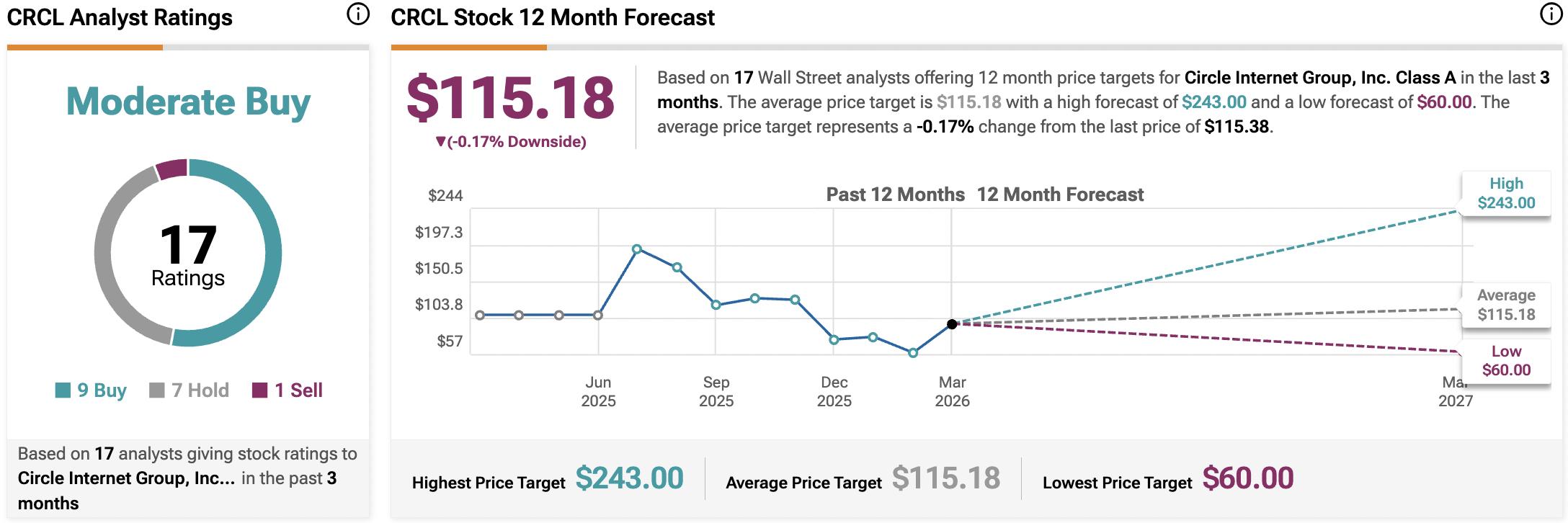
Circle stock (CRCL) has a consensus Moderate Buy rating among 17 Wall Street analysts. This rating is based on nine Buy, seven Hold, and one Sell recommendation issued in the last three months. The average 12-month CRCL price target of $115.17 implies 0.2% downside risk from current levels.

Copyright © 2026, TipRanks. All rights reserved.
Disclaimer: The content of this article solely reflects the author's opinion and does not represent the platform in any capacity. This article is not intended to serve as a reference for making investment decisions.
You may also like
US PPI report to test Bitcoin, gold and Nasdaq as December rate hike looms
Nvidia falls to its lowest valuation in 14 years! "Super bull" Tom Lee calls for bottom fishing, retail investors are buying more as it drops, but Wall Street is divided
After the market opened on Thursday, retail investors went against the trend and bought up Nvidia, with net purchases reaching $111 million in just half an hour, setting a record for the same period. Investors such as Tom Lee have publicly supported the company, with institutions optimistic about strong order backlogs extending to 2028, robust revenue growth, and opportunities created by declining valuations. Meanwhile, institutions like Bernstein and Goldman Sachs have become more cautious about Nvidia's outlook, with concerns focusing on management succession and technological leadership following Jensen Huang's departure.

Jane Street boosts Fidelity Bitcoin ETF stake 8x in Q3, trims BlackRock IBIT

From SpaceX to Anthropic, the market has new strategies for dealing with tech giants' IPOs
The market's response strategies to major listings are currently centered around "index inclusion expectations": the new regulations allow mega IPOs to be included in the six major indices within 15 days, triggering concentrated buying by passive funds. Investors are positioning themselves in advance and using options to hedge and amplify buying power. However, Anthropic has a free float of only about 6%; shares available for sale by employees on the first day and privately placed shares with no lock-up period may create supply pressure. On the other hand, index arbitrageurs are facing a rare opportunity.

Crypto prices
More


