
BlackRock’s staked Ethereum ETF sees $15.5M volume on debut

BlackRock’s staked Ethereum exchange-traded fund has tallied $15.5 million in trading volume on its first trading day, which a market analyst described as “very, very solid” despite falling short of two similar Solana staking products that launched last year.
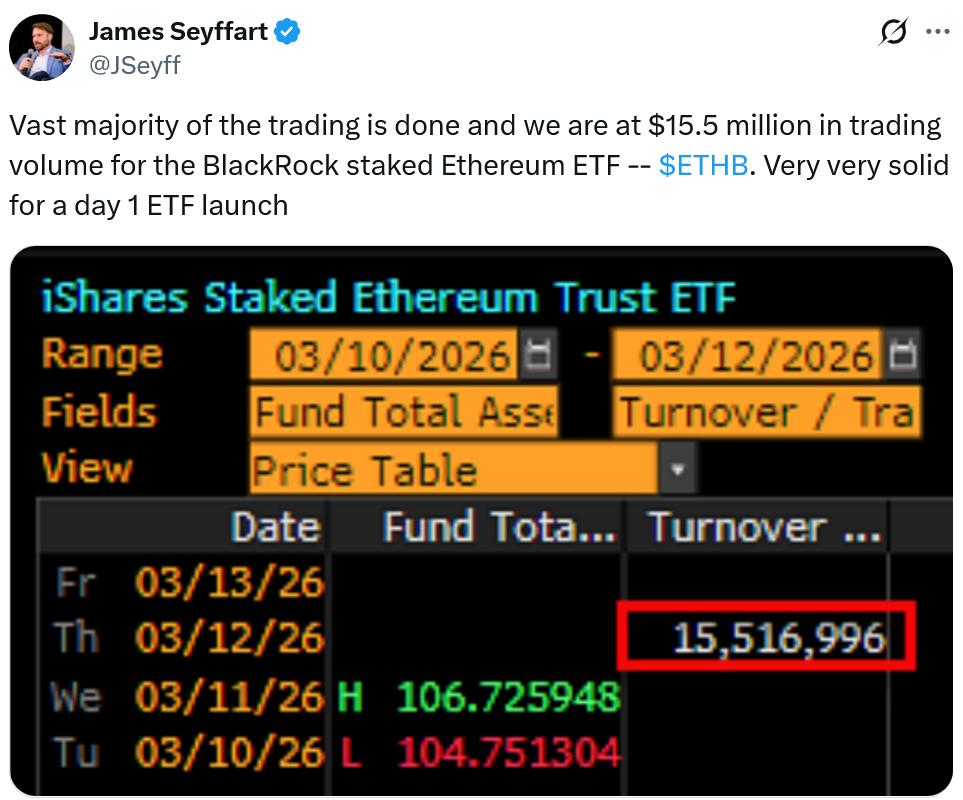
Nasdaq shows the iShares Staked Ethereum Trust (ETHB) had 592,804 shares traded on its debut on Thursday, with Bloomberg ETF analyst James Seyffart noting on X that the product turned over around $15.5 million.
“Very, very solid for a day 1 ETF launch,” Seyffart said.
The ETF invests and stakes Ether (ETH), locking up the tokens on the blockchain with the aim of providing a yield. The fund relies on network validators to capture staking rewards, typically offering a yield of 4% annually.
 Source:
James Seyffart
ETHB’s $15.5 million in debut trading volume trailed similar staking funds tied to the Solana (SOL) token, including the $55.4 million in volume recorded by the Bitwise Solana Staking ETF (BSOL) when it debuted in October. Another similar fund, the REX-Osprey SOL + Staking ETF (SSK), also recorded $33.7 million on its debut in July.
ETHB adds to BlackRock’s crypto product lineup, which includes its two flagship crypto funds, the iShares Bitcoin Trust ETF (IBIT) and iShares Ethereum Trust ETF (ETHA).
Related: Basic adds VanEck crypto ETFs to 401(k) plans amid US retirement shift
The two ETFs have respectively attracted over $62.8 billion and $11.9 billion worth of inflows since launching in 2024, Farside Investors data shows.
BlackRock is also looking to offer a Bitcoin Premium Income ETF, which would sell covered call options on Bitcoin futures, collecting premiums to generate yield.
ETHB is backed by 80% staked Ether and 20% Ether, according to BlackRock’s website. It launched with $106.7 million in net assets, which is being custodied by Coinbase.
Staking rewards will be distributed on a monthly basis and will be obtained from Ethereum network validators run by Figment, Galaxy Digital and Bitwise-owned Attestant.
ETHB offers a 0.25% sponsor fee with a one-year waiver, reducing the fee to 0.12% on the first $2.5 billion assets under management.
Magazine: What’s a ‘Network State’ and are there real-life examples? Big Questions
Disclaimer: The content of this article solely reflects the author's opinion and does not represent the platform in any capacity. This article is not intended to serve as a reference for making investment decisions.
You may also like
US PPI report to test Bitcoin, gold and Nasdaq as December rate hike looms
Nvidia falls to its lowest valuation in 14 years! "Super bull" Tom Lee calls for bottom fishing, retail investors are buying more as it drops, but Wall Street is divided
After the market opened on Thursday, retail investors went against the trend and bought up Nvidia, with net purchases reaching $111 million in just half an hour, setting a record for the same period. Investors such as Tom Lee have publicly supported the company, with institutions optimistic about strong order backlogs extending to 2028, robust revenue growth, and opportunities created by declining valuations. Meanwhile, institutions like Bernstein and Goldman Sachs have become more cautious about Nvidia's outlook, with concerns focusing on management succession and technological leadership following Jensen Huang's departure.
Jane Street boosts Fidelity Bitcoin ETF stake 8x in Q3, trims BlackRock IBIT
From SpaceX to Anthropic, the market has new strategies for dealing with tech giants' IPOs
The market's response strategies to major listings are currently centered around "index inclusion expectations": the new regulations allow mega IPOs to be included in the six major indices within 15 days, triggering concentrated buying by passive funds. Investors are positioning themselves in advance and using options to hedge and amplify buying power. However, Anthropic has a free float of only about 6%; shares available for sale by employees on the first day and privately placed shares with no lock-up period may create supply pressure. On the other hand, index arbitrageurs are facing a rare opportunity.

Crypto prices
More


