
9% of Global Capacity Interrupted by Middle East Conflict: LME Aluminum Prices Surge to 4-Year High, Supply Crisis Intensifies

The ongoing war in Iran continues to disrupt the global aluminum supply chain, profoundly reshaping the supply and demand dynamics of the global aluminum market.
London Metal Exchange (LME) aluminum prices rose 0.5% in early trading on Wednesday to $3,426.50 per ton, hovering near the four-year high touched earlier this week. The Middle East accounts for about 9% of global aluminum production, and the conflict has led to a significant reduction in local output; meanwhile, the Strait of Hormuz has effectively been blockaded, blocking both the import of raw materials and the export of finished products. Aluminum prices on the LME have climbed more than 9% this month and are up 27% over the past year.
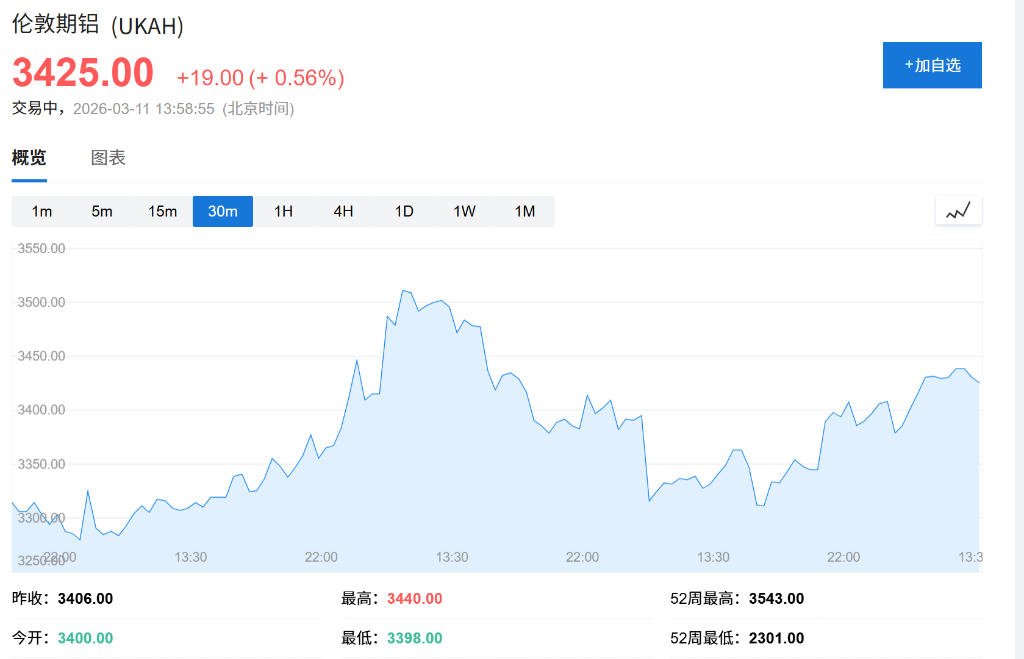
Signals of tight supply are being released from multiple dimensions. On Tuesday, Rio Tinto quoted a supply premium of $350 per ton for Q2 shipments to Japanese buyers. According to sources cited by the media, this would be the highest quarterly premium since 2015.
The stance of the Trump administration regarding the development of the conflict has fluctuated, causing ongoing volatility in the commodity markets this week. US officials signaled on Tuesday that military operations against Iran are still escalating, and that a diplomatic resolution appears nearly impossible. This contradicts earlier indications from Trump that the conflict might end soon, making it increasingly difficult for the market to gauge the duration of supply disruptions.
The Hormuz Blockade Deals a Heavy Blow to Middle Eastern Capacity
The Middle Eastern aluminum industry has suffered a double blow—direct capacity cuts due to the war, and further isolation due to the blockade of the Strait of Hormuz, which has cut both raw material imports and finished product export routes. The strait is a critical channel for Middle Eastern smelters to acquire raw materials such as alumina, and the blockade has brought this supply chain to a near standstill.
The Middle East accounts for around 9% of global aluminum output, and the scale of supply disruption cannot be ignored. As market pressure intensifies, the number of canceled warrants at LME warehouses has shot up. According to Bloomberg, this indicator's rise is the largest since May 2024, mainly driven by demand for deliveries from Malaysian warehouses.
Japan’s Aluminum Premium Soars to 11-Year High
The aluminum premium at major Japanese ports serves as a key pricing benchmark for aluminum in Asia, paid on top of the LME spot price. According to Bloomberg’s sources, Rio Tinto on Tuesday offered Japanese buyers a supply premium of $350 per ton for Q2 shipments, which, if finalized, would mark the highest quarterly premium since 2015, when the premium exceeded $400.
Notably, Rio Tinto had previously offered a price of $250 per ton, but following the escalation of strikes on Iran by the US and Israel last week and the rapid surge in aluminum prices, the company quickly withdrew the offer and raised it sharply to $350. In addition to being a mining giant, Rio Tinto is also one of the world's top aluminum suppliers, thanks to its smelters in Canada and Australia.
Tight supply has triggered a chain reaction among downstream manufacturers in Asia. According to Bloomberg, several Japanese auto parts makers have begun to seek supplies from the Russian aluminum giant United Co. Rusal International PJSC to address the supply gap created by the Middle Eastern shortfall.
Disclaimer: The content of this article solely reflects the author's opinion and does not represent the platform in any capacity. This article is not intended to serve as a reference for making investment decisions.
You may also like
US PPI report to test Bitcoin, gold and Nasdaq as December rate hike looms
Nvidia falls to its lowest valuation in 14 years! "Super bull" Tom Lee calls for bottom fishing, retail investors are buying more as it drops, but Wall Street is divided
After the market opened on Thursday, retail investors went against the trend and bought up Nvidia, with net purchases reaching $111 million in just half an hour, setting a record for the same period. Investors such as Tom Lee have publicly supported the company, with institutions optimistic about strong order backlogs extending to 2028, robust revenue growth, and opportunities created by declining valuations. Meanwhile, institutions like Bernstein and Goldman Sachs have become more cautious about Nvidia's outlook, with concerns focusing on management succession and technological leadership following Jensen Huang's departure.

Jane Street boosts Fidelity Bitcoin ETF stake 8x in Q3, trims BlackRock IBIT

From SpaceX to Anthropic, the market has new strategies for dealing with tech giants' IPOs
The market's response strategies to major listings are currently centered around "index inclusion expectations": the new regulations allow mega IPOs to be included in the six major indices within 15 days, triggering concentrated buying by passive funds. Investors are positioning themselves in advance and using options to hedge and amplify buying power. However, Anthropic has a free float of only about 6%; shares available for sale by employees on the first day and privately placed shares with no lock-up period may create supply pressure. On the other hand, index arbitrageurs are facing a rare opportunity.

Crypto prices
More


