
Ether funding rate flips negative: Are ETH bears back in control?

Key takeaways:
Ether price struggled as investors pulled $225 million from the spot ETFs, and Ethereum staking rewards underperformed compared to stablecoin yields.
Recent Ethereum network upgrades and plans for improved wallet security are positives, but fail to kickstart demand for Ether.
Ether (ETH) price has repeatedly failed to sustain levels above $2,100 over the past month, gradually eroding traders’ confidence in the altcoin. Even with a 7% rise between Monday and Tuesday, ETH derivatives metrics suggest a lack of interest in leveraged bullish positions, potentially signaling that bears remain in control.

ETH perpetual futures dipped into negative territory on Tuesday, signaling increased demand for short (bearish) positions. More importantly, this metric has remained below the neutral 6% to 12% range for the past month. Part of this investor disappointment stems from a 54% price decline over six months, even though cooling onchain activity has also played a significant role.
Weekly base layer fees on the Ethereum network averaged $2.3 million over the past month, down from an $8 million peak in early February. While 7-day transaction counts stabilized near 14 million, the current industry focus on layer-2 rollup scalability has so far failed to generate fresh demand for native Ether.

Contrary to perpetual futures markets, the ETH options risk gauge hovered near the neutral -6% to +6% range on Tuesday. Put (sell) options traded at a 7% premium relative to call (buy) instruments, suggesting confidence is slowly returning among Ether bulls. Furthermore, no competitor has yet challenged Ethereum’s $56 billion in total value locked (TVL).
Ether exchange-traded funds (ETFs) saw $225 million in net outflows between Thursday and Monday, reversing the $169 million in inflows seen on Wednesday. This metric serves as a proxy to institutional demand, which is currently held back by the 2.8% native staking reward rate. By comparison, stablecoin yields on Sky Lending (formerly MakerDAO) sat higher at 3.75%.
Weak spot ETH ETF demand and concerns with Ethereum’s roadmap
Excitement surrounding the ETF staking approval in the US, which occurred in late 2025, has not yet translated into sustainable demand. One could argue that the negative outcome was simply a result of bad luck, as the launch coincided with a broader crypto market downturn that began in early October after total market capitalization neared a $4 trillion all-time high.
Related:
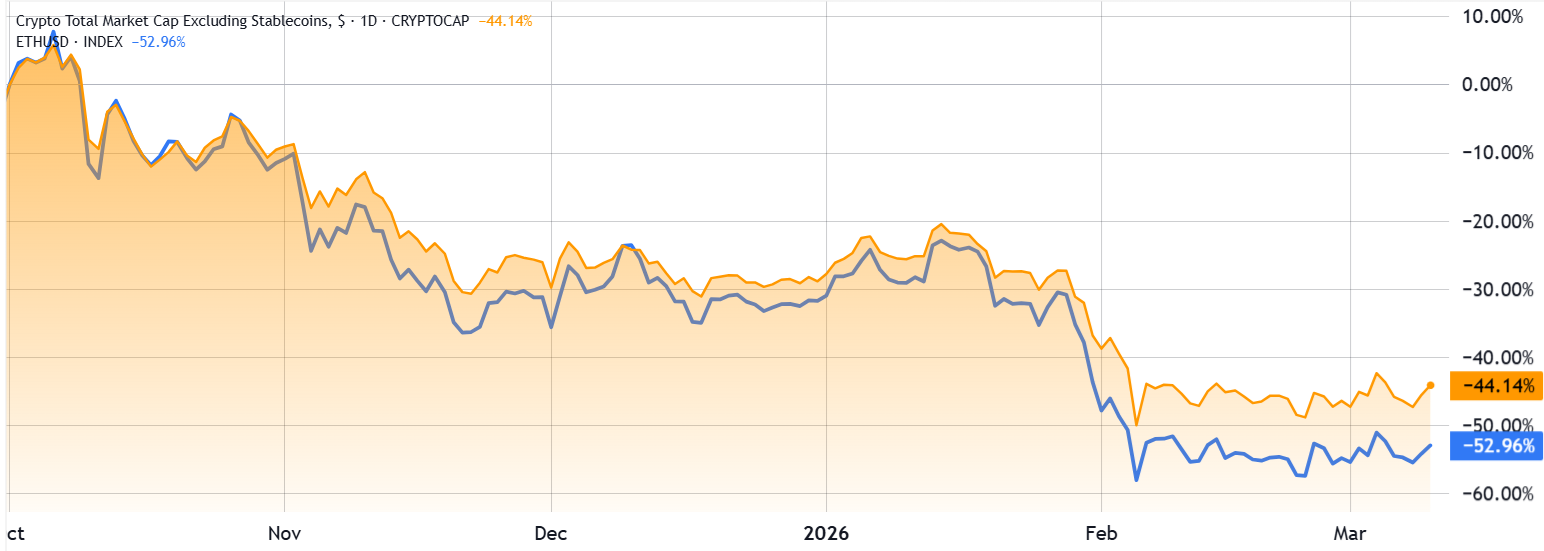
ETH has underperformed the broader cryptocurrency market since October 2025, and there are no signs that a reversal is underway. Investor sentiment is also impaired by a staggering $735 million net loss from the Ethereum treasury firm Sharplink (SBET US) in 2025. The company, chaired by Ethereum co-founder Joseph Lubin, released these financial results on Monday.
The pace of native chain scalability might have contributed to Ether’s negative performance. For instance, Ethereum co-founder Vitalik Buterin said on Saturday that account abstraction, equivalent to smart accounts, will likely be shipped “within a year,” after more than a decade under development. Transactions will be able to reference each other’s data, enabling quantum-resistant wallets.
Another advantage of the upcoming Ethereum Hegota fork is paying gas fees in non-ETH tokens using special-purpose decentralized exchanges, while adding a “general-purpose public mempool” and removing “public broadcasters” in privacy platforms such as Railgun and Tornado Cash. Buterin also said that he expects “progressive decreases” of slot time and finality time in the long term.
Overall, ETH derivatives and onchain activity point to low conviction in a bullish breakout above $2,200, but at the same time, there is no indication of worsening conditions or domination from bears.
Disclaimer: The content of this article solely reflects the author's opinion and does not represent the platform in any capacity. This article is not intended to serve as a reference for making investment decisions.
You may also like
US PPI report to test Bitcoin, gold and Nasdaq as December rate hike looms
Nvidia falls to its lowest valuation in 14 years! "Super bull" Tom Lee calls for bottom fishing, retail investors are buying more as it drops, but Wall Street is divided
After the market opened on Thursday, retail investors went against the trend and bought up Nvidia, with net purchases reaching $111 million in just half an hour, setting a record for the same period. Investors such as Tom Lee have publicly supported the company, with institutions optimistic about strong order backlogs extending to 2028, robust revenue growth, and opportunities created by declining valuations. Meanwhile, institutions like Bernstein and Goldman Sachs have become more cautious about Nvidia's outlook, with concerns focusing on management succession and technological leadership following Jensen Huang's departure.

Jane Street boosts Fidelity Bitcoin ETF stake 8x in Q3, trims BlackRock IBIT

From SpaceX to Anthropic, the market has new strategies for dealing with tech giants' IPOs
The market's response strategies to major listings are currently centered around "index inclusion expectations": the new regulations allow mega IPOs to be included in the six major indices within 15 days, triggering concentrated buying by passive funds. Investors are positioning themselves in advance and using options to hedge and amplify buying power. However, Anthropic has a free float of only about 6%; shares available for sale by employees on the first day and privately placed shares with no lock-up period may create supply pressure. On the other hand, index arbitrageurs are facing a rare opportunity.

Crypto prices
More


