
Societe Generale-FORGE launches EURCV stablecoin on Stellar

Societe Generale-FORGE, the crypto arm of French banking company Societe Generale, has deployed its euro-denominated stablecoin on the Stellar blockchain, completing a multichain expansion first announced in 2025.
The stablecoin, known as EUR CoinVertible (EURCV), is designed to comply with the European Union’s Markets in Crypto-Assets (MiCA) framework and represents a tokenized euro issued by the company for use in digital asset markets.
According to the company, the Stellar deployment is intended to broaden the stablecoin’s use across blockchain-based financial applications and tokenized asset services.
SG-FORGE said Stellar offers high transaction throughput, low network fees and built-in support for tokenized assets. The network also includes a decentralized exchange that allows users to trade digital assets directly onchain.
Societe Generale-FORGE first launched the EUR CoinVertible (EURCV) stablecoin on Ethereum in April 2023. The stablecoin is fully backed by reserves consisting of bank deposits and high-quality liquid assets on a one-to-one basis, and has a current market cap of around $452 million, according to DefiLlama data.
The development comes weeks after SG-FORGE deployed EUR CoinVertible on the XRP Ledger, then marking the token’s third blockchain network after Ethereum (ETH) and Solana (SOL).
In January, the stablecoin was used by global banking network SWIFT in a pilot that demonstrated the exchange and settlement of tokenized bonds using both fiat and digital currencies.
Related: Stablecoin payments startup Kast raises $80M at $600M valuation: Report
European stablecoin push
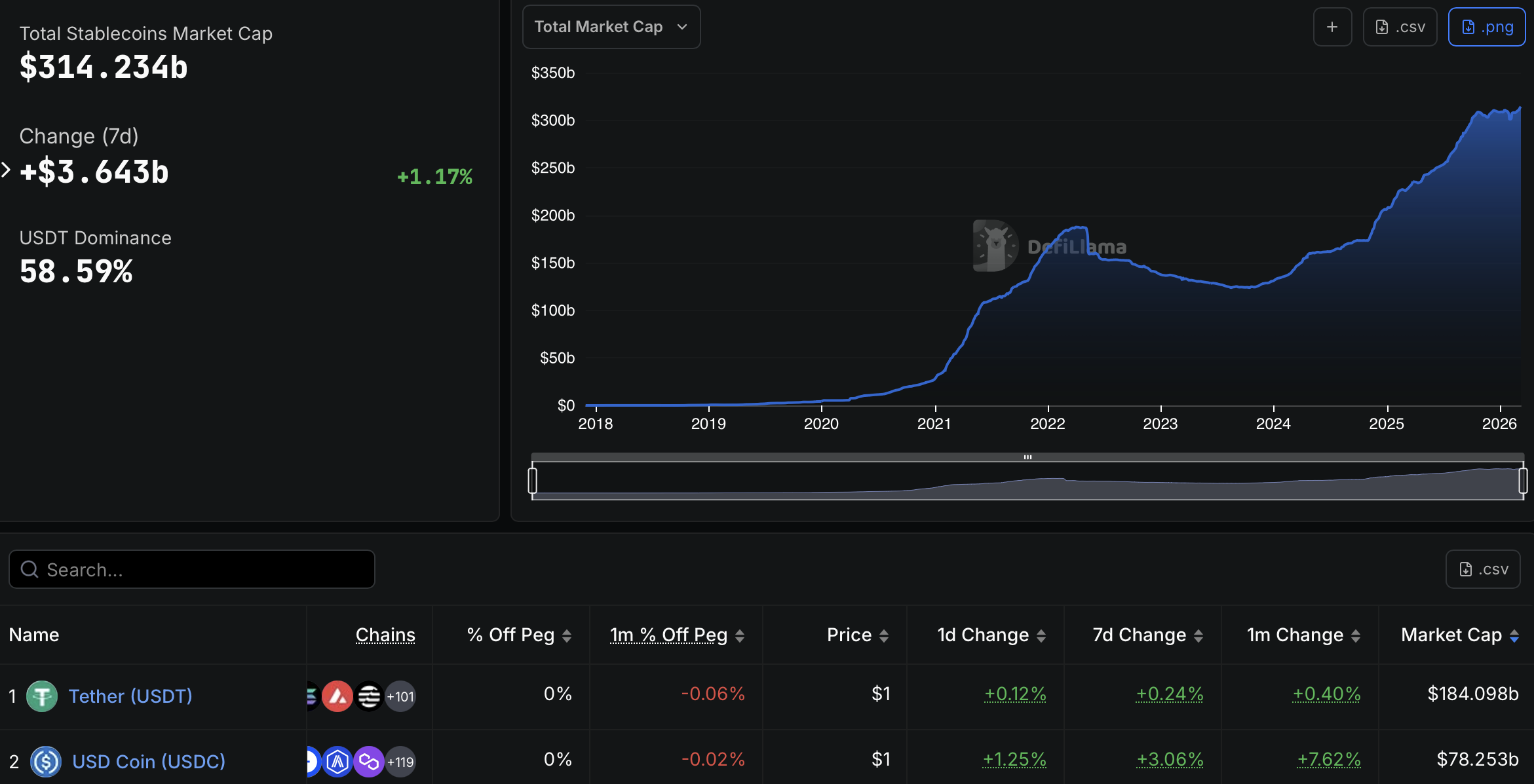
Despite growing interest in euro-denominated tokens, the stablecoin market remains dominated by US dollar-backed assets. Tether’s USDT (USDT) holds a market capitalization of about $185 billion, representing nearly 60% of the sector, while Circle’s USDC (USDC) accounts for roughly $78 billion.
Adoption of digital dollars accelerated in the US after the GENIUS Act passed in July 2025, providing regulatory clarity for stablecoin issuers. Total market capitalization has climbed from around $260 billion on July 20 to more than $314 billion today, per DefiLlama data.
Meanwhile, Europe has taken a more restrictive regulatory approach. The European Union’s MiCA framework introduced new rules for stablecoin issuers in June 2024, requiring companies operating in the European Economic Area to obtain an e-money license in at least one EU member state.
The regulation prompted several exchanges, including Coinbase, OKX, Bitstamp, Uphold and Binance, to remove or restrict support for stablecoins that had not secured authorization under the framework. Tether also decided it would discontinue its euro-pegged stablecoin EURT.
In November, European Central Bank officials warned that the growth of US dollar–backed stablecoins could weaken Europe’s monetary sovereignty by increasing reliance on dollar-denominated digital assets.
Magazine: The debate over Bitcoin’s four-year cycle is over: Benjamin Cowen
Disclaimer: The content of this article solely reflects the author's opinion and does not represent the platform in any capacity. This article is not intended to serve as a reference for making investment decisions.
You may also like
Assessing if Avalanche’s growing network activity can spur AVAX’s price recovery

Berkshire's stock hits a new high amid tech plunge as return to yen bonds sparks heated "increase positions in Japan" discussion
Berkshire Hathaway has hired banks to prepare for its first yen bond issuance since April, aiming to raise more funds in Japan. According to sources familiar with the matter, Berkshire has mandated Mizuho Securities and Bank of America Securities for a potential benchmark yen bond issuance, which is expected to take place in the near future, though the exact timing will depend on market conditions.
Nomura's monopoly is being challenged! Mizuho (MFG.US) is reshaping Japan's underwriting landscape with global IPOs
Mizuho is establishing a solid foothold in Japan's equity capital market by leveraging a unique and highly profitable track: on one hand, it is tapping into the strong demand for AI financing from the US market, and on the other, connecting with the vast domestic household savings in Japan.


Crypto prices
More


