
Wall Street funneled $540M into US Solana ETFs in Q4: Bloomberg

Silicon Valley-based venture capital firm Electric Capital Partners and investment bank Goldman Sachs were the two largest buyers of spot Solana exchange-traded funds, which launched for trading in the US in October last year.
Data shared by Bloomberg ETF analyst James Seyffart on Monday shows that the top 30 institutional holders of US spot Solana (SOL) exchange-traded funds bought over $540 million worth of the ETFs in the quarter.
Electric Capital and Goldman Sachs took out the top two positions with $137.8 million and $107.4 million worth of Solana ETF exposure, while Elequin Capital, SIG Holding and Multicoin Capital rounded out the top five.
Morgan Stanley and Citadel Advisors were among the other notable institutions that bought spot Solana ETFs after Bitwise launched the first Securities and Exchange Commission-approved spot Solana ETF on Oct. 28.

Seyffart’s data comes from 13F filings submitted to the SEC in mid-February, where institutions managing over $100 million in assets are required to disclose their Q4 holdings and position sizes.
Investment advisors accounted for by far the largest share of spot Solana ETF ownership at over $270 million, while hedge fund managers came in next at $186.4 million.
Holding companies and brokerage firms held $59.5 million and $20.3 million, while banks held $4.5 million.
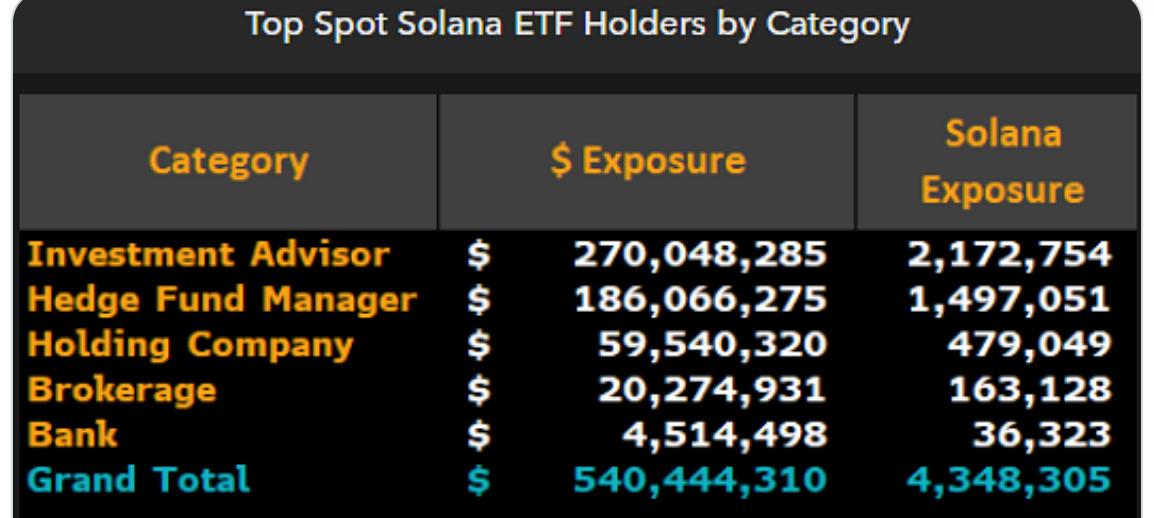
The $540 million in Solana ETF holdings was backed by approximately 4.3 million SOL tokens.
However, those 4.3 million SOL tokens have fallen over 30% in market value since the end of Q4, from $124.95 to $86.53 at the time of writing.
SOL ETF net flows steadying despite price fall
Bloomberg ETF analyst Eric Balchunas noted on Thursday that cumulative flows into spot Solana ETFs have held strong in recent months despite Solana’s price fall.
Related: US banking lobby considers suing OCC over crypto bank charters: Report
Balchunas also noted that 50% of Solana ETF assets are held by these 13F-filing firms, arguably making for a more serious investor base.
Farside Investors data shows that US spot Solana ETFs have accumulated $952 million worth of inflows since launching in the US.
Magazine: What’s a ‘Network State’ and are there real-life examples? Big Questions
Disclaimer: The content of this article solely reflects the author's opinion and does not represent the platform in any capacity. This article is not intended to serve as a reference for making investment decisions.
You may also like
US PPI report to test Bitcoin, gold and Nasdaq as December rate hike looms
Nvidia falls to its lowest valuation in 14 years! "Super bull" Tom Lee calls for bottom fishing, retail investors are buying more as it drops, but Wall Street is divided
After the market opened on Thursday, retail investors went against the trend and bought up Nvidia, with net purchases reaching $111 million in just half an hour, setting a record for the same period. Investors such as Tom Lee have publicly supported the company, with institutions optimistic about strong order backlogs extending to 2028, robust revenue growth, and opportunities created by declining valuations. Meanwhile, institutions like Bernstein and Goldman Sachs have become more cautious about Nvidia's outlook, with concerns focusing on management succession and technological leadership following Jensen Huang's departure.

Jane Street boosts Fidelity Bitcoin ETF stake 8x in Q3, trims BlackRock IBIT

From SpaceX to Anthropic, the market has new strategies for dealing with tech giants' IPOs
The market's response strategies to major listings are currently centered around "index inclusion expectations": the new regulations allow mega IPOs to be included in the six major indices within 15 days, triggering concentrated buying by passive funds. Investors are positioning themselves in advance and using options to hedge and amplify buying power. However, Anthropic has a free float of only about 6%; shares available for sale by employees on the first day and privately placed shares with no lock-up period may create supply pressure. On the other hand, index arbitrageurs are facing a rare opportunity.

Crypto prices
More


