
领涨海外银行股,高盛才是特朗普交易大赢家?

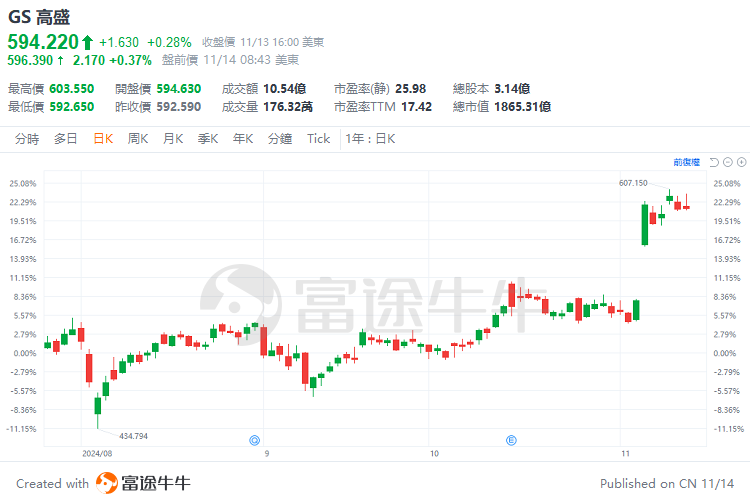
 据《华尔街日报》报道,高盛的这一表现可能并非偶然。与其他华尔街银行一样,高盛将从并购和IPO活动的增加以及监管放宽中受益。而且,通常在华尔街繁荣时期,高盛也会表现出色:在2021年(交易)活动激增期间,其全年股本回报率达到23%,而标普500银行指数的整体回报率仅为12%。
Analysis suggests that due to the significant growth of private crediting and alternative assets, goldman sachs may become a potential big winner among banks. On one hand, there will be no restrictions on private crediting during Trump's presidency, allowing it to continue growing for the next four years; on the other hand, the rise in government bond yields may also benefit private crediting.
Since Trump's election, the market's expectations for trade activities, regulatory relaxation, and private crediting have risen, with bullish factors continuing to accumulate, driving. $Goldman Sachs (GS.US)$ the arrival of the "harvest season."
In November, Goldman Sachs topped the global banks in the S&P 500 index, with a nearly 15% increase, far exceeding the approximately 9% increase in the S&P 500 bank index, and on par with the increase of private equity giant Apollo this month.
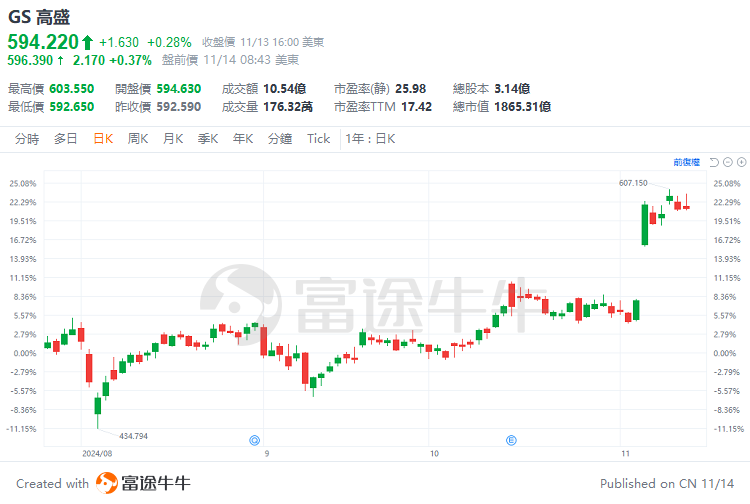
 According to The Wall Street Journal, Goldman Sachs' performance is likely not accidental. Like other Wall Street banks, Goldman Sachs will benefit from increased M&A and IPO activities, as well as relaxed regulations. Moreover, during prosperous times on Wall Street, Goldman Sachs tends to perform exceptionally well: in 2021, during the surge in trading activities, its annual return on equity reached 23%, while the overall return on equity of the S&P 500 bank index was only 12%.
However, due to the significant growth in private crediting and alternative assets, Goldman Sachs may become a potential big winner among these banks.
Analysts believe that under the Trump administration, new securities regulatory agencies or systemic risk regulatory agencies may be less inclined to restrict the availability of private crediting investments with relatively poor liquidity to everyday investors, or see them as a source of financial risk. TD Cowen Washington Research Group analyst Jaret Seiberg said:
"We expect no restrictions on private crediting during the Trump administration, which is why we believe private crediting will continue to grow over the next four years."
Another reason is that the rise in government bond yields may benefit private credit, especially in rapidly growing areas such as Asset Backed Financing (ABF). Moody's Executive Vice President of Private Credit Mark Wasden said, "The increase in government bond yields will impact long-term asset rates (follow the increase)."
Although other major Wall Street banks are also involved in private credit business, analysts believe that Goldman Sachs' ongoing strategic shift may allow it to gain more significant benefits.
In its recent strategy, Goldman Sachs has shifted its asset management department from betting on the company's own funds to investing more through funds for clients. The latter has lower capital intensity and can generate stable management fee income. As of the third quarter, Goldman Sachs manages approximately $140 billion of private credit assets and continues to enter rapidly growing markets such as Asset Backed Securities (ABS).
This also means that Goldman Sachs can further expand the pre-tax profits of its asset and wealth management division by charging higher fees.
However, analysts also warn that if the tariffs implemented by Trump put pressure on large multinational companies, it may widen credit spreads or slow down client activities. Policy uncertainties or excessive market volatility caused by unexpected presidential statements, combined with rapidly rising rates, may make financing more challenging. In addition, regulatory changes sometimes do not necessarily meet people's expectations.
Editor/ping
Disclaimer: The content of this article solely reflects the author's opinion and does not represent the platform in any capacity. This article is not intended to serve as a reference for making investment decisions.
You may also like
US PPI report to test Bitcoin, gold and Nasdaq as December rate hike looms
Nvidia falls to its lowest valuation in 14 years! "Super bull" Tom Lee calls for bottom fishing, retail investors are buying more as it drops, but Wall Street is divided
After the market opened on Thursday, retail investors went against the trend and bought up Nvidia, with net purchases reaching $111 million in just half an hour, setting a record for the same period. Investors such as Tom Lee have publicly supported the company, with institutions optimistic about strong order backlogs extending to 2028, robust revenue growth, and opportunities created by declining valuations. Meanwhile, institutions like Bernstein and Goldman Sachs have become more cautious about Nvidia's outlook, with concerns focusing on management succession and technological leadership following Jensen Huang's departure.
Jane Street boosts Fidelity Bitcoin ETF stake 8x in Q3, trims BlackRock IBIT

From SpaceX to Anthropic, the market has new strategies for dealing with tech giants' IPOs
The market's response strategies to major listings are currently centered around "index inclusion expectations": the new regulations allow mega IPOs to be included in the six major indices within 15 days, triggering concentrated buying by passive funds. Investors are positioning themselves in advance and using options to hedge and amplify buying power. However, Anthropic has a free float of only about 6%; shares available for sale by employees on the first day and privately placed shares with no lock-up period may create supply pressure. On the other hand, index arbitrageurs are facing a rare opportunity.

Crypto prices
More


