
Finance job openings at 2012 levels, US lost 92K jobs last month

Finance and insurance job openings towards the end of 2025 fell to 13-year lows, according to February data from the Federal Reserve Bank of St. Louis, with markets commentary outlet The Kobeissi Letter arguing on Saturday that the industry may be “bracing for more layoffs.”
In an X post, The Kobeissi Letter highlighted data showing that finance and insurance job openings have declined by 117,000 since December to hit 134,000 last month, with overall finance and insurance job listings nearing recession levels.
“Available vacancies in these sectors have dropped -410,000, or -75%, since the 2022 peak. Openings are now even lower than at the 2001 recession bottom,” The Kobeissi Letter said, adding:
“By comparison, the largest monthly decline during the 2008 Financial Crisis was -125,000. As a result, the finance and insurance job openings rate fell to 1.9%, meaning fewer than 2 out of every 100 jobs in the sector are currently vacant, the lowest since February 2010.”
Finance jobs increased despite challenges
Despite a fall in job openings in December, the finance sector was actually one of the bright spots of a US Bureau of Labor Statistics report on Friday, showing that while US unexpectedly lost 92,000 jobs in February, the “financial activities” sector posted a net employment gain of 10,000.
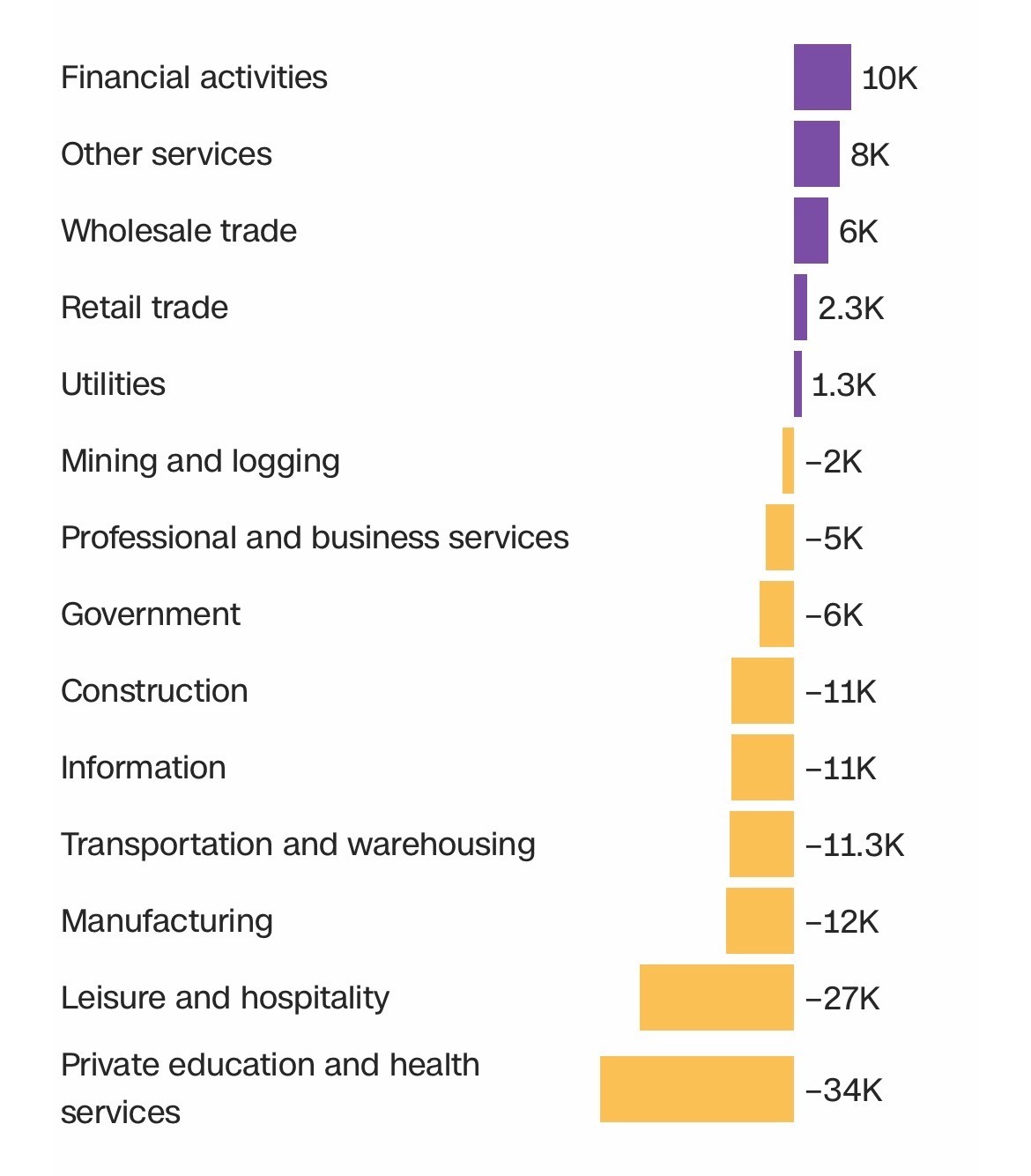
The bureau instead highlighted the healthcare sector as one of the key drivers behind the 92,000 net loss, following a four-week healthcare strike by Kaiser Permanente employees that ended late last month. The healthcare sector lost 28,000 jobs in the month, accounting for 30% of the full total.
Meanwhile, the information sector, transportation and warehousing, and the federal government lost 11,000, 11,000, and 10,000 jobs, respectively.
CNN reported on Saturday that extreme weather conditions may have impacted the numbers, though the bureau’s report indicated that the impact of weather conditions is difficult to quantify.
Related: Crypto Fear and Greed Index falls back down to 'extreme fear' levels
A weak jobs market can increase the chances of the US Federal Reserve cutting interest rates to ease pressure, which could be a boon for the crypto market.
However, it can also be a double-edged sword, as the fragility could spark investors into taking risk-off strategies to weather the storm.
Magazine: The debate over Bitcoin’s four-year cycle is over: Benjamin Cowen
Disclaimer: The content of this article solely reflects the author's opinion and does not represent the platform in any capacity. This article is not intended to serve as a reference for making investment decisions.
You may also like
Nvidia falls to its lowest valuation in 14 years! "Super bull" Tom Lee calls for bottom fishing, retail investors are buying more as it drops, but Wall Street is divided
After the market opened on Thursday, retail investors went against the trend and bought up Nvidia, with net purchases reaching $111 million in just half an hour, setting a record for the same period. Investors such as Tom Lee have publicly supported the company, with institutions optimistic about strong order backlogs extending to 2028, robust revenue growth, and opportunities created by declining valuations. Meanwhile, institutions like Bernstein and Goldman Sachs have become more cautious about Nvidia's outlook, with concerns focusing on management succession and technological leadership following Jensen Huang's departure.

Jane Street boosts Fidelity Bitcoin ETF stake 8x in Q3, trims BlackRock IBIT

From SpaceX to Anthropic, the market has new strategies for dealing with tech giants' IPOs
The market's response strategies to major listings are currently centered around "index inclusion expectations": the new regulations allow mega IPOs to be included in the six major indices within 15 days, triggering concentrated buying by passive funds. Investors are positioning themselves in advance and using options to hedge and amplify buying power. However, Anthropic has a free float of only about 6%; shares available for sale by employees on the first day and privately placed shares with no lock-up period may create supply pressure. On the other hand, index arbitrageurs are facing a rare opportunity.

Nvidia Q3 Earnings Preview: Revenue Expectations and Key Metrics to Watch
Crypto prices
More


