
38% of altcoins near all-time lows, worse than FTX crash: Analyst

An estimated 38% of altcoins are now hovering near all-time lows, which is worse than the post-FTX market crash, according to CryptoQuant analyst Darkfost.
The current market is “unfavorable” for risk-on assets, and the crypto markets are the first to absorb this risk-off posturing, he said, adding:
“For comparison, this metric reached 35% in April 2025 and 37.8% just after the FTX crash. This chart perfectly illustrates the current situation for altcoins. Investors remain cautious and continue to lose interest in altcoins.”
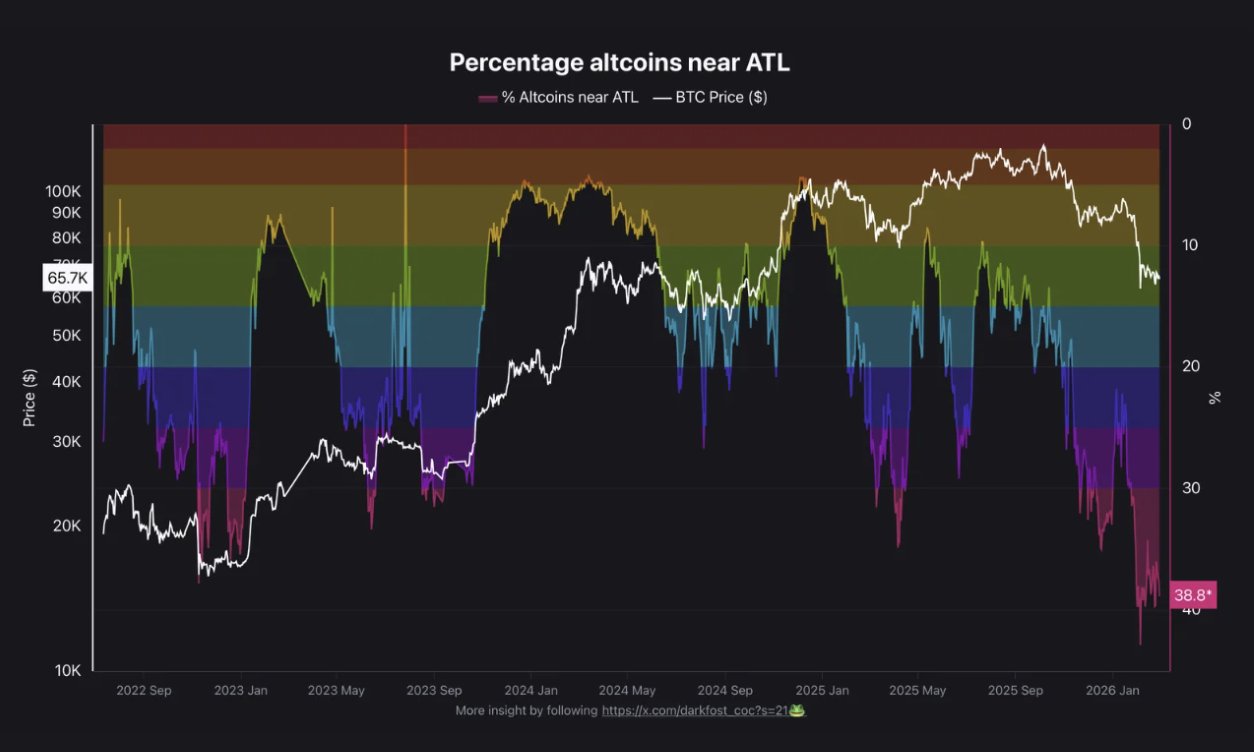 The percentage of altcoins trading at or near all-time lows. Source:
CryptoQuant
Examples of altcoins, cryptocurrency that typically serves as an alternative to Bitcoin (BTC), include Cardano’s ADA (ADA), which is hovering at about $0.10 above its all-time low of $0.17. Polkadot (DOT) reached an all-time low of $1.13 in February, but is now up 33% from there, and Polygon (POL) is trading at about $0.02 off its all-time low of $0.08.
Liquidity is being siphoned from altcoins and into equities and commodities, Darkfost said. Daily trading volume reached a high of over $417 billion on Oct. 10, the day of the historic crypto market crash, according to data from CoinMarketCap.
 The Total3 metric, which tracks the market capitalization of the entire cryptocurrency market, excluding BTC and ETH, has retraced to November 2024 levels. Source:
TradingView
For comparison, daily trading volumes ranged from $49.4 billion to $268 billion in February and March 2026.
The altcoin drawdown represents the “largest regression” recorded during the current market cycle, he said, and could present a buying opportunity for investors, he concluded.
Related: $209B exited altcoins over the last 13 months: Did traders rotate into Bitcoin?
Altcoin social activity drowned out by Bitcoin
The analysis comes as mentions of altcoins on social media platforms dropped to two-year lows, according to crypto market sentiment analysis platform Santiment.
Google worldwide search volume for altcoins also dropped to the yearly low of 4 out of 100, according to data from Google Trends.
 Google worldwide search volume for “altcoins” is back at the one-year low. Source:
Google Trends
“Altcoins are suffering from a ‘liquidity drain,’ where even minor shifts in sentiment trigger outsized sell-offs,” Jimmy Xue, co-founder of liquidity platform Axis, said in a message shared with Cointelegraph.
This is because altcoins lack the same institutional support and the “digital gold” narrative enjoyed by Bitcoin, he added.
Analysts have cited several reasons for the decline in altcoins, including too many tokens competing for limited investor capital, and the launch of BTC exchange-traded funds (ETFs), altering market dynamics by trapping liquidity in traditional financial vehicles.
There are more than 36.8 million different crypto tokens listed on CoinMarketCap at the time of this writing.
Magazine: Brandt says Bitcoin yet to bottom, Polymarket sees hope: Trade Secrets
Disclaimer: The content of this article solely reflects the author's opinion and does not represent the platform in any capacity. This article is not intended to serve as a reference for making investment decisions.
You may also like
Nvidia falls to its lowest valuation in 14 years! "Super bull" Tom Lee calls for bottom fishing, retail investors are buying more as it drops, but Wall Street is divided
After the market opened on Thursday, retail investors went against the trend and bought up Nvidia, with net purchases reaching $111 million in just half an hour, setting a record for the same period. Investors such as Tom Lee have publicly supported the company, with institutions optimistic about strong order backlogs extending to 2028, robust revenue growth, and opportunities created by declining valuations. Meanwhile, institutions like Bernstein and Goldman Sachs have become more cautious about Nvidia's outlook, with concerns focusing on management succession and technological leadership following Jensen Huang's departure.

Jane Street boosts Fidelity Bitcoin ETF stake 8x in Q3, trims BlackRock IBIT

From SpaceX to Anthropic, the market has new strategies for dealing with tech giants' IPOs
The market's response strategies to major listings are currently centered around "index inclusion expectations": the new regulations allow mega IPOs to be included in the six major indices within 15 days, triggering concentrated buying by passive funds. Investors are positioning themselves in advance and using options to hedge and amplify buying power. However, Anthropic has a free float of only about 6%; shares available for sale by employees on the first day and privately placed shares with no lock-up period may create supply pressure. On the other hand, index arbitrageurs are facing a rare opportunity.

Nvidia Q3 Earnings Preview: Revenue Expectations and Key Metrics to Watch
Crypto prices
More


