
RedStone launches Stellar price feeds after $10M exploit highlights oracle risks

Oracle provider RedStone has launched its price feed infrastructure on the Stellar network, introducing a new data layer for decentralized finance (DeFi) applications on a blockchain historically focused on payments and stablecoin transfers.
The deployment makes price feeds for major crypto assets and stablecoins available on the Stellar mainnet, including Bitcoin (BTC), Ether (ETH), USD Coin (USDC) and PayPal USD (PYUSD). The rollout also includes pricing data for the Franklin Templeton BENJI tokenized money market fund.
RedStone said the feeds are designed to support financial applications like lending markets, decentralized exchanges (DEXs) and tokenized real-world asset (RWA) platforms building on Stellar.
The launch adds a new infrastructure provider to Stellar’s emerging DeFi stack as developers experiment with lending, tokenized assets and onchain financial services.
Stellar expands DeFi infrastructure
RedStone said the price feeds rely on a deviation-based update system and freshness checks intended to ensure data accuracy for financial applications.
“Stellar has long demonstrated its strength as a blockchain for real-world financial activity, particularly in payments and stablecoins,” RedStone co-founder Marcin Kazmierczak said in a statement.
He added that an enterprise-level oracle infrastructure was “what has been missing” for the network to unlock more advanced financial applications.
Related: ‘ClickFix’ hackers pose as VCs, hijack QuickLens in latest crypto attacks
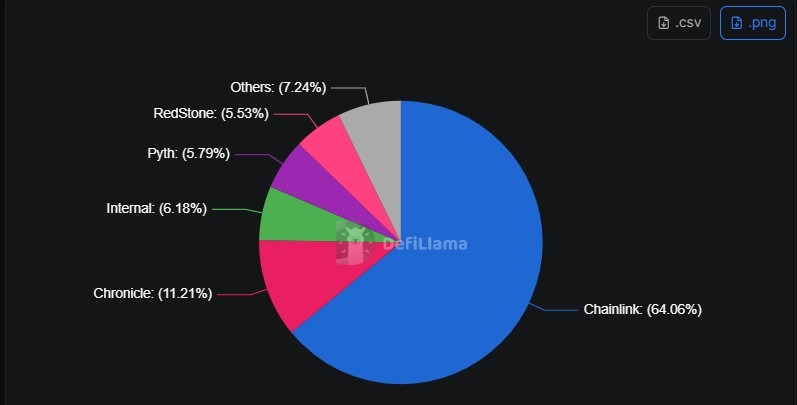
RedStone operates in a competitive oracle market dominated by Chainlink. Data from DeFiLlama shows Chainlink secures about 64% of the market by value, followed by Chronicle with 11%.
Internal protocol oracles account for about 6%, while Pyth and RedStone hold about 5.8% and 5.5%, respectively.
Oracle risks highlighted by recent exploit
The launch comes weeks after a DeFi exploit on Stellar highlighted risks tied to price feeds and collateral valuation in lending protocols.
On Feb. 21, attackers drained roughly $10 million from a YieldBlox DAO-managed lending pool built on the Blend protocol after manipulating the price of the USTRY token used as collateral.
A security analysis by blockchain security firm BlockSec found the lending protocol relied on a price path linked to the shallow USTRY/USDC market on Stellar’s decentralized exchange. The manipulated price inflated the token’s collateral value, allowing the attacker to borrow assets beyond its real worth.
A Redstone spokesperson told Cointelegraph that relying on thin onchain markets for price discovery can expose lending pools to manipulation risks.
“The February exploit was only possible because an oracle was deriving a price from a market with less than one dollar in hourly trading volume,” the spokesperson said.
RedStone said its price feeds instead use deviation-based updates, typically around 0.5% to 1% for stablecoins, along with minimum daily refreshes to ensure data remains current.
Magazine: Telegram avoids Philippines ban, yen carry trade going onchain: Asia Express
Disclaimer: The content of this article solely reflects the author's opinion and does not represent the platform in any capacity. This article is not intended to serve as a reference for making investment decisions.
You may also like
Nvidia falls to its lowest valuation in 14 years! "Super bull" Tom Lee calls for bottom fishing, retail investors are buying more as it drops, but Wall Street is divided
After the market opened on Thursday, retail investors went against the trend and bought up Nvidia, with net purchases reaching $111 million in just half an hour, setting a record for the same period. Investors such as Tom Lee have publicly supported the company, with institutions optimistic about strong order backlogs extending to 2028, robust revenue growth, and opportunities created by declining valuations. Meanwhile, institutions like Bernstein and Goldman Sachs have become more cautious about Nvidia's outlook, with concerns focusing on management succession and technological leadership following Jensen Huang's departure.

Jane Street boosts Fidelity Bitcoin ETF stake 8x in Q3, trims BlackRock IBIT

From SpaceX to Anthropic, the market has new strategies for dealing with tech giants' IPOs
The market's response strategies to major listings are currently centered around "index inclusion expectations": the new regulations allow mega IPOs to be included in the six major indices within 15 days, triggering concentrated buying by passive funds. Investors are positioning themselves in advance and using options to hedge and amplify buying power. However, Anthropic has a free float of only about 6%; shares available for sale by employees on the first day and privately placed shares with no lock-up period may create supply pressure. On the other hand, index arbitrageurs are facing a rare opportunity.

Nvidia Q3 Earnings Preview: Revenue Expectations and Key Metrics to Watch
Crypto prices
More


