
If OpenAI is valued at $830 billion, how much should Google be worth?

As OpenAI is pushed to an $830 billion valuation in the private market, a sharp question arises: On the same AI track, why does Google command less than half the revenue multiple in the secondary market?
This Thursday, the Nasdaq Index fell by 0.4%, with continued selling pressure on tech stocks. This may seem like an uneventful day in February 2026, but beneath the surface, a strong sense of division is brewing: Investors’ anxiety over AI disrupting existing giants continues to suppress the stock prices of industry leaders like Google; meanwhile, unlisted AI leaders such as OpenAI are raising funds at valuations that are constantly stretching the imagination.
Tech media The Information analyst Martin Peers analyzes that if investors recognize OpenAI’s $830 billion valuation, then logically, this should be positive for Google.
According to S&P Global Market Intelligence, at $830 billion, ChatGPT creator OpenAI is valued at 14 times its projected 2027 revenue. By comparison, Google is currently trading at only 6.7 times its projected 2027 revenue.
From a multiples arithmetic perspective, this means that if Google were measured by the same “2027 revenue multiple,” its valuation multiple would need to be nearly 2.1 times its current level to match OpenAI (14/6.7≈2.1). It’s important to note that this is just an analogy of “valuation scale.”
Despite Google’s recent performance outpacing other tech giants, its stock price remains down year-to-date.
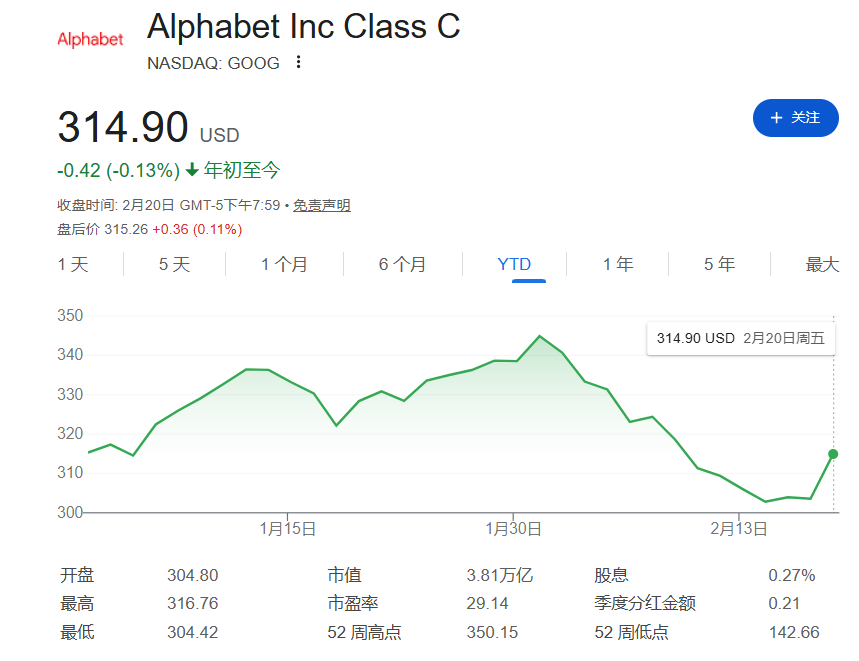
The market’s bullish logic for OpenAI lies in its “high growth premium”—as a still-developing business entity, its revenue is expected to explode in the coming years. While this is a reasonable view, investors seem to be overlooking two key facts:
-
The profitability gap: OpenAI is currently incurring heavy losses, and is expected to continue burning cash for the next several years. Whether it can ultimately turn a profit remains unknown.
-
Comparing moats: Google possesses virtually all the technical capabilities that OpenAI has in AI (except for the constant management drama), and Google owns extremely mature, money-printing businesses that OpenAI does not.
As analyst Martin Peers put it: “Who would you bet on?”
The Forgotten Giant Dividend?
Amid the wave of investors rushing to flee tech stocks, an obvious trend is being overlooked: Some giants will become even richer and stronger during the AI transformation. In Peers’ view, Google clearly belongs to this category.
“Some companies will become stronger and richer after the AI transformation. Google will clearly be among them.”
In addition, Microsoft, which holds a 27% stake in OpenAI, as well as cloud services giant Amazon, both have the potential to become winners.
Although the stock performance of these two companies over the past year has left investors hesitant, the current valuation gap may be an opportunity for independent thinking.
For the market, Peers’ core point is not to provide a single answer to “how much is Google worth,” but to highlight two main lines of the current valuation system: one is the high-multiple “growth bet” represented by OpenAI, and the other is the “cash flow and certainty discount” represented by Google. How the two will be rebalanced depends on how quickly the market reprices AI commercialization paths and competitive dynamics.
Disclaimer: The content of this article solely reflects the author's opinion and does not represent the platform in any capacity. This article is not intended to serve as a reference for making investment decisions.
You may also like
Microsoft (MSFT.US) 365 services experience second major outage this year, affecting multiple government agencies and enterprises worldwide
Despite a "partial recovery," the latest Microsoft service outage continued into Asia-Pacific business hours.
Nvidia (NVDA.US) New CEO Candidates and Market Predictions: Trump Nominates Cook as Successor
As the successor remains uncertain, external voices have already begun to "make choices" for Nvidia.
Safe haven halo fails? US Treasury sell-off returns, Wall Street just breathed a sigh of relief and is startled again
Just as global bond investors began to believe that the worst phase of this year's sell-off had passed, the surge in U.S. Treasury yields has forced them to reassess that judgment.

Before the Jensen Huang scandal broke out, the Quant King precisely cleared out Nvidia!
The latest 13F filing shows that quantitative giant Renaissance Technologies almost completely sold off its holdings in Nvidia (reduced by 99.7%), Meta (reduced by 99.9%), as well as other tech giants like Apple and Amazon in the third quarter, and significantly reduced its position in Palantir. At the same time, it heavily increased its holdings in Micron Technology (up by 618.7%), AMD, and SanDisk, as well as other storage and chip stocks.
Crypto prices
More


