
TER Benefits From Robust Semiconductor Test Segment: What's Ahead?

Teradyne TER is experiencing strong growth in its semiconductor test segment. In the fourth quarter of 2025, Semiconductor Test revenues were $883 million, accounting for approximately 81.5% of total sales. This reflects 45% year-over-year growth and a 46% sequential increase compared with the third quarter of 2025. This growth was fueled by increasing demand for AI-driven compute and memory applications, which have become a significant portion of Teradyne's business.
The semiconductor test segment, particularly the System-on-Chip (SoC) and memory test divisions, has shown impressive year-over-year growth. In 2025, SoC test revenue grew 23% year over year, driven by networking and VIP compute, while memory test revenue saw slight growth in a flat market, supported by share gains in high-bandwidth memory and DRAM final tests.
Compute has emerged as the largest component of Teradyne’s revenue, increasing 90% year over year in 2025, a shift from its previous reliance on mobile applications. This transition reflects the company's strategic pivot to capitalize on AI-driven demand in high-performance computing.
Teradyne expects robust growth in the semiconductor test market, particularly in the compute segment, which is projected to expand significantly due to the rapid build-out of AI data centers and growth of edge AI. The company anticipates that the compute segment will drive a substantial portion of its revenue in 2026, with AI applications accounting for up to 70% of its revenue in the first quarter of 2026.
Teradyne Suffers From Stiff Competition
Teradyne is facing stiff competition from companies such as Advantest Corporation ATEYY and Cohu COHU. Both Advantest and Cohu are expanding their footprint in the semiconductor test market.
Advantest is expanding its footprint in the semiconductor test market by focusing on the growing demand for AI-related high-performance semiconductors, such as high-performance computing devices and high-performance DRAM for data centers.
Cohu’s expanding portfolio has been noteworthy. In September 2025, Cohu announced that a major U.S. semiconductor manufacturer and foundry services company chose its Eclipse platform for production testing of next-generation processors.
The Eclipse systems feature Cohu’s T-Core Active Thermal Control, which offers precise thermal management up to 3kW dissipation with fast ramp rates. This improves yield and test repeatability. This scalable platform supports a variety of high-performance devices while lowering the total cost of ownership for IDMs, foundries and OSATs.
TER’s Share Price Performance, Valuation, and Estimates
Teradyne shares have surged 184.6% in the trailing six-month period, outperforming the Zacks Computer & Technology sector’s rise of 9.7% and the Zacks Electronics - Miscellaneous Products increase of 34.4%.
TER Stock's Performance
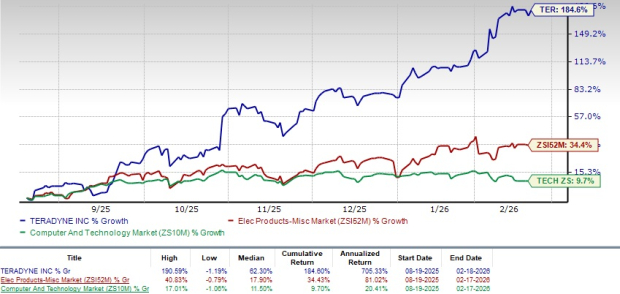
Image Source: Zacks Investment Research
TER stock is trading at a premium with a forward 12-month Price/Sales of 11.77X compared with the Electronics - Miscellaneous Products industry’s 8.33X. TER has a Value Score of F.
TER's Valuation

Image Source: Zacks Investment Research
The Zacks Consensus Estimate for 2026 earnings is pegged at $5.91 per share, which has increased 16.11% the past 30 days. This suggests 49.24% year-over-year growth.
Teradyne, Inc. Price and Consensus

Teradyne, Inc. price-consensus-chart | Teradyne, Inc. Quote
Teradyne currently sports a Zacks Rank #1 (Strong Buy). You can see the complete list of today’s Zacks #1 Rank stocks here.
Disclaimer: The content of this article solely reflects the author's opinion and does not represent the platform in any capacity. This article is not intended to serve as a reference for making investment decisions.
You may also like
Bernstein Comments on Coherent (COHR.US) Q1 Results: No Issues with Fundamentals, Focus is on Timing of Realization, Maintains "Outperform" Rating
Bernstein released its latest research report assessing Coherent’s quarterly performance: there is nothing wrong with the quarterly report itself; the issue lies in "when it will be realized."

Microsoft regrets its bet on "new cloud," intensifies scrutiny and exits some data center projects
Microsoft is tightening its oversight of "new cloud" computing power partners, withdrawing from high-risk projects and pausing the signing of new deals. Previously, Microsoft had committed a total of over $80 billion to partners such as Nscale, Nebius, CoreWeave, and IREN, but due to data center delivery delays, wiring faults, and regulatory pressure, these partnerships have become increasingly strained. Following the news, the stock prices of IREN and Nebius both dropped by more than 20% at one point.
A Different Approach! Under Regulatory Pressure, Nvidia Plans "Old Building Renovation" Data Center with a Capacity of 1 GW
Nvidia is targeting over 130 buildings owned by the near-bankrupt telecom company Brightspeed, partnering with private equity giant Apollo, to build a distributed AI inference network across 20 US states, with a total available power of about 1 GW. Renovating old buildings does not require new approvals from scratch, effectively bypassing new data center regulations being pushed by newly elected governors in multiple states. Server deployment is expected as early as Q1 2027, with target clients including SpaceX, Anthropic, and OpenAI.
Crypto prices
More


