
Netflix vs. Roku: Which Streaming Stock is the Better Buy-the-Dip Target?

Two appealing buy-the-dip prospects that investors may be taking notice of are streaming services leaders Netflix NFLX and Roku ROKU.
Notably, Netflix stock has fallen 30% to under $80 a share since implementing a 10-1 stock split in November to make shares more affordable to employees regarding its stock-based compensation (SBC) programs.
Meanwhile, Roku shares now cost more than Netflix at around $90, but are more than 20% from a 52-week high of $116.
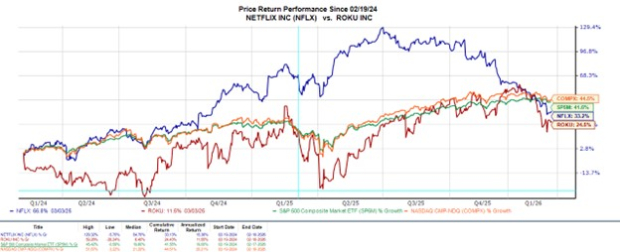
Image Source: Zacks Investment Research
Netflix & Roku Overview Reminder
Netflix and Roku feel like they live in the same universe because both are tied to streaming, but they actually play very different roles in the ecosystem. Think of Netflix as the content, and Roku as the infrastructure that helps you access lots of content.
Netflix is a content creator and subscription streaming service with a moat that comes from exclusive originals with global scale, while Roku is a platform and operating system for streaming devices and smart TVs that aggregates thousands of channels and apps, including Netflix.
Tracking Netflix & Roku’s Expansion
Having a layered strategy revolving around content, technology, pricing, and global reach, Netflix’s annual sales are projected to exceed $50 billion this year. Although Netflix’s captivating growth has begun to slow, a 13% increase is expected from sales of $45.18 billion in 2025. Plus, Netflix’s top line is projected to stretch another 12% in FY27 to $57.22 billion.
One of Netflix’s most impactful recent moves was launching ad-supported subscription plans in multiple countries. Operating in nearly 200 countries, Netflix now has more than 200 million international subscribers and remains the largest global streaming service.
Netflix also remains the frontrunner to expand its streaming services by acquiring Warner Bros. Discovery WBD., even with Paramount Skydance PSKY getting a new window to make its best and final offer.
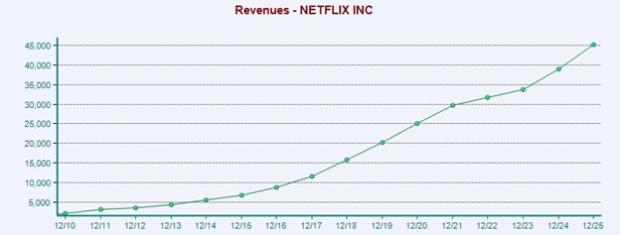
Image Source: Zacks Investment Research
Similarly, Roku’s rise has been attributed to a blended strategy that includes advertising growth and international expansion, lifting its strategic positioning in the streaming ecosystem. Carving out a unique niche as a neutral platform that isn’t tied to a single content ecosystem, Roku is referred to as the “Switzerland” of streaming.
Roku’s neutrality makes its platform and tv’s attractive to both consumers and content providers. To that point, Roku controls about 50% of the streaming operating systems (OS) market. Furthermore, Roku’s biggest growth engine is no longer hardware, with its platform revenue being propelled by advertising partnerships, including with Amazon AMZN.
Roku’s annual sales are projected to be up 16% in FY26 and are forecasted to increase another 13% in FY27 to $6.22 billion.
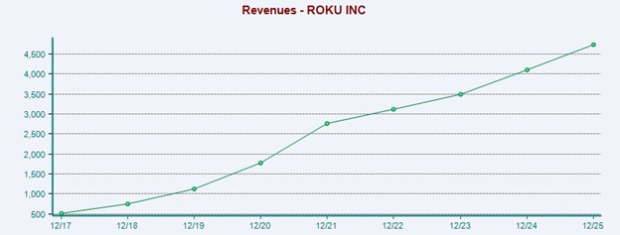
Image Source: Zacks Investment Research
EPS Growth & Revisions
With Netflix being the larger, more mature company, its annual earnings are expected to increase by a respectable 20% for the foreseeable future.
Netflix’s EPS projections are edging toward $4.00, with it noteworthy that the 10-1 stock split lowered its earnings per share but does not impact a company’s actual net income.
However, following Netflix’s stock split, FY26 & FY27 EPS revisions are modestly lower after initially seeing an uptick but falling over the last 30 days. The dip comes as Netflix slightly edged Q4 EPS expectations in January, but the market viewed the quarterly results as somewhat underwhelming.
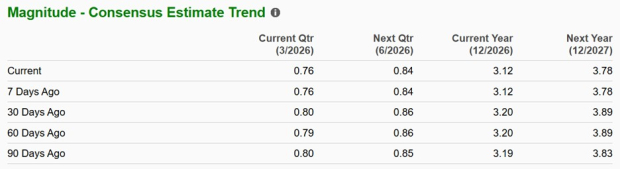
Image Source: Zacks Investment Research
Roku, on the other hand, has seen a compelling trend of positive EPS revisions since crushing its Q4 EPS expectations by an eye-catching 89% last Thursday. In the last week, Roku’s FY26 and FY27 EPS estimates have skyrocketed 60% and 39%, respectively.
Resurging past the probability line after going public in 2017, Roku’s EPS is now expected at $2.03 in FY26, a 244% spike from $0.59 per share last year. Even better, FY27 EPS is now projected to leap another 58% to $3.20.
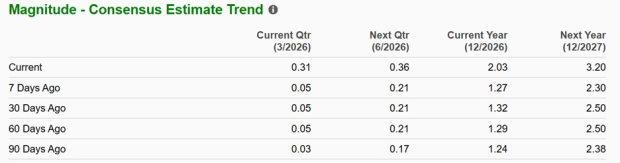
Image Source: Zacks Investment Research
Bottom Line
Long-term investors may still be more inclined to consider Netflix stock at a very reasonable 24X forward earnings multiple compared to Roku’s 43X. That said, Roku's compelling trend of positive EPS revisions does support more short-term upside.
Roku has also grown into what was a much loftier valuation, similar to what Netflix has done in recent years. At the moment, Roku stock sports a Zacks Rank #1 (Strong Buy) with Netflix shares landing a Zack Rank #3 (Hold).
Disclaimer: The content of this article solely reflects the author's opinion and does not represent the platform in any capacity. This article is not intended to serve as a reference for making investment decisions.
You may also like
British Pound extends losing streak against US Dollar, US PPI in focus

Barclays: US-Iran conflict unlikely to end in next 12 months, oil exports near 85% of pre-war level

Jensen Huang's sudden resignation shrouded in suspicion: Did the White House secretly intervene? Is a return possible in the future?
Only a few days separated Jensen Huang’s strong support from the board last Sunday and his late-night resignation on Wednesday. Multiple reports of the Wednesday night Nvidia board meeting were co-authored by Washington-based journalists—who do not typically cover Nvidia—fueling rumors of "White House pressure and information leaks." Huang’s unique value lies in leveraging his personal reputation to secure the supply chain and drive the implementation of technological roadmaps, making him difficult to replace. Some analysts note that, drawing on examples such as Steve Jobs’ return to Apple, it is possible that Huang may come back in the future.
Gold recovers from YTD low, retakes $3,900; Fed hike bets and bullish USD to cap gains
Crypto prices
More


