
ECB targets 2027 digital euro pilot as provider selection begins in Q1 2026

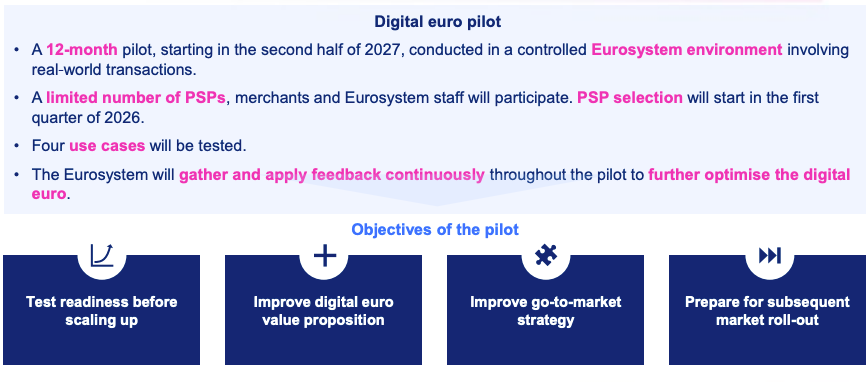
The European Central Bank (ECB) is moving closer to a pilot for a digital euro, with Executive Board member Piero Cipollone outlining plans to begin selecting payment service providers (PSPs) in early 2026 ahead of a 12-month test scheduled for the second half of 2027.
Cipollone on Wednesday held an executive committee meeting of the Italian Banking Association. He said the pilot would involve a limited number of payment service providers, merchants and Eurosystem staff. Selection of participating providers is expected to start in the first quarter of 2026.
Cipollone said the digital euro will be designed to ensure it protects European card schemes and keeps banks at the core of the Eurozone payments system, according to Reuters.
Pilot could give PSPs an early start
European Union-licensed PSPs will be at the core of digital euro distribution, Cipollone said. For participating PSPs, the pilot offers an early-readiness advantage ahead of a potential broader rollout, including hands-on experience with onboarding, settlement and liquidity management.
 Source: ECB
He added that it also provides clearer visibility on future infrastructure, compliance and staffing costs, helping firms plan investments more accurately.
With direct Eurosystem support and the ability to feed into the design process, participants could gain both operational insight and influence over how the digital euro ultimately takes shape.
Stablecoins are not the only threat to banks, says Cipollone
The digital euro pilot is also intended to protect domestic European payment schemes, such as Italy’s Bancomat card network and Spain’s Bizum peer-to-peer system.
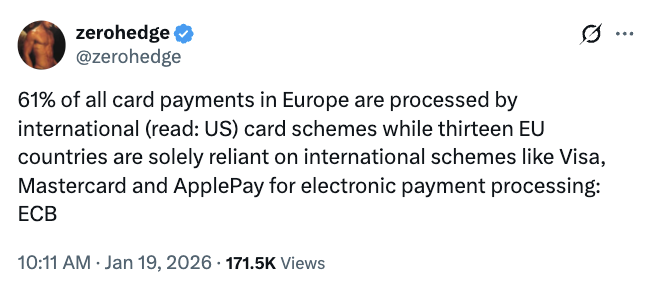
“Banks could lose their role in payments not just because of stablecoins but also due to other private solutions,” Cipollone said, pointing to Europe’s heavy reliance on international card networks like Visa and Mastercard.
 Source:
He added that the digital euro would be structured to preserve the competitiveness of local schemes.
“The cap on the fee that merchants will pay on the digital euro network will be lower than what the international payments network, normally the costlier, charge, but higher than what domestic payments scheme, normally the cheapest, charge,” Cipollone said.
Cointelegraph contacted the ECB for comment on the PSP selection but had not received a response by publication.
Related: Lagarde early exit report puts ECB succession and digital euro in focus
The news marks a milestone in the digital euro pilot after the ECB officially moved to the next phase of the project in October 2025, targeting a launch in 2029.
The central bank then projected that a pilot exercise could start in 2027 if legislation is put in place during the course of 2026.
Magazine: Is China hoarding gold so yuan becomes global reserve instead of USD?
Disclaimer: The content of this article solely reflects the author's opinion and does not represent the platform in any capacity. This article is not intended to serve as a reference for making investment decisions.
You may also like
Barclays: US-Iran conflict unlikely to end in next 12 months, oil exports near 85% of pre-war level

Jensen Huang's sudden resignation shrouded in suspicion: Did the White House secretly intervene? Is a return possible in the future?
Only a few days separated Jensen Huang’s strong support from the board last Sunday and his late-night resignation on Wednesday. Multiple reports of the Wednesday night Nvidia board meeting were co-authored by Washington-based journalists—who do not typically cover Nvidia—fueling rumors of "White House pressure and information leaks." Huang’s unique value lies in leveraging his personal reputation to secure the supply chain and drive the implementation of technological roadmaps, making him difficult to replace. Some analysts note that, drawing on examples such as Steve Jobs’ return to Apple, it is possible that Huang may come back in the future.

Gold recovers from YTD low, retakes $3,900; Fed hike bets and bullish USD to cap gains
Crypto prices
More


