
Robinhood Launches $1B Fund To Give Retail Investors Access To Space X, Stripe

Robinhood (NASDAQ:HOOD) has launched a $1 billion closed-end fund IPO, giving retail investors access to pre-IPO companies including SpaceX, Databricks, and Stripe.
The $1 Billion Fund Structure
Robinhood Ventures Fund I is raising $1 billion by selling 40 million shares at $25 each—35 million from the fund and 5 million from Robinhood, according to Bloomberg.
Investors can request shares starting February 17, with trading beginning February 26.
The fund already owns stakes in AI software firm Databricks, smart ring maker Oura Health, and UK fintech Revolut.
Additionally, it has agreed to invest in payments giant Stripe. These are the exact companies institutions have access to but retail investors normally don’t.
Instead of waiting years for SpaceX or Databricks to go public, investors can buy shares of this fund that already owns pieces of them. When those companies eventually IPO or get sold, the fund’s value reflects it.
The Fee Structure
The fund charges a 2% management fee, reduced to 1% for the first six months after IPO.
No performance or carry fees apply, and there’s no minimum investment requirement. The fund won’t pay regular dividends and only considers distributions if excess cash exists in the portfolio.
However, closed-end funds come with risks. Unlike mutual funds, these vehicles don’t continuously create or redeem shares.
Prices can trade at premiums or discounts to underlying asset value based on sentiment and liquidity rather than fundamental worth.
“Investors need to remember they’re buying a vehicle that will trade on sentiment, liquidity and supply-demand dynamics — not just underlying net asset value,” said John Cole Scott, president of CEF Advisors.
“That discount or premium can become the story,” he further added.
The Market Context
Since 2019, only 46 new closed-end funds have launched. This year marked the first such IPO since 2022, raising just $53 million—showing how dormant this market has been.
Billionaire Bill Ackman sought to raise $5 billion for a closed-end fund but faced tepid demand.
Robinhood continues expanding retail access to private markets.
In June, the firm offered tokenized equities in Europe and launched a limited giveaway of equity tokens tied to OpenAI and SpaceX.
The Technical Crisis
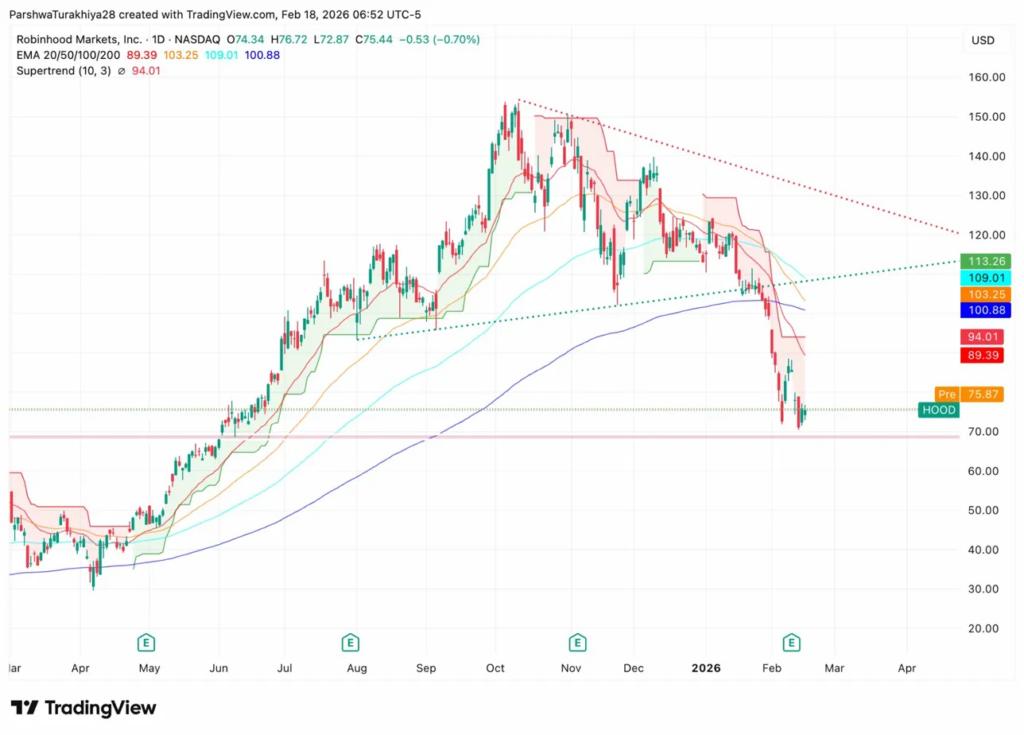
HOOD closed down 0.70% on Tuesday, hovering dangerously close to critical $70-$72 support.
All moving averages sit well above price: 20 EMA at $89.39, 50 EMA at $103.25, 100 EMA at $109.01, and 200 EMA at $100.88.
Meanwhile, the Supertrend at $94.01 remains firmly bearish.
An ascending trendline from lows provides long-term support around $72-$75, but the stock tests this zone now.
Breaking below $70-$72 would be catastrophic, likely triggering a cascade toward $60 with no meaningful support between.
For reversal, HOOD needs to reclaim $89 and the Supertrend at $94.
Image: Shutterstock
Disclaimer: The content of this article solely reflects the author's opinion and does not represent the platform in any capacity. This article is not intended to serve as a reference for making investment decisions.
You may also like
Jensen Huang's sudden resignation shrouded in suspicion: Did the White House secretly intervene? Is a return possible in the future?
Only a few days separated Jensen Huang’s strong support from the board last Sunday and his late-night resignation on Wednesday. Multiple reports of the Wednesday night Nvidia board meeting were co-authored by Washington-based journalists—who do not typically cover Nvidia—fueling rumors of "White House pressure and information leaks." Huang’s unique value lies in leveraging his personal reputation to secure the supply chain and drive the implementation of technological roadmaps, making him difficult to replace. Some analysts note that, drawing on examples such as Steve Jobs’ return to Apple, it is possible that Huang may come back in the future.
Gold recovers from YTD low, retakes $3,900; Fed hike bets and bullish USD to cap gains
Cerebras (CBRS.US) Cloud Business Soars, Masking Hardware Decline; OpenAI Supports Half of Cloud Revenue
Cerebras achieved record Q3 revenue, but hardware income dropped by nearly 30%, while cloud business accounted for two-thirds of total revenue. OpenAI contributed $72.4 million. The company raised its full-year guidance and expects Q4 to be close to breakeven.
Crypto prices
More


