
JPMorgan Trading Desk: The "sell first, ask questions later" AI stock sell-off in the US market is coming to an end; it's time to buy software stocks

In recent weeks, the core trading logic of the US stock market has been simplified into a suffocating narrative—“AI replacement risk.” This intense fear of being “eliminated by AI” has triggered dramatic turbulence in the financial and industrial sectors, leading to a frenzy of capital pouring into semiconductors, while software has been indiscriminately subjected to a “sell first, ask later” approach.
However, in its latest report on February 17, the JP Morgan trading desk believes that this extreme emotional outburst is nearing its end. The team is seizing the upcoming rebound opportunity by taking contrarian positions in oversold software stocks and assets “immune to AI disruption”:
“Although the short-term market structure remains unchanged, the narrative of ‘AI replacement’ is nearing its end, which means the window for bottom-fishing large-cap tech stocks has opened.”
The Market Has Overreacted Across Multiple Sectors
JP Morgan’s positioning intelligence team has observed that, in the current US stock market, the semiconductor sector’s position crowding has reached +4 standard deviations (+4z), while the software sector has sunk to a low of -3.5 standard deviations (-3.5z). The position difference between the two industries has reached a historic extreme.
Year to date, the return from longing semiconductors and shorting software has reached about 34.9%. This divergence stems from a linear mindset among investors: AI computing power is the sole winner, and traditional software will be completely disrupted.
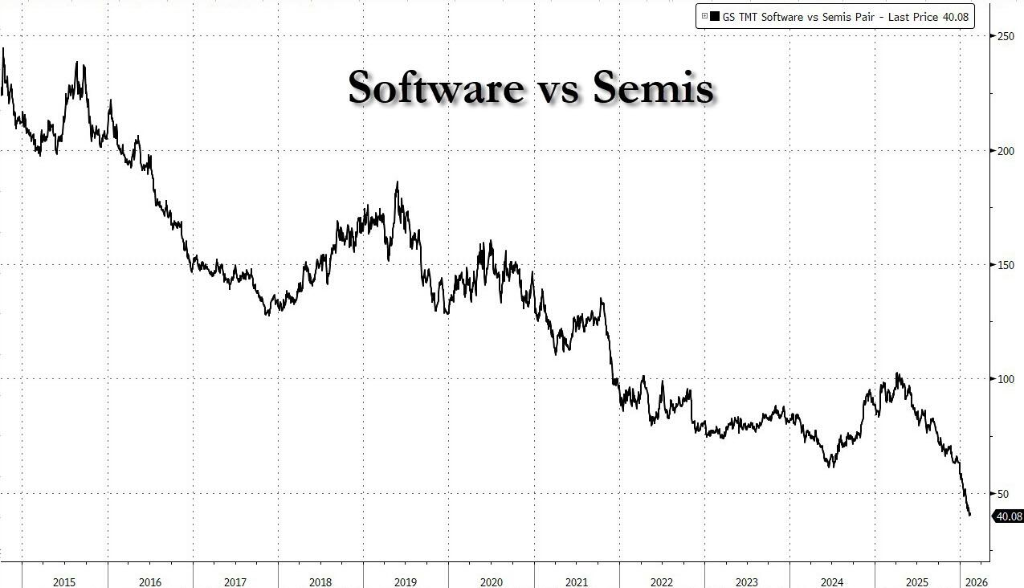
In their latest report, JP Morgan’s sector analysts conducted an in-depth breakdown of this wave of AI-driven sell-offs, concluding that the market has clearly overreacted in several areas:
1. Software Industry: An “Undisprovable Negative Logic”
Analyst Mark Murphy points out that the current dilemma is that software companies find it hard to “prove their innocence”—that is, to prove that AI will not disrupt them in the coming years. Although sector growth has slowed due to macroeconomic headwinds, given that valuations have already pulled back significantly, investors are advised to adopt a “barbell strategy”: on one hand, allocate to top-tier software companies supported by strong free cash flow (FCF); on the other hand, avoid targets with excessive valuations.
2. Wealth Management & Life Sciences: Profit Expansion vs. Short-term Risks
Last week, large bank stocks (JP2LBK Index) fell 6%, and M&A brokers plunged 7%. However, fundamental feedback was the opposite: loan growth is healthy, and the M&A and IPO pipelines are robust. Analyst Rob O’Dwyer believes that the market underestimates the value of “human relationships” in wealth management. In reality, for wealth management institutions, AI is more likely to be a tool to enhance profit margins rather than a killer of client relationships.
Turning to the life sciences tools sector, this is currently an area where risks are more clearly defined. CRO companies (such as MEDP) have admitted that pharmaceutical clients are using AI internally to boost productivity, which may reduce their demand for outsourced services. This could be one of the few sectors where the negative AI narrative holds true.
3. Logistics & Transportation: Panic Over AI “Disintermediation”
The logistics sector has been a hard-hit area of recent AI panic. After competitor Algorhythm Holdings announced that its AI platform, SemiCab, can greatly improve freight scheduling efficiency (one operator can handle 2,000 orders, four times that of a traditional broker), US freight giant CHRW’s stock price plummeted 25%, dragging down global peers such as DSV and DHL by about 10%.
JP Morgan analyst Alexia Dogani is skeptical of this. She points out that freight forwarding involves the integration of complex physical infrastructure, and current digitalization is extremely low. While AI can improve efficiency, it cannot overcome physical barriers to achieve complete “disintermediation” in the short term.
4. Japanese Market: AI Unlikely to Replace Outsourcing in the Short Term
The same logic applies to the Japanese IT services market.
Analyst Matthew Henderson notes that large Japanese enterprises are highly dependent on system integrators (SIers) and face severe talent shortages. In this structurally deadlocked scenario, AI will not replace outsourcing; instead, it will become a tool to alleviate talent shortages and enhance SIers’ profit margins.
Bottom Fishing for Software Stocks?
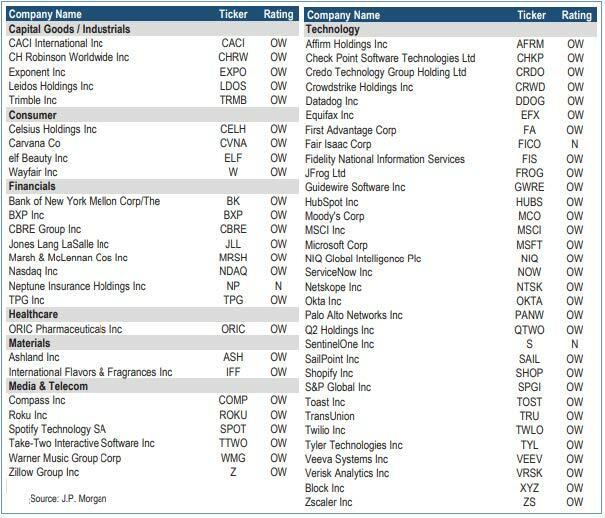
The JP Morgan trading team writes in the report that although the short-term market structure remains unchanged, the narrative of “AI replacement” is nearing its end, which means the window for bottom-fishing large-cap tech stocks has opened. Their specific trading strategy recommendations are as follows:
-
Core themes: Continue to be bullish on AI/TMT, a global growth restart, international market opportunities, and the US dollar depreciation trade.
-
Hedging risk: It is recommended to go long on crude oil and energy stocks to hedge geopolitical risks; buy volatility (Vol); and short the momentum factor (Momentum).
-
Own operations: The trading desk is executing a long strategy, going long a basket of stocks that are “seriously mispriced and immune to AI disruption.”
Disclaimer: The content of this article solely reflects the author's opinion and does not represent the platform in any capacity. This article is not intended to serve as a reference for making investment decisions.
You may also like
Jensen Huang's sudden resignation shrouded in suspicion: Did the White House secretly intervene? Is a return possible in the future?
Only a few days separated Jensen Huang’s strong support from the board last Sunday and his late-night resignation on Wednesday. Multiple reports of the Wednesday night Nvidia board meeting were co-authored by Washington-based journalists—who do not typically cover Nvidia—fueling rumors of "White House pressure and information leaks." Huang’s unique value lies in leveraging his personal reputation to secure the supply chain and drive the implementation of technological roadmaps, making him difficult to replace. Some analysts note that, drawing on examples such as Steve Jobs’ return to Apple, it is possible that Huang may come back in the future.
Gold recovers from YTD low, retakes $3,900; Fed hike bets and bullish USD to cap gains
Cerebras (CBRS.US) Cloud Business Soars, Masking Hardware Decline; OpenAI Supports Half of Cloud Revenue
Cerebras achieved record Q3 revenue, but hardware income dropped by nearly 30%, while cloud business accounted for two-thirds of total revenue. OpenAI contributed $72.4 million. The company raised its full-year guidance and expects Q4 to be close to breakeven.
Crypto prices
More


