Bitcoin has struggled to regain its footing above $72,000 and continues to hover below this key resistance level. Despite institutional players like BitMine ETH and Strategy maintaining their accumulation of BTC, persistent negative market sentiment is casting doubt on the durability of these trends. Mounting geopolitical tensions, particularly out of Iran, are stoking volatility and providing the backdrop for continued sell-offs across the cryptocurrency market.
Mounting Geopolitical Uncertainty Pressures Crypto Prices
Iran’s Foreign Ministry made headlines by announcing that—at least in principle—agreements had been reached in ongoing negotiations and that the process was advancing. While Iran appears eager to secure a nuclear deal, it remains reluctant to include its missile arsenal in any formal pact. Meanwhile, former U.S. President Donald Trump expressed optimism about a potential breakthrough. Yet, the situation is awash in uncertainty, and as long as a concrete agreement remains elusive, markets are likely to remain on edge, especially given Trump’s unpredictable tendencies.
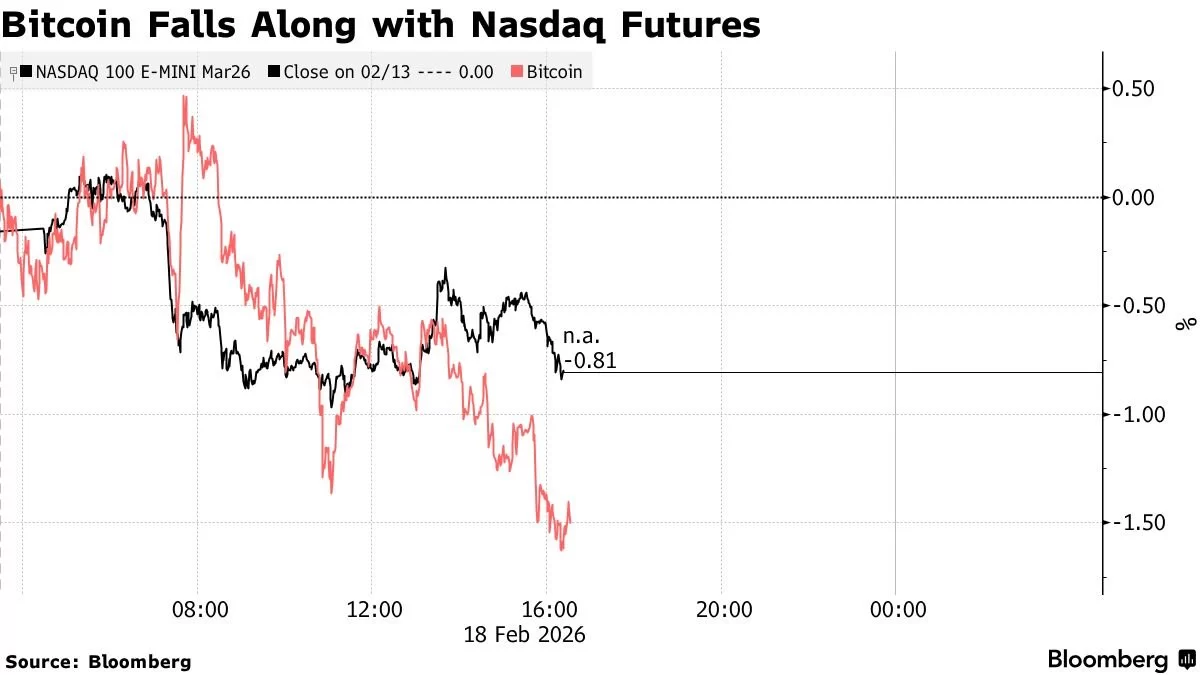
Ahead of U.S. market open, Bitcoin tracked declines in U.S. equity futures, sliding 1.7% to $67,600. The dip mirrored ongoing weakness in the futures market, with persistent debates around AI and continued ambiguity over Federal Reserve interest rate policy weaving into broader geopolitical nerves—none of which is creating a welcoming backdrop for Bitcoin bulls.
Market commentator DeItaone noted that flows across crypto exchanges have turned sharply negative, and investors are closely watching as uncertainty compounds within the sector.
“The flows remain negative: U.S.-listed Bitcoin ETFs saw $360 million in outflows last week, marking the fourth consecutive week of net withdrawals. With the CryptoQuant Fear and Greed Index sitting at 10—indicative of extreme fear—market sentiment is weak.
Several analysts say Bitcoin may enter a consolidation phase with $60,000 acting as key support. However, any further macroeconomic shock could drive prices back to the $50,000 range.”
Stablecoin Dominance Signals Growing Risk Aversion
Earlier signs had pointed to shrinking USDT reserves and a sustained net outflow from Binance, the world’s largest crypto exchange. Evidence suggests investors have not only been reducing risk but are actually cashing out of cryptocurrencies altogether, having shifted to a risk-off posture some time ago. The latest charts reinforce this trend: CryptoBullet, sharing a chart on USDT dominance, predicted further increases. A rising USDT dominance often signals growing risk aversion in the market, pointing to steeper sell-offs across Bitcoin and other digital assets.
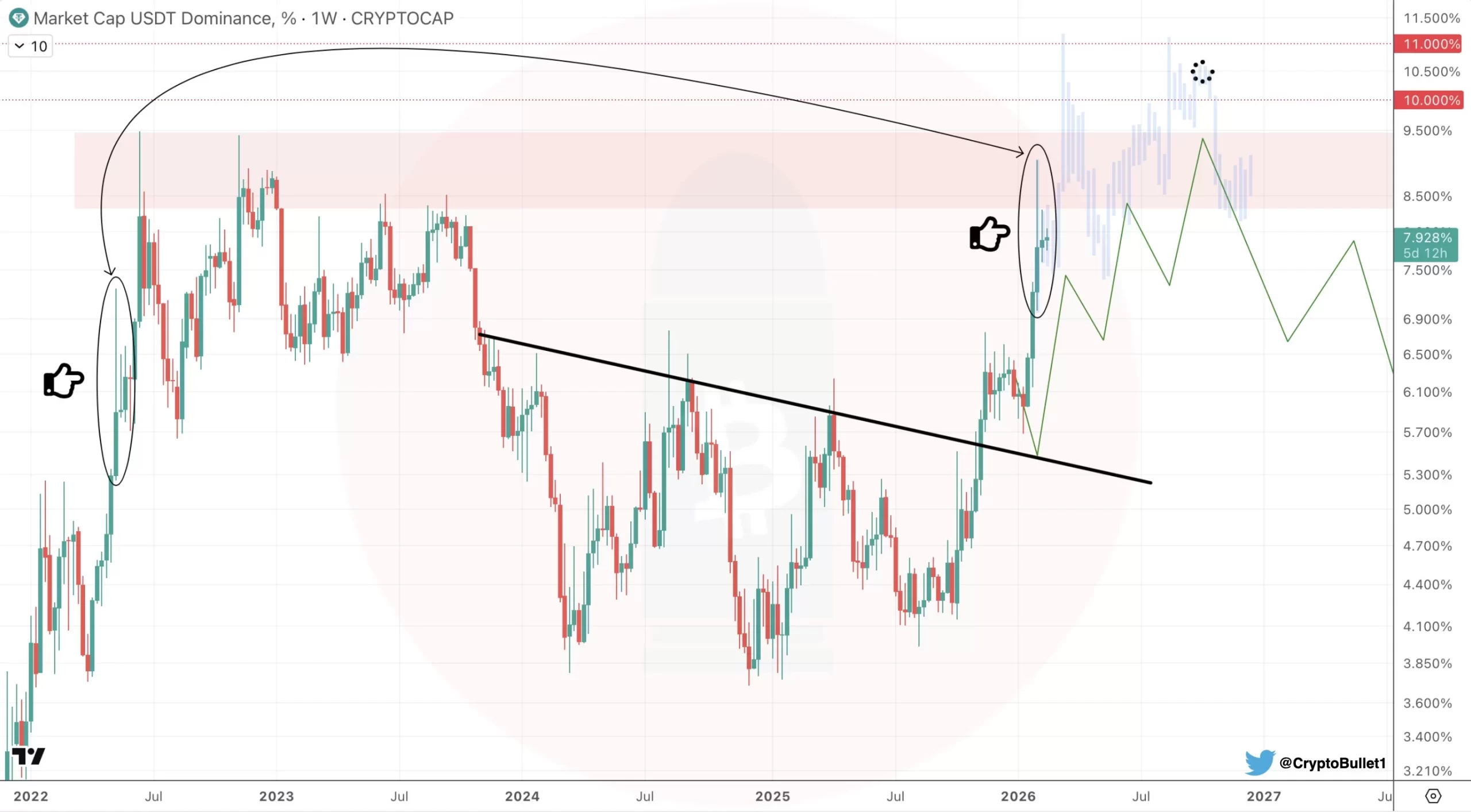
“Looking at the weekly chart of USDT dominance, it feels reminiscent of May 2022. In the first week of February 2026, USDT.D printed a similar long upper-wick green candle. My projection is that, within the next three months, this wick fills in and USDT dominance rises even further—potentially entering my 10-11% peak target zone.”
Speculation is mounting that if the wave of fear and market caution persists, further capital outflows from riskier crypto assets toward stable assets like USDT will accelerate. Such a move could push the price of Bitcoin and its peers into even deeper correction territory. Analysts now see $60,000 as a critical support level for Bitcoin, with $50,000 looming as a possible target should external macroeconomic shocks or escalating geopolitical rifts intensify.
The continued surge in stablecoin dominance illustrates just how cautious market participants have become. While some observers still see strategic accumulation by a handful of institutional actors, the broader pattern suggests general risk aversion and a “wait-and-see” approach in the face of headline risk—from geopolitics to evolving monetary policy.
Meanwhile, the uncertainty enveloping both crypto and traditional finance is forcing investors to constantly reassess their exposure to digital assets. The prevailing winds suggest nervousness will linger unless concrete diplomatic progress can be demonstrated and macroeconomic outlooks stabilize. For now, market sentiment remains highly sensitive to any sign of escalation or relief.