
Crypto investor sentiment will rise once CLARITY Act is passed: Bessent

Passing the CLARITY crypto structure bill could improve market sentiment amid the ongoing downturn, according to United States Treasury Secretary Scott Bessent.
The stalling of the CLARITY bill over concerns voiced by crypto industry executives has negatively impacted the industry, Bessent told CNBC on Friday. He said:
“In a time when we are having one of these historically volatile sell-offs, I think some clarity on the CLARITY bill would give great comfort to the market, and we could move forward from there.
I think if the Democrats were to take the House, which is far from my best case, then the prospects of getting a deal done will just fall apart,” Bessent continued.
 Bessent discusses the importance of passing the CLARITY crypto market structure bill ahead of the 2026 US midterm elections. Source:
CNBC
He said that getting the bill passed “as soon as possible” and sent to US President Donald Trump for signature by spring, which occurs between late March and late June in the US, is important, given the potential shift in the balance of power in the 2026 midterm elections.
Related: White House officials met with crypto, banking reps to discuss stablecoins
The 2026 midterm elections could throw a wrench in Trump’s crypto agenda
The balance of power typically shifts in US midterm election years, Joe Doll, the former general counsel at non-fungible token (NFT) marketplace Magic Eden, told Cointelegraph.
“President Trump has a two-year unimpeded mandate that can be weakened greatly in the 2026 mid-term elections and reversed in the 2028 elections,” economist Ray Dalio said in January.
This potential political shift could reverse the Trump administration’s pro-crypto policies, if they are not codified into law, Dalio warned.
The Republican Party holds a slim four-seat majority in the US House of Representatives, with 218 seats compared to 214 seats held by the Democratic Party, according to data from the US House.
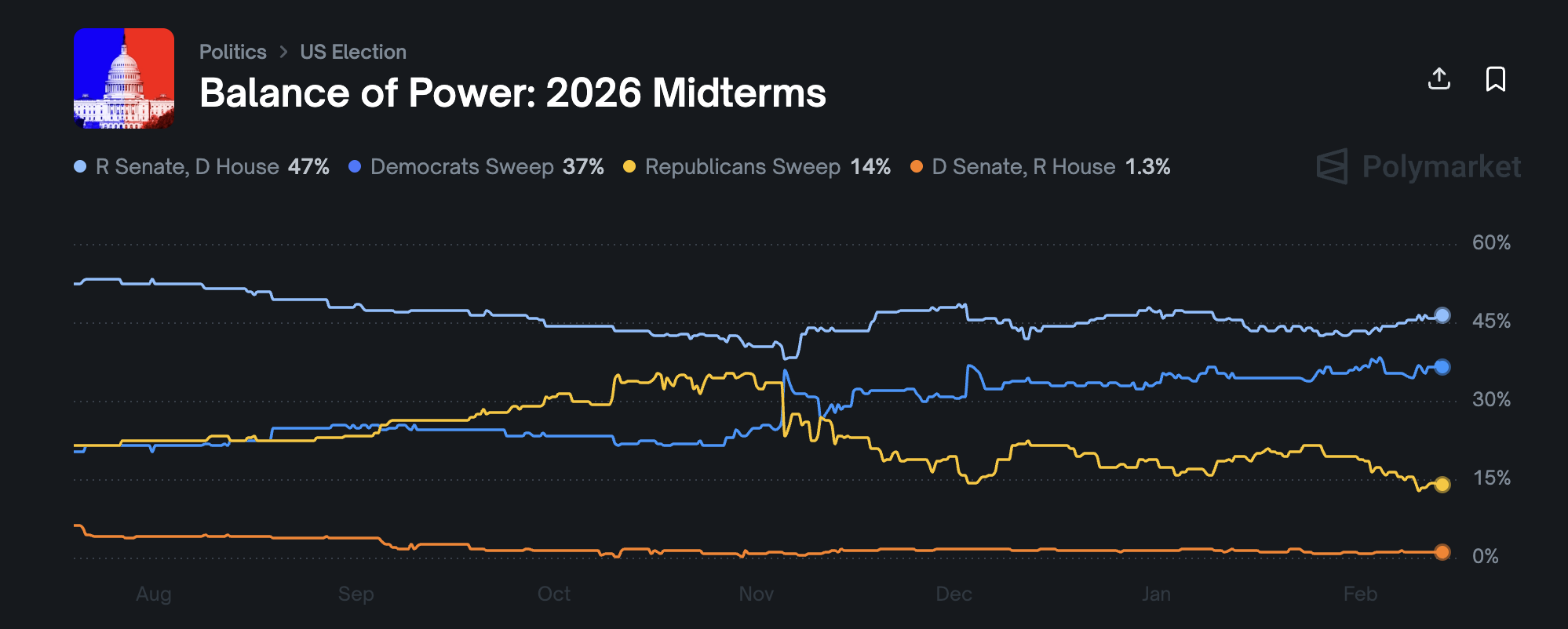 Polymarket 2026 US midterm election odds. Source:
Polymarket
47% of traders on the prediction market Polymarket project that power will be split in the 2026 midterms, with each political party taking control of one chamber of Congress.
The Polymarket odds of a full sweep by the Democratic Party, meaning they claim a majority in both chambers, is 37% at the time of this writing.
Magazine: Crypto wanted to overthrow banks, now it’s becoming them in stablecoin fight
Disclaimer: The content of this article solely reflects the author's opinion and does not represent the platform in any capacity. This article is not intended to serve as a reference for making investment decisions.
You may also like
MSTR stock falls 6.8% in 2026 despite Strategy’s $20.9B Q3 income – Why?

Bank of Japan shifts to “anti-inflation” mode! Kazuo Ueda hints at further room for rate hikes, December move under watch
The Bank of Japan kept its policy rate unchanged at 1.25% on Friday, but Governor Kazuo Ueda's remarks at the post-meeting press conference sent policy signals that are more noteworthy than the rate decision itself.

Betting Big on AI Burns Through Cash Cows—This Time, the Market No Longer "Rewards Burning Money"!
The AI spending race faces profitability scrutiny: Google’s search advertising growth rate has dropped to its lowest in five quarters, and Amazon’s single-quarter free cash flow has plunged to -$33.5 billion. Yet both companies continue with capital expenditure plans exceeding $400 billion. As their core cash-generating businesses lose momentum and debt and financing needs surge, the market is shifting from rewarding AI investment to questioning returns, forcing a re-evaluation of the valuation logic for tech giants.

Wall Street Sees AWS’s Ambition, But Can’t See the Future of Amazon’s Advertising Business
Amazon's Q3 financial report presents a mixed picture: AWS order backlog soared by 189% to $578 billion, and the CEO made the rare promise that growth will exceed 40% in 2027-2028, aiming for $1 trillion in revenue within five to ten years. However, advertising business growth plunged from 26% to 12%, and capital expenditure reached $77.3 billion, far exceeding expectations, causing the stock price to fall 7% after hours. While major Wall Street banks collectively maintain their “buy” ratings, they admit that the structural risks posed by AI agents to the advertising ecosystem remain unresolved.
Crypto prices
More


