
Ingersoll Rand (NYSE:IR) Posts Better-Than-Expected Sales In Q4 CY2025

Industrial manufacturing company Ingersoll Rand (NYSE:IR) reported Q4 CY2025 results
Is now the time to buy Ingersoll Rand?
Ingersoll Rand (IR) Q4 CY2025 Highlights:
- Revenue: $2.09 billion vs analyst estimates of $2.04 billion (10.1% year-on-year growth, 2.6% beat)
- Adjusted EPS: $0.96 vs analyst estimates of $0.90 (6.6% beat)
- Adjusted EBITDA: $580.1 million vs analyst estimates of $560.3 million (27.7% margin, 3.5% beat)
- Adjusted EPS guidance for the upcoming financial year 2026 is $3.51 at the midpoint, missing analyst estimates by 1.3%
- EBITDA guidance for the upcoming financial year 2026 is $2.16 billion at the midpoint, below analyst estimates of $2.19 billion
- Operating Margin: 18.7%, down from 20% in the same quarter last year
- Free Cash Flow Margin: 25.7%, similar to the same quarter last year
- Market Capitalization: $38.23 billion
“Against the backdrop of a complex global environment, we delivered strong growth, earnings, and free cash flow, reflecting the resilience and execution strength of our portfolio,” said Vicente Reynal, chairman and chief executive officer of Ingersoll Rand.
Company Overview
Started with the invention of the steam drill, Ingersoll Rand (NYSE:IR) provides mission-critical air, gas, liquid, and solid flow creation solutions.
Revenue Growth
A company’s long-term performance is an indicator of its overall quality. Any business can have short-term success, but a top-tier one grows for years. Over the last five years, Ingersoll Rand grew its sales at a mediocre 7.3% compounded annual growth rate. This fell short of our benchmark for the industrials sector and is a poor baseline for our analysis.
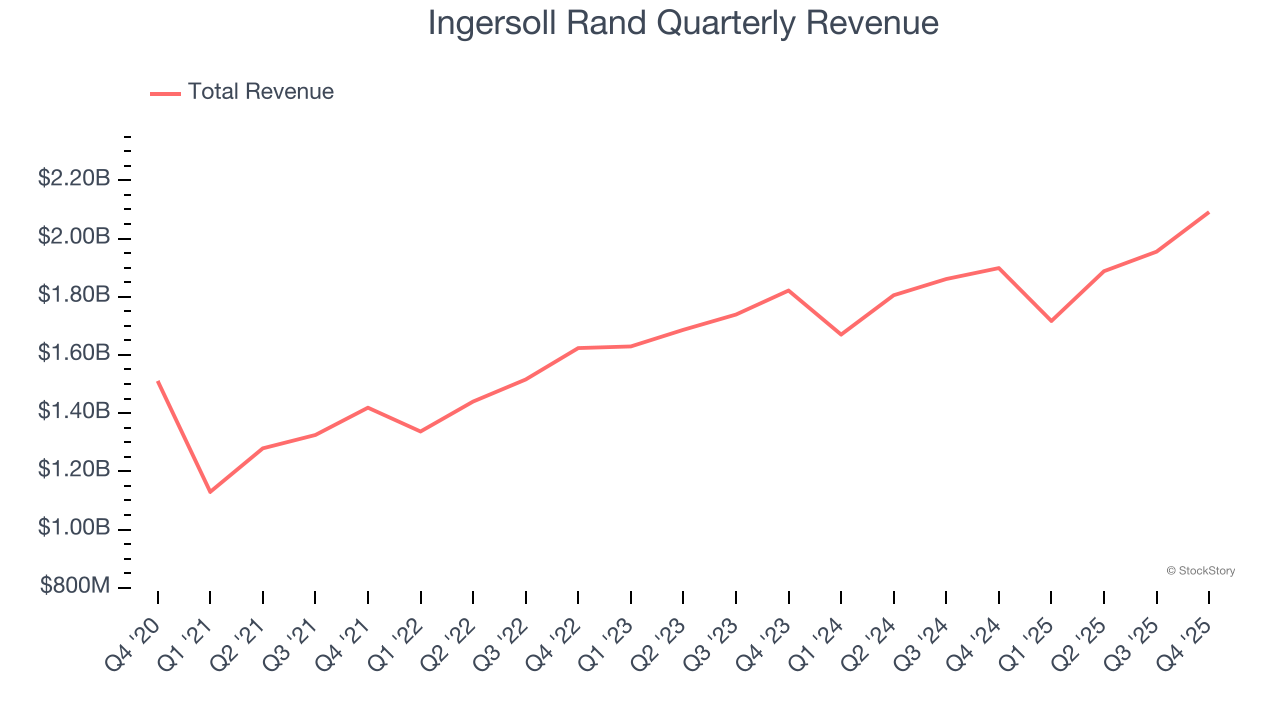
Long-term growth is the most important, but within industrials, a half-decade historical view may miss new industry trends or demand cycles. Ingersoll Rand’s recent performance shows its demand has slowed as its annualized revenue growth of 5.5% over the last two years was below its five-year trend. We’re wary when companies in the sector see decelerations in revenue growth, as it could signal changing consumer tastes aided by low switching costs.
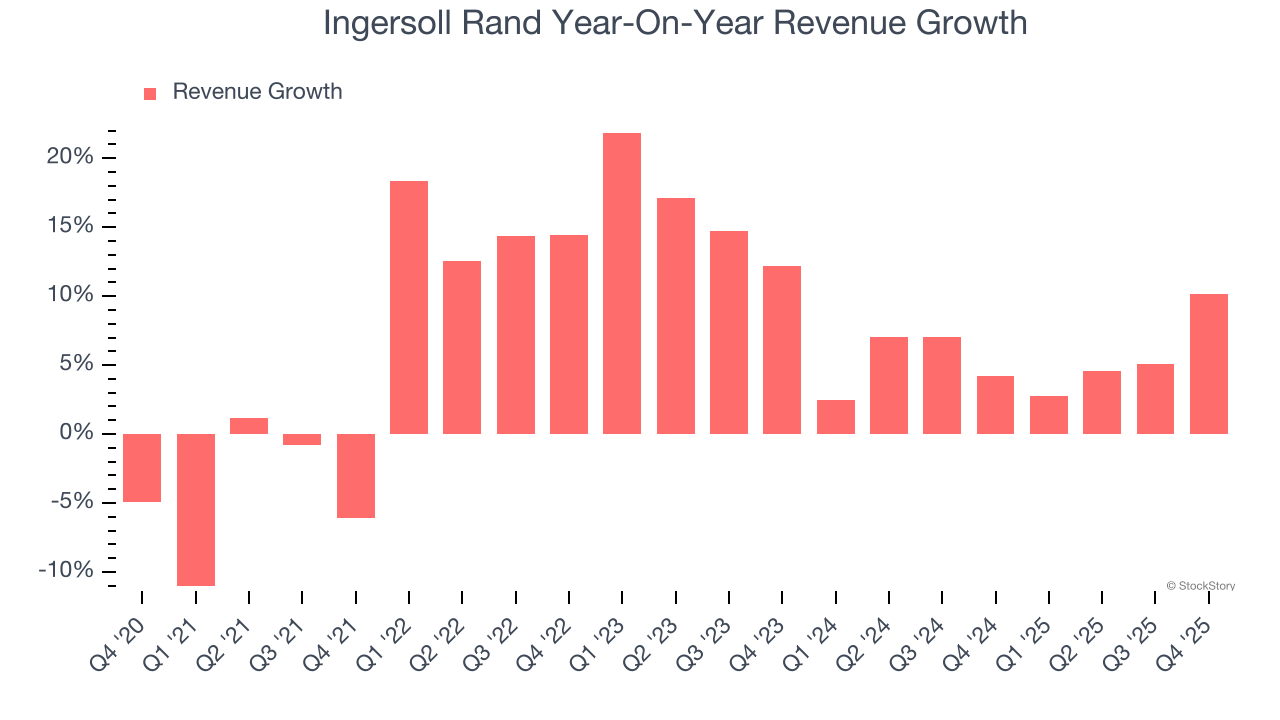
This quarter, Ingersoll Rand reported year-on-year revenue growth of 10.1%, and its $2.09 billion of revenue exceeded Wall Street’s estimates by 2.6%.
Looking ahead, sell-side analysts expect revenue to grow 4.1% over the next 12 months, similar to its two-year rate. This projection is underwhelming and implies its products and services will see some demand headwinds.
Software is eating the world and there is virtually no industry left that has been untouched by it. That drives increasing demand for tools helping software developers do their jobs, whether it be monitoring critical cloud infrastructure, integrating audio and video functionality, or ensuring smooth content streaming.
Operating Margin
Operating margin is an important measure of profitability as it shows the portion of revenue left after accounting for all core expenses – everything from the cost of goods sold to advertising and wages. It’s also useful for comparing profitability across companies with different levels of debt and tax rates because it excludes interest and taxes.
Ingersoll Rand has been an efficient company over the last five years. It was one of the more profitable businesses in the industrials sector, boasting an average operating margin of 15.2%. This result isn’t surprising as its high gross margin gives it a favorable starting point.
Analyzing the trend in its profitability, Ingersoll Rand’s operating margin rose by 4 percentage points over the last five years, as its sales growth gave it operating leverage.
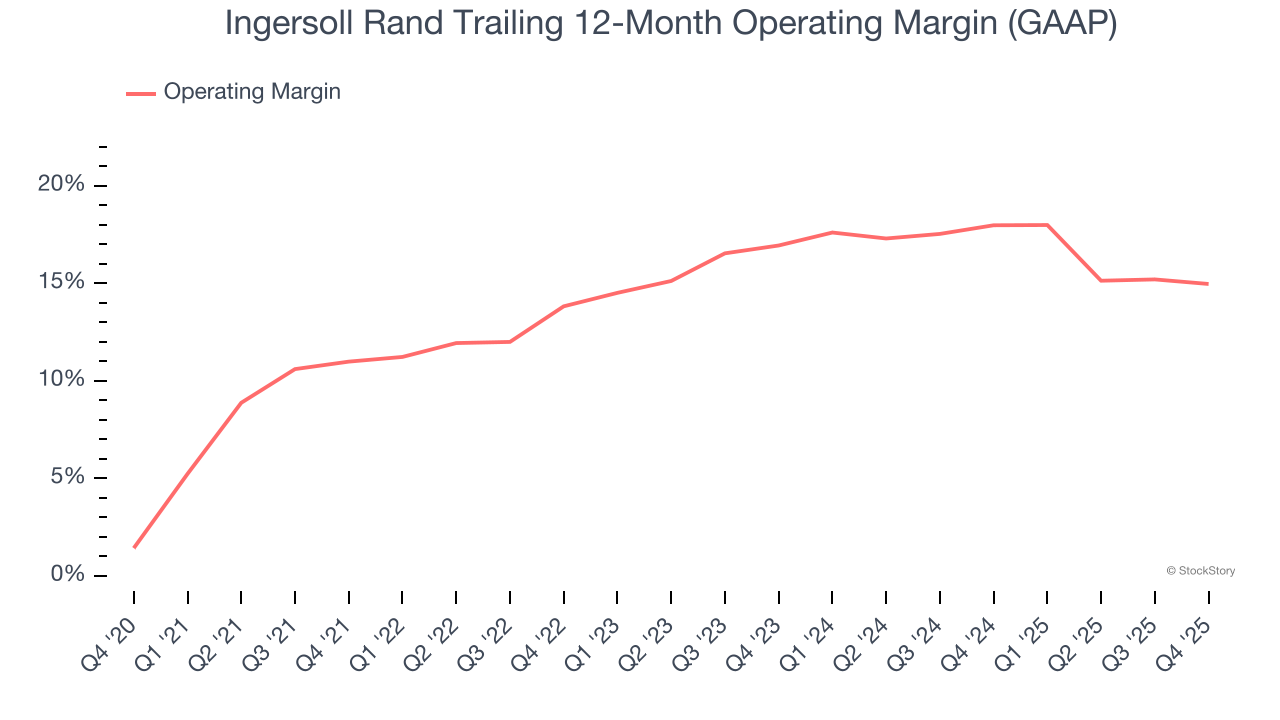
This quarter, Ingersoll Rand generated an operating margin profit margin of 18.7%, down 1.3 percentage points year on year. Since Ingersoll Rand’s operating margin decreased more than its gross margin, we can assume it was less efficient because expenses such as marketing, R&D, and administrative overhead increased.
Earnings Per Share
We track the long-term change in earnings per share (EPS) for the same reason as long-term revenue growth. Compared to revenue, however, EPS highlights whether a company’s growth is profitable.
Ingersoll Rand’s EPS grew at an astounding 17.5% compounded annual growth rate over the last five years, higher than its 7.3% annualized revenue growth. This tells us the company became more profitable on a per-share basis as it expanded.
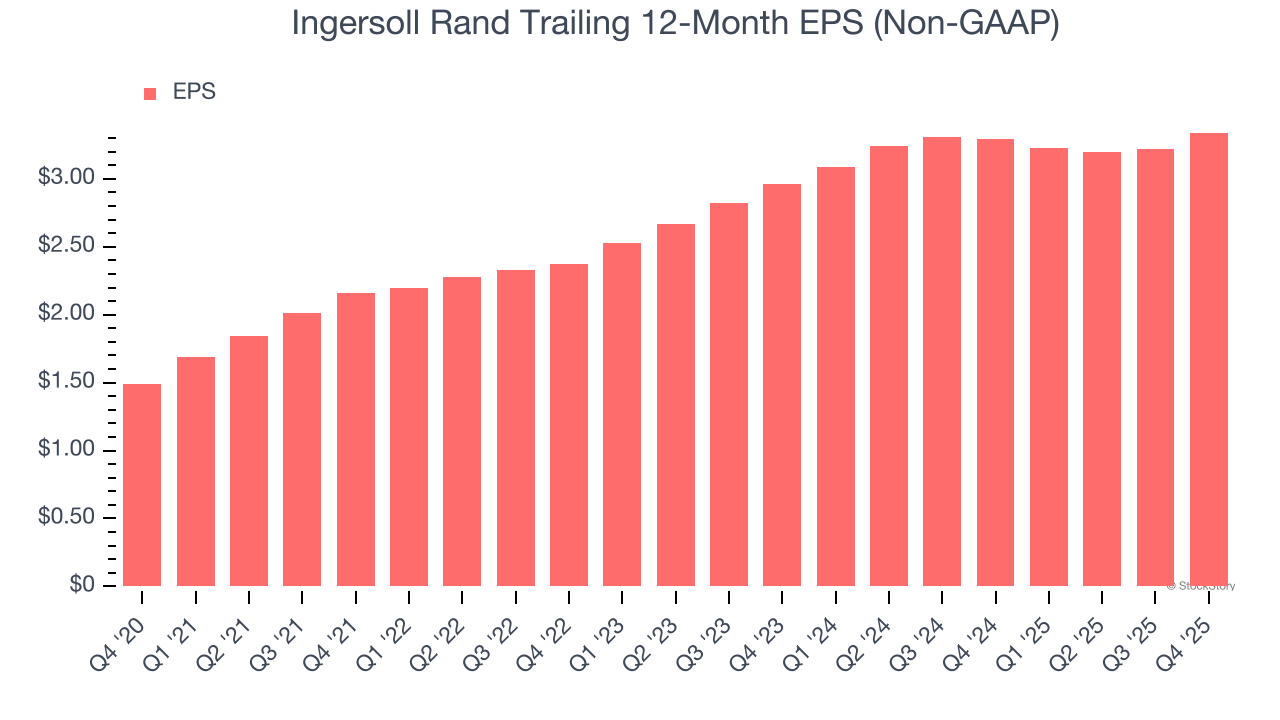
Diving into the nuances of Ingersoll Rand’s earnings can give us a better understanding of its performance. As we mentioned earlier, Ingersoll Rand’s operating margin declined this quarter but expanded by 4 percentage points over the last five years. Its share count also shrank by 6.8%, and these factors together are positive signs for shareholders because improving profitability and share buybacks turbocharge EPS growth relative to revenue growth.
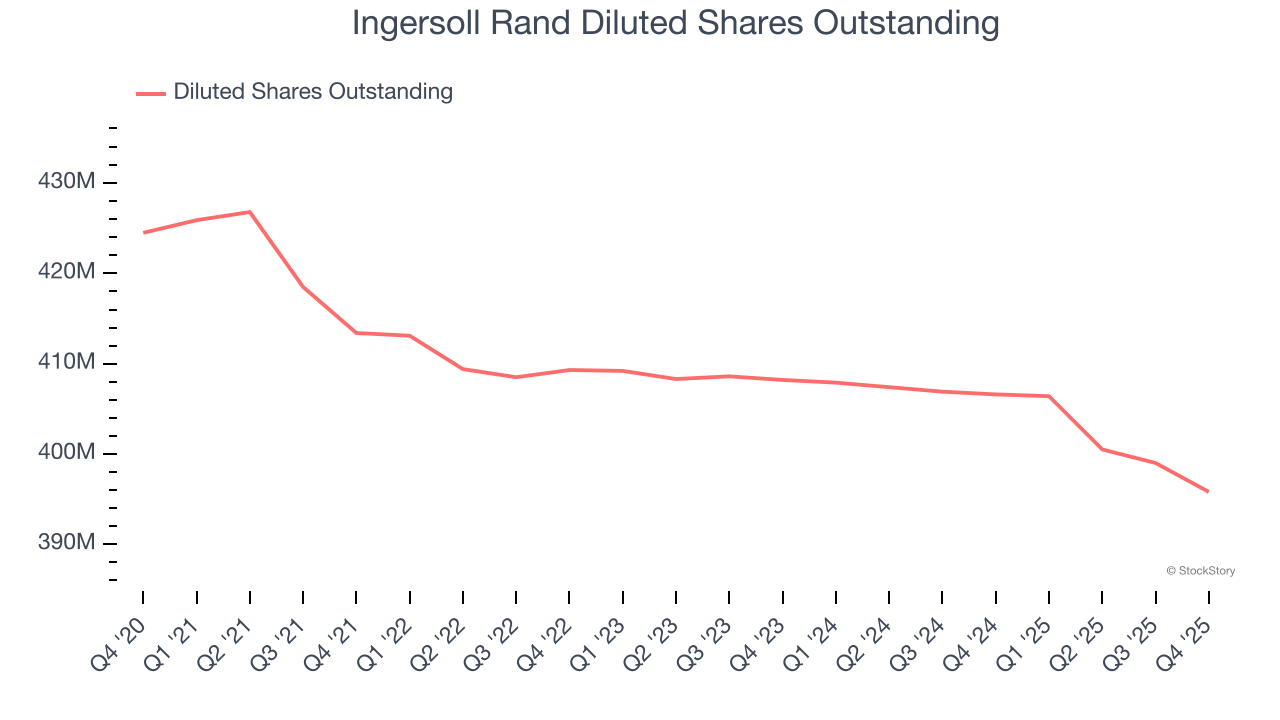
Like with revenue, we analyze EPS over a more recent period because it can provide insight into an emerging theme or development for the business.
For Ingersoll Rand, its two-year annual EPS growth of 6.2% was lower than its five-year trend. We hope its growth can accelerate in the future.
In Q4, Ingersoll Rand reported adjusted EPS of $0.96, up from $0.84 in the same quarter last year. This print beat analysts’ estimates by 6.6%. Over the next 12 months, Wall Street expects Ingersoll Rand’s full-year EPS of $3.34 to grow 6.6%.
Key Takeaways from Ingersoll Rand’s Q4 Results
We enjoyed seeing Ingersoll Rand beat analysts’ revenue expectations this quarter. We were also happy its EBITDA outperformed Wall Street’s estimates. On the other hand, its full-year EBITDA guidance slightly missed. Overall, this print had some key positives. The stock traded up 2.7% to $96.89 immediately after reporting.
Sure, Ingersoll Rand had a solid quarter, but if we look at the bigger picture, is this stock a buy? The latest quarter does matter, but not nearly as much as longer-term fundamentals and valuation, when deciding if the stock is a buy.
Disclaimer: The content of this article solely reflects the author's opinion and does not represent the platform in any capacity. This article is not intended to serve as a reference for making investment decisions.
You may also like
Cerebras (CBRS.US) Cloud Business Soars, Masking Hardware Decline; OpenAI Supports Half of Cloud Revenue
Cerebras achieved record Q3 revenue, but hardware income dropped by nearly 30%, while cloud business accounted for two-thirds of total revenue. OpenAI contributed $72.4 million. The company raised its full-year guidance and expects Q4 to be close to breakeven.
Microsoft (MSFT.US) offers voluntary buyout packages to about 60,000 employees: Structural divergence in U.S. employment under AI transformation
In 2026, the U.S. labor market is characterized by both low layoffs and weak hiring. Companies like Microsoft and American Express are leveraging AI to optimize their workforce, while data centers are driving growth in the construction sector. However, entry-level white-collar jobs face increasing pressure, with real wages experiencing negative growth and structural transformation risks becoming more prominent.
"Inflation is really too high"! Federal Reserve "third-in-command": The Fed must continue to take action and promptly bring the price level back to 2%
John Williams, President of the New York Federal Reserve and the “number three” official at the Federal Reserve with a permanent voting right, stated that U.S. inflation remains high and policymakers must take further action to curb price pressures.

Jensen Huang steps down, and the "biggest patron" of new AI players is gone too
Anthropic's tens-of-billions IPO investment, Figure AI's additional $1 billion, and Nscale's over $5 billion credit guarantee are all in negotiations but their outcomes remain uncertain. Meanwhile, its $500 billion AI financing platform has stalled, and some clients are considering switching to AMD or Google. Successor Kress has a conservative style and has repeatedly vetoed deals aggressively promoted by Jensen Huang, signaling the possible end of Nvidia's era of bold investments.
Crypto prices
More


