
TradFi giant Fiserv builds real-time dollar rails for crypto companies

Fiserv, a major US payments and financial technology provider, has launched a new cash settlement platform for digital asset companies, a move that could strengthen fiat infrastructure for crypto players and improve access to liquidity.
On Thursday, Fiserv announced the debut of INDX, a real-time cash settlement system that operates 24 hours a day, 365 days a year. The platform allows digital asset companies to move US dollars instantly using a single custodial account, potentially improving how exchanges, trading desks and other crypto businesses manage fiat balances.
 Source:
Fiserv
INDX will be made available to more than 1,100 insured financial institutions participating in the Fiserv Deposit Network. The account structure provides up to $25 million in Federal Deposit Insurance Corporation (FDIC) coverage, according to the company.
The launch is notable because many digital asset companies still rely on traditional banking rails that operate only during business hours or on onchain token transfers to move dollar value. By enabling round-the-clock US dollar settlement within the banking system, INDX offers functionality similar to blockchain-based settlement while remaining offchain.
Fiserv is one of the largest payments and financial services technology providers globally, offering core banking, merchant acquiring and transaction processing services. The company generated more than $21 billion in revenue in fiscal 2025.
Fiserv has also expanded its footprint in digital assets. As reported in October, the company is involved in North Dakota’s state-backed stablecoin initiative, where it is providing payments and settlement infrastructure to support the project’s rollout.
Related: Crypto’s 2026 investment playbook: Bitcoin, stablecoin infrastructure, tokenized assets
TradFi and digital assets continue to converge
INDX is the latest example of an established financial institution building infrastructure for the digital asset sector. For institutional clients, the platform offers a more familiar banking framework while introducing faster, always-on cash management capabilities.
The system could also position Fiserv ahead of legacy banking partners that still depend on batch-based processing for US dollar transfers. For crypto infrastructure providers, including exchanges, trading desks, stablecoin issuers and custodians, reliable, real-time dollar liquidity can provide a meaningful operational advantage.
The Milwaukee, Wisconsin company in December completed the acquisition of Stone Castle Cash Management, which provides banks liquidity, in a move widely seen as bolstering its FIUSD stablecoin, launched in June 2025
Beyond settlement speed, stablecoins are increasingly being viewed by traditional financial institutions as liquidity infrastructure. Always-on digital dollars can facilitate collateral movement, treasury operations and cross-border payments with fewer intermediaries and less settlement friction.
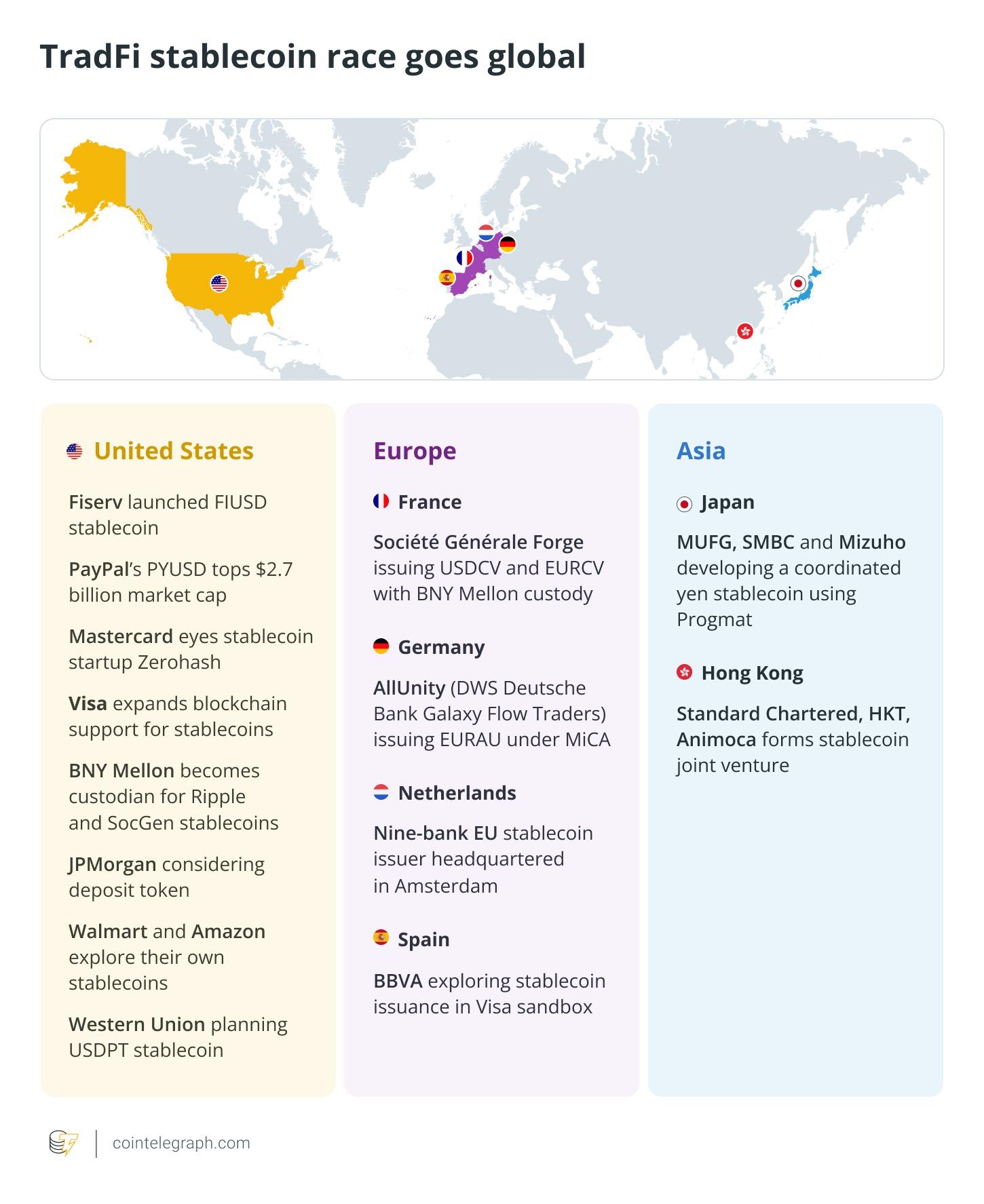 The stablecoin race goes global. Source: Cointelegraph
While INDX stands out for combining traditional bank settlement with continuous-dollar availability tailored to digital-asset companies, other companies have also prioritized real-time settlement.
For example, Sygnum operates a round-the-clock multi-asset network that enables instant settlement across fiat currencies, stablecoins and other digital assets for institutional clients.
Similarly, Fireblocks supports real-time settlement infrastructure for stablecoins and digital asset transfers, helping institutions streamline liquidity management.
Related: How TradFi banks are advancing new stablecoin models
Disclaimer: The content of this article solely reflects the author's opinion and does not represent the platform in any capacity. This article is not intended to serve as a reference for making investment decisions.
You may also like
Cerebras (CBRS.US) Cloud Business Soars, Masking Hardware Decline; OpenAI Supports Half of Cloud Revenue
Cerebras achieved record Q3 revenue, but hardware income dropped by nearly 30%, while cloud business accounted for two-thirds of total revenue. OpenAI contributed $72.4 million. The company raised its full-year guidance and expects Q4 to be close to breakeven.
Microsoft (MSFT.US) offers voluntary buyout packages to about 60,000 employees: Structural divergence in U.S. employment under AI transformation
In 2026, the U.S. labor market is characterized by both low layoffs and weak hiring. Companies like Microsoft and American Express are leveraging AI to optimize their workforce, while data centers are driving growth in the construction sector. However, entry-level white-collar jobs face increasing pressure, with real wages experiencing negative growth and structural transformation risks becoming more prominent.

"Inflation is really too high"! Federal Reserve "third-in-command": The Fed must continue to take action and promptly bring the price level back to 2%
John Williams, President of the New York Federal Reserve and the “number three” official at the Federal Reserve with a permanent voting right, stated that U.S. inflation remains high and policymakers must take further action to curb price pressures.

Jensen Huang steps down, and the "biggest patron" of new AI players is gone too
Anthropic's tens-of-billions IPO investment, Figure AI's additional $1 billion, and Nscale's over $5 billion credit guarantee are all in negotiations but their outcomes remain uncertain. Meanwhile, its $500 billion AI financing platform has stalled, and some clients are considering switching to AMD or Google. Successor Kress has a conservative style and has repeatedly vetoed deals aggressively promoted by Jensen Huang, signaling the possible end of Nvidia's era of bold investments.
Crypto prices
More


