
Datavault AI Death Cross Collides With IBM, Super Bowl Boost

Datavault AI Inc (NASDAQ:DVLT) just triggered a bearish technical signal — at the exact moment its business momentum is accelerating. The AI infrastructure company recently flashed a Death Cross — typically viewed as a warning of sustained downside pressure.
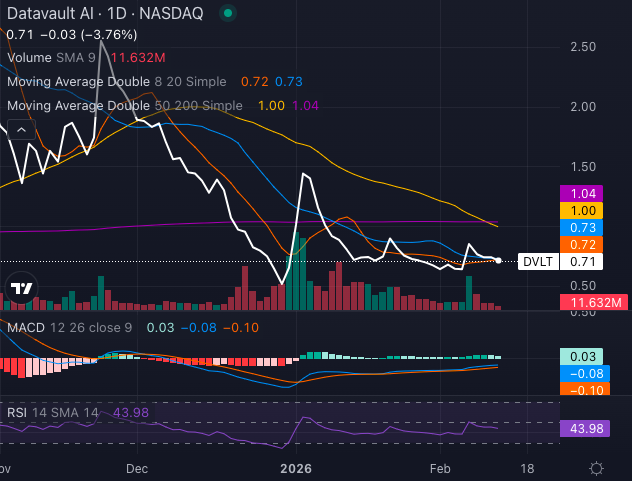
Chart created using Benzinga Pro
But the signal arrives alongside high-profile catalysts, including a Super Bowl LX activation and an expanded collaboration with IBM (NYSE:IBM).
That clash between weak technicals and improving fundamentals is now defining Datavault's next move.
Datavault stock remains down roughly 45% over the past year and nearly 30% year-to-date. The stock trades well below its $4.10 52-week high, reflecting a prolonged downtrend that has kept traders cautious.
DVLT Death Cross Signals Ongoing Technical Weakness
The death cross reinforces the broader selling pressure that has weighed on Datavault for months. With shares still closer to their 25 cent 52-week low than prior highs, the chart suggests momentum remains fragile.
For technical traders, the signal typically confirms bearish control — at least in the near term.
Super Bowl Spotlight, IBM Expansion
Yet operational momentum tells a different story.
Datavault deployed its "ADIO" data-over-sound and holographic technologies during Super Bowl LX in partnership with NFL Alumni, showcasing immersive data transmission on one of the world's largest stages.
The company also expanded its collaboration with IBM to deploy enterprise-grade AI at the edge through its SanQtum AI platform, strengthening its positioning in infrastructure-level AI solutions.
Why It Matters
Death crosses often warn of weakness. But catalysts can shift sentiment quickly.
For Datavault AI, the real question isn't whether the chart looks bearish — it's whether enterprise momentum and headline visibility can override it.
That tension makes Datavault stock one of the more volatile AI small-cap setups to watch right now.
Photo: Below the Sky via Shutterstock
Disclaimer: The content of this article solely reflects the author's opinion and does not represent the platform in any capacity. This article is not intended to serve as a reference for making investment decisions.
You may also like
Cerebras (CBRS.US) Cloud Business Soars, Masking Hardware Decline; OpenAI Supports Half of Cloud Revenue
Cerebras achieved record Q3 revenue, but hardware income dropped by nearly 30%, while cloud business accounted for two-thirds of total revenue. OpenAI contributed $72.4 million. The company raised its full-year guidance and expects Q4 to be close to breakeven.
Microsoft (MSFT.US) offers voluntary buyout packages to about 60,000 employees: Structural divergence in U.S. employment under AI transformation
In 2026, the U.S. labor market is characterized by both low layoffs and weak hiring. Companies like Microsoft and American Express are leveraging AI to optimize their workforce, while data centers are driving growth in the construction sector. However, entry-level white-collar jobs face increasing pressure, with real wages experiencing negative growth and structural transformation risks becoming more prominent.
"Inflation is really too high"! Federal Reserve "third-in-command": The Fed must continue to take action and promptly bring the price level back to 2%
John Williams, President of the New York Federal Reserve and the “number three” official at the Federal Reserve with a permanent voting right, stated that U.S. inflation remains high and policymakers must take further action to curb price pressures.

Jensen Huang steps down, and the "biggest patron" of new AI players is gone too
Anthropic's tens-of-billions IPO investment, Figure AI's additional $1 billion, and Nscale's over $5 billion credit guarantee are all in negotiations but their outcomes remain uncertain. Meanwhile, its $500 billion AI financing platform has stalled, and some clients are considering switching to AMD or Google. Successor Kress has a conservative style and has repeatedly vetoed deals aggressively promoted by Jensen Huang, signaling the possible end of Nvidia's era of bold investments.
Crypto prices
More


