
Down 21.6% in 4 Weeks, Here's Why Genpact (G) Looks Ripe for a Turnaround

We use Relative Strength Index (RSI), one of the most commonly used technical indicators, for spotting whether a stock is oversold. This is a momentum oscillator that measures the speed and change of price movements.
RSI oscillates between zero and 100. Usually, a stock is considered oversold when its RSI reading falls below 30.
Technically, every stock oscillates between being overbought and oversold irrespective of the quality of their fundamentals. And the beauty of RSI is that it helps you quickly and easily check if a stock's price is reaching a point of reversal.
So, by this measure, if a stock has gotten too far below its fair value just because of unwarranted selling pressure, investors may start looking for entry opportunities in the stock for benefiting from the inevitable rebound.
However, like every investing tool, RSI has its limitations, and should not be used alone for making an investment decision.
Here's Why G Could Experience a Turnaround
The RSI reading of 26.62 for G is an indication that the heavy selling could be in the process of exhausting itself, so the stock could bounce back in a quest for reaching the old equilibrium of supply and demand.
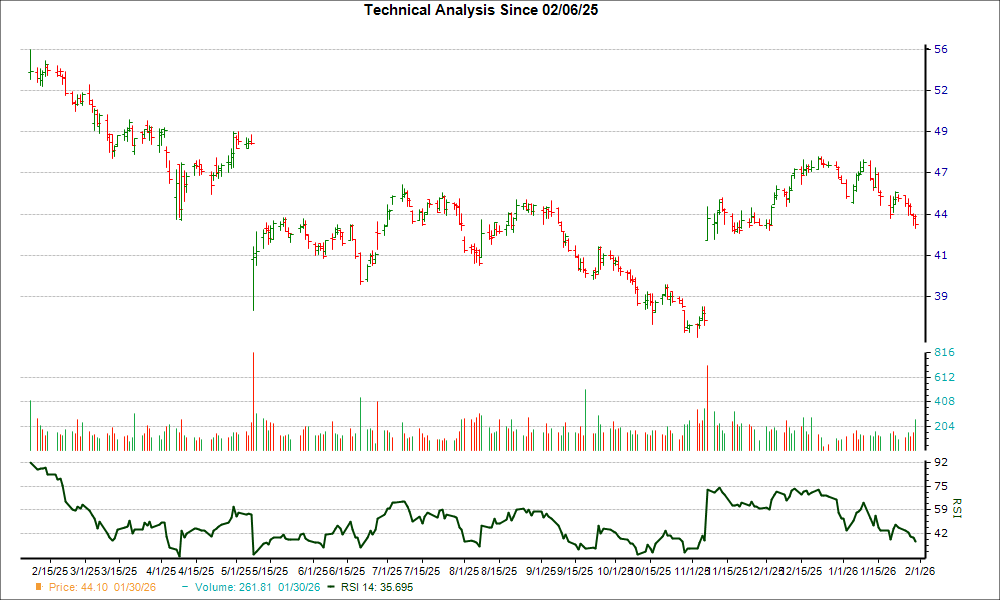
The RSI value is not the only factor that indicates a potential turnaround for the stock in the near term. On the fundamental side, there has been strong agreement among the sell-side analysts covering the stock in raising earnings estimates for the current year. Over the last 30 days, the consensus EPS estimate for G has increased 2.9%. And an upward trend in earnings estimate revisions usually translates into price appreciation in the near term.
Moreover, G currently has a Zacks Rank #2 (Buy), which means it is in the top 20% of more than 4,000 stocks that we rank based on trends in earnings estimate revisions and EPS surprises. This is a more conclusive indication of the stock's potential turnaround in the near term. You can see the complete list of today's Zacks Rank #1 (Strong Buy) stocks here >>>> .
Disclaimer: The content of this article solely reflects the author's opinion and does not represent the platform in any capacity. This article is not intended to serve as a reference for making investment decisions.
You may also like
Cerebras (CBRS.US) Cloud Business Soars, Masking Hardware Decline; OpenAI Supports Half of Cloud Revenue
Cerebras achieved record Q3 revenue, but hardware income dropped by nearly 30%, while cloud business accounted for two-thirds of total revenue. OpenAI contributed $72.4 million. The company raised its full-year guidance and expects Q4 to be close to breakeven.
Microsoft (MSFT.US) offers voluntary buyout packages to about 60,000 employees: Structural divergence in U.S. employment under AI transformation
In 2026, the U.S. labor market is characterized by both low layoffs and weak hiring. Companies like Microsoft and American Express are leveraging AI to optimize their workforce, while data centers are driving growth in the construction sector. However, entry-level white-collar jobs face increasing pressure, with real wages experiencing negative growth and structural transformation risks becoming more prominent.
"Inflation is really too high"! Federal Reserve "third-in-command": The Fed must continue to take action and promptly bring the price level back to 2%
John Williams, President of the New York Federal Reserve and the “number three” official at the Federal Reserve with a permanent voting right, stated that U.S. inflation remains high and policymakers must take further action to curb price pressures.

Jensen Huang steps down, and the "biggest patron" of new AI players is gone too
Anthropic's tens-of-billions IPO investment, Figure AI's additional $1 billion, and Nscale's over $5 billion credit guarantee are all in negotiations but their outcomes remain uncertain. Meanwhile, its $500 billion AI financing platform has stalled, and some clients are considering switching to AMD or Google. Successor Kress has a conservative style and has repeatedly vetoed deals aggressively promoted by Jensen Huang, signaling the possible end of Nvidia's era of bold investments.
Crypto prices
More


