
Bitcoin miner outflows spike in January, but public sales remain limited

Bitcoin miner outflows jumped to 28,605 BTC, worth about $1.8 billion, on Feb. 5, one of the largest single-day transfers since November 2024, as prices swung sharply during a volatile trading session.
Another 20,169 Bitcoin (BTC), worth about $1.4 billion, left miner-linked wallets on Feb. 6, to data from CryptoQuant. The last comparable spike occurred on Nov. 12, 2024, when outflows reached 30,187 BTC.
The spike coincided with sharp price swings, with BTC trading at about $62,809 on Feb. 5 before rebounding to $70,544 a day later. Large miner wallet transfers during volatile sessions often draw scrutiny because they can signal potential selling pressure.
Eight miners disclosed January figures so far: CleanSpark, Bitdeer, Hive Digital Technologies, BitFuFu, Canaan, LM Funding America, Cango and DMG Blockchain Solutions. They reported a combined production of roughly 2,377 BTC for the month. That total is far below the 28,605 BTC transferred in a single day on Feb. 5.
Outflows likely reflect broader ecosystem flows
The scale of the Feb. 5 and Feb. 6 outflows exceeds the January production of the publicly reporting firms reviewed by Cointelegraph.
Even combining disclosed January sales from CleanSpark, Cango and DMG, confirmed selling amounts remain a fraction of the 28,605 BTC transferred in a single day.
However, miner outflows do not automatically equate to capitulation or immediate spot-market selling.
According to CryptoQuant, miner outflow includes transfers to exchanges as well as internal wallet movements and transfers to other entities, meaning the metric does not by itself confirm that coins were sold on the open market.
Given the scale of the transfers relative to disclosed public miner sales, the movements may reflect activity beyond large, listed firms.
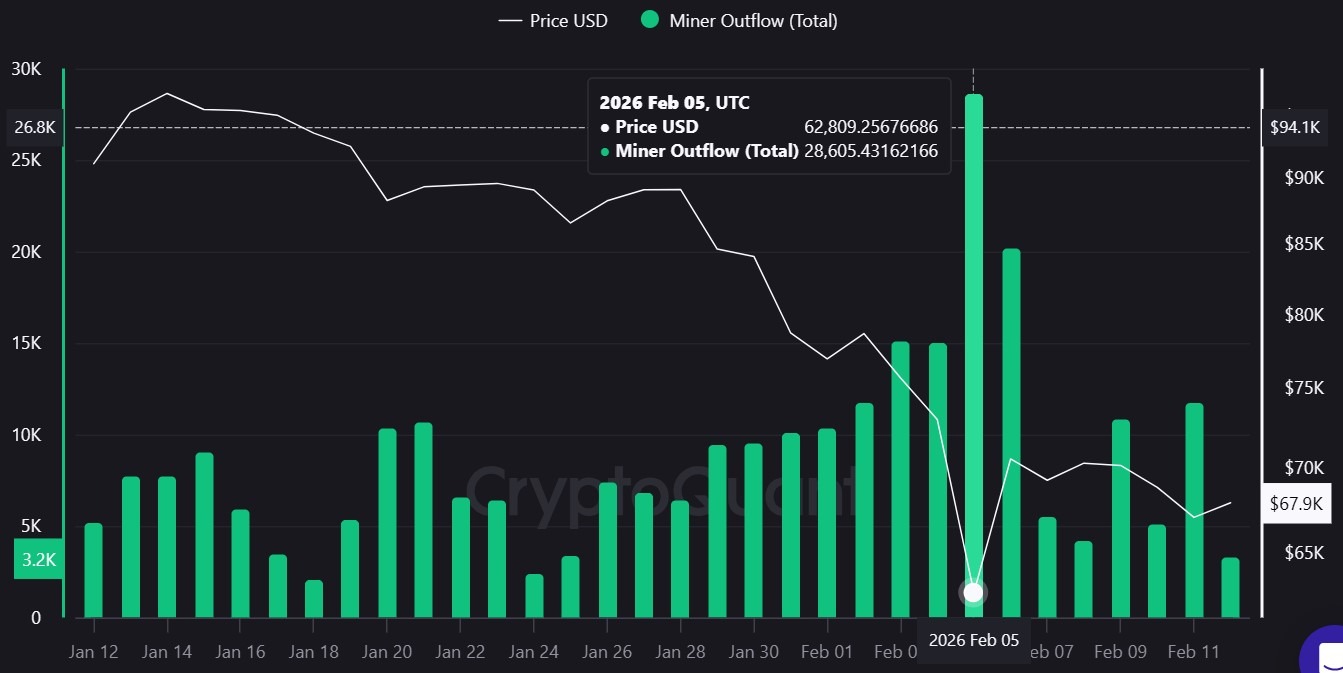 Bitcoin Miner Outflow 30-day chart. Source:
CryptoQuant
Public miner disclosures show mixed treasury moves
CleanSpark reported mining 573 BTC and selling 158.63 BTC during the month, ending January with 13,513 BTC on its balance sheet.
Cango mined 496.35 BTC and disclosed selling 550.03 BTC, stating it would continue to sell newly mined Bitcoin to support the expansion of its artificial intelligence and inference platform.
On Feb. 9, the company sold an additional 4,451 BTC for about $305 million to partially repay a Bitcoin-collateralized loan and fund its AI pivot.
Related: Bitcoin difficulty drops by over 11%, sharpest drop since 2021 China ban
Other firms took a different approach. Canaan mined 83 BTC and increased its reserves to 1,778 BTC and 3,951 ETH. LM Funding mined 7.8 BTC and reported no sales, lifting its treasury to 364.1 BTC.
Meanwhile, Hive used structured pledge mechanics tied to 480 BTC to preserve liquidity while maintaining operations.
While some miners report monthly production results consistently, others only report intermittently or have shifted to quarterly disclosures.
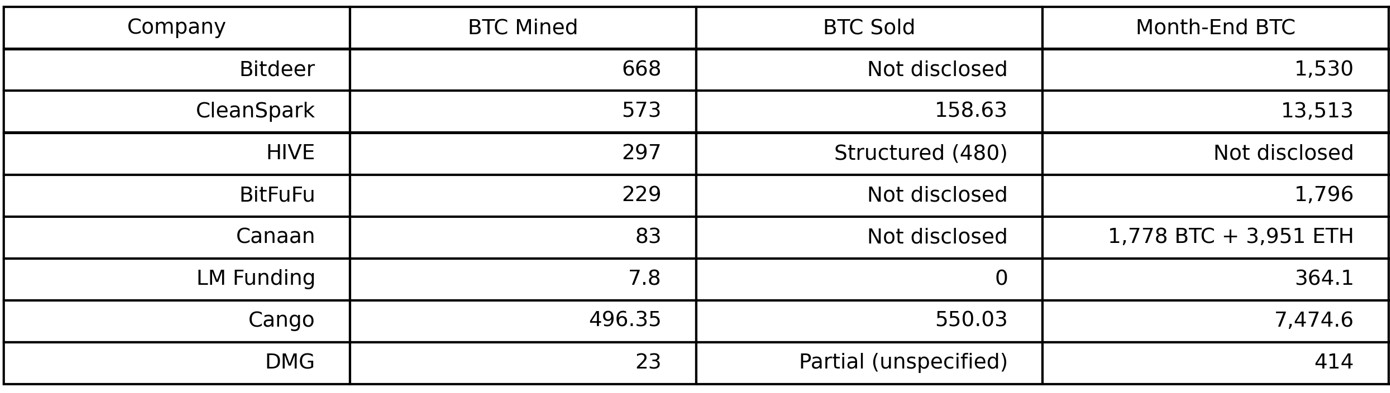 January miner data compiled by Cointelegraph. Source: Cointelegraph
Related: Bitcoin miners IREN, CleanSpark shares plunge as earnings fall short
Winter storms affect US miner hashrates
Network hashrate also fluctuated sharply in late January as severe winter storms hit parts of the United States. On Jan. 27, Bitcoin’s hashrate fell to 663 exahashes per second over two days, marking a more than 40% drop.
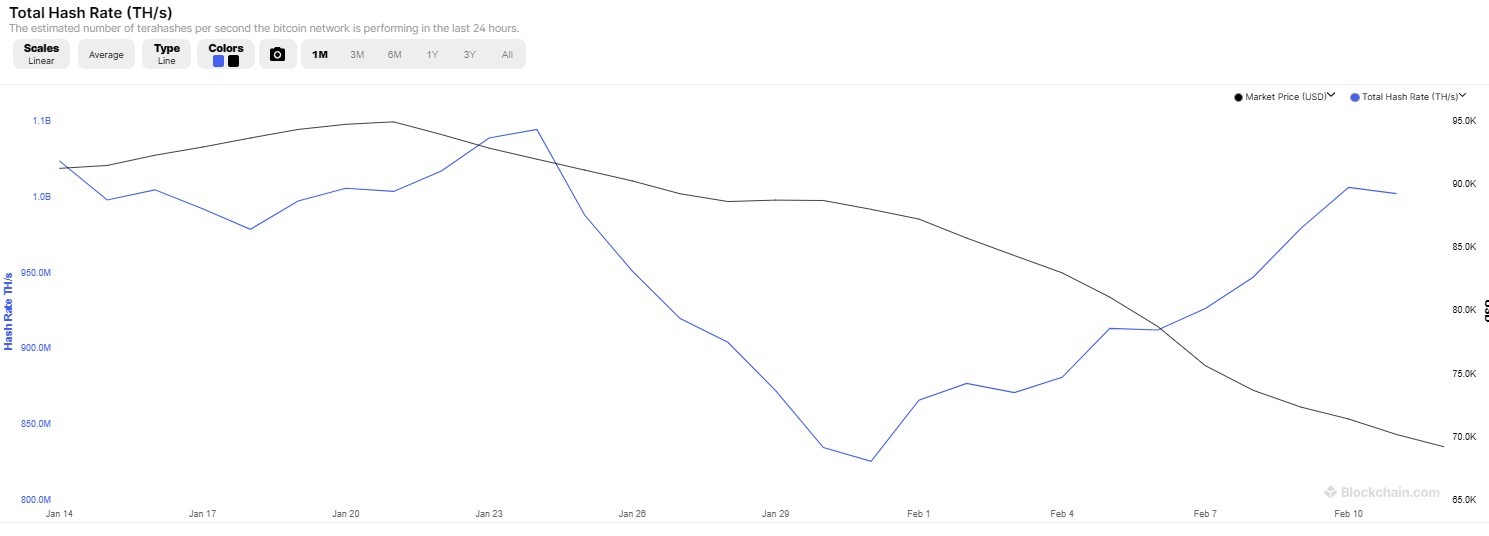 Total mining hashrate. Source:
Blockchain.com
The temporary decline came as miners curtailed operations to stabilize regional power grids during extreme cold and surging energy demand. US-based firms reported reduced uptime, including Marathon Digital Holdings and Iren, which saw sharp short-term drops in daily production.
Blockchain.com data showed that hashrate recovered in early February after the drop during the last week of January.
Magazine: 6 weirdest devices people have used to mine Bitcoin and crypto
Disclaimer: The content of this article solely reflects the author's opinion and does not represent the platform in any capacity. This article is not intended to serve as a reference for making investment decisions.
You may also like
Cerebras (CBRS.US) Cloud Business Soars, Masking Hardware Decline; OpenAI Supports Half of Cloud Revenue
Cerebras achieved record Q3 revenue, but hardware income dropped by nearly 30%, while cloud business accounted for two-thirds of total revenue. OpenAI contributed $72.4 million. The company raised its full-year guidance and expects Q4 to be close to breakeven.
Microsoft (MSFT.US) offers voluntary buyout packages to about 60,000 employees: Structural divergence in U.S. employment under AI transformation
In 2026, the U.S. labor market is characterized by both low layoffs and weak hiring. Companies like Microsoft and American Express are leveraging AI to optimize their workforce, while data centers are driving growth in the construction sector. However, entry-level white-collar jobs face increasing pressure, with real wages experiencing negative growth and structural transformation risks becoming more prominent.

"Inflation is really too high"! Federal Reserve "third-in-command": The Fed must continue to take action and promptly bring the price level back to 2%
John Williams, President of the New York Federal Reserve and the “number three” official at the Federal Reserve with a permanent voting right, stated that U.S. inflation remains high and policymakers must take further action to curb price pressures.

Jensen Huang steps down, and the "biggest patron" of new AI players is gone too
Anthropic's tens-of-billions IPO investment, Figure AI's additional $1 billion, and Nscale's over $5 billion credit guarantee are all in negotiations but their outcomes remain uncertain. Meanwhile, its $500 billion AI financing platform has stalled, and some clients are considering switching to AMD or Google. Successor Kress has a conservative style and has repeatedly vetoed deals aggressively promoted by Jensen Huang, signaling the possible end of Nvidia's era of bold investments.
Crypto prices
More


