
Diebold Nixdorf (NYSE:DBD) Reports Q4 CY2025 In Line With Expectations, Stock Soars

Banking and retail technology provider Diebold Nixdorf (NYSE:DBD)
Is now the time to buy Diebold Nixdorf?
Diebold Nixdorf (DBD) Q4 CY2025 Highlights:
- Revenue: $1.10 billion vs analyst estimates of $1.11 billion (11.7% year-on-year growth, in line)
- Adjusted EPS: $3.02 vs analyst estimates of $1.65 (83% beat)
- Adjusted EBITDA: $164.3 million vs analyst estimates of $164.2 million (14.9% margin, in line)
- Adjusted EPS guidance for the upcoming financial year 2026 is $5.50 at the midpoint, beating analyst estimates by 9.6%
- EBITDA guidance for the upcoming financial year 2026 is $522.5 million at the midpoint, above analyst estimates of $513.9 million
- Operating Margin: 7.5%, up from 4.2% in the same quarter last year
- Free Cash Flow Margin: 17.7%, down from 18.8% in the same quarter last year
- Market Capitalization: $2.60 billion
Company Overview
With roots dating back to 1859 and a presence in over 100 countries, Diebold Nixdorf (NYSE:DBD) provides automated self-service technology, software, and services that help banks and retailers digitize their customer transactions.
Revenue Growth
Examining a company’s long-term performance can provide clues about its quality. Any business can have short-term success, but a top-tier one grows for years.
With $3.81 billion in revenue over the past 12 months, Diebold Nixdorf is one of the larger companies in the business services industry and benefits from a well-known brand that influences purchasing decisions. However, its scale is a double-edged sword because finding new avenues for growth becomes difficult when you already have a substantial market presence. To accelerate sales, Diebold Nixdorf likely needs to optimize its pricing or lean into new offerings and international expansion.
As you can see below, Diebold Nixdorf struggled to increase demand as its $3.81 billion of sales for the trailing 12 months was close to its revenue five years ago. This shows demand was soft, a poor baseline for our analysis.
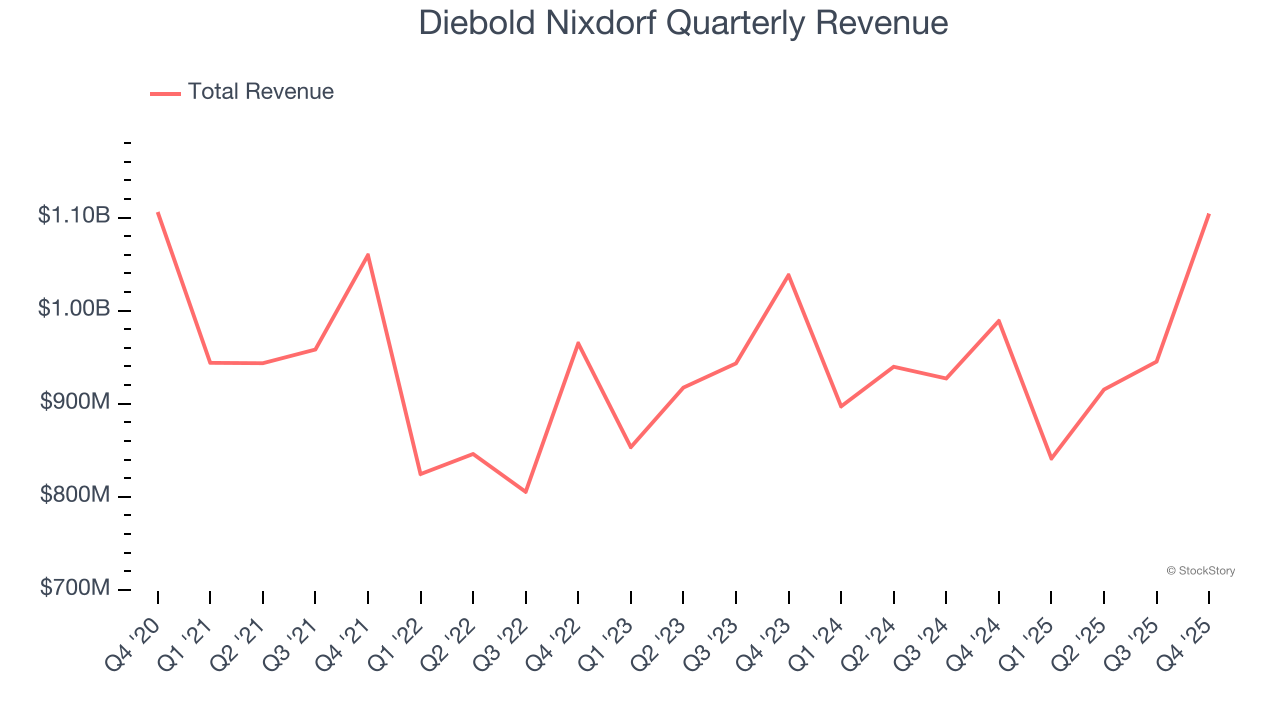
We at StockStory place the most emphasis on long-term growth, but within business services, a half-decade historical view may miss recent innovations or disruptive industry trends. Just like its five-year trend, Diebold Nixdorf’s revenue over the last two years was flat, suggesting it is in a slump.
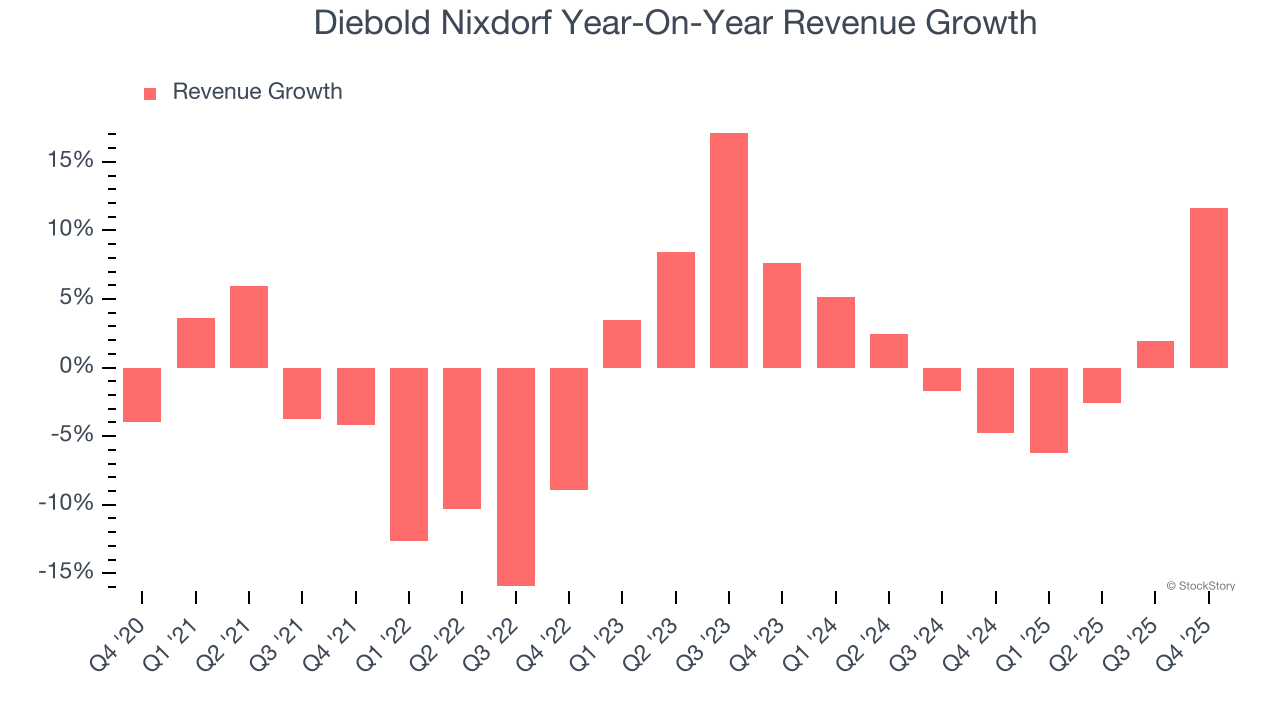
This quarter, Diebold Nixdorf’s year-on-year revenue growth was 11.7%, and its $1.10 billion of revenue was in line with Wall Street’s estimates.
Looking ahead, sell-side analysts expect revenue to grow 2.5% over the next 12 months. While this projection implies its newer products and services will spur better top-line performance, it is still below average for the sector.
Software is eating the world and there is virtually no industry left that has been untouched by it. That drives increasing demand for tools helping software developers do their jobs, whether it be monitoring critical cloud infrastructure, integrating audio and video functionality, or ensuring smooth content streaming.
Operating Margin
Operating margin is one of the best measures of profitability because it tells us how much money a company takes home after subtracting all core expenses, like marketing and R&D.
Diebold Nixdorf was profitable over the last five years but held back by its large cost base. Its average operating margin of 2.5% was weak for a business services business.
On the plus side, Diebold Nixdorf’s operating margin rose by 2.8 percentage points over the last five years.
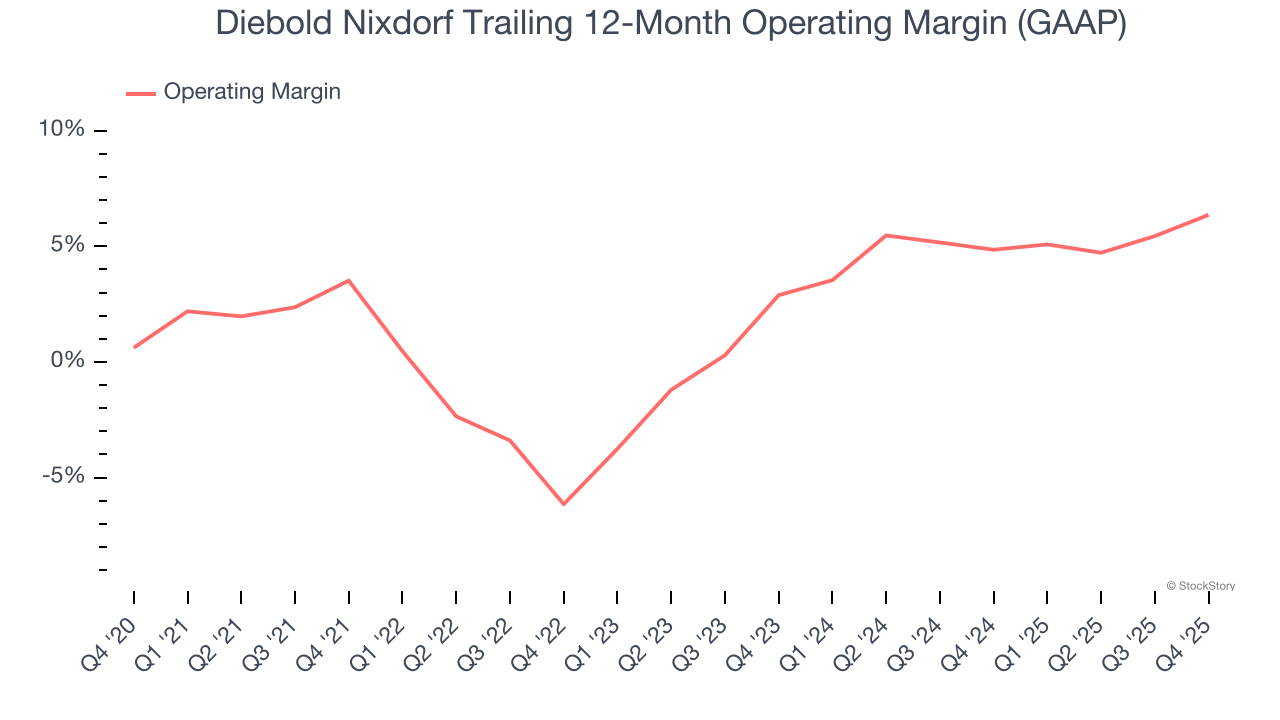
This quarter, Diebold Nixdorf generated an operating margin profit margin of 7.5%, up 3.3 percentage points year on year. This increase was a welcome development and shows it was more efficient.
Cash Is King
Although earnings are undoubtedly valuable for assessing company performance, we believe cash is king because you can’t use accounting profits to pay the bills.
While Diebold Nixdorf posted positive free cash flow this quarter, the broader story hasn’t been so clean. Diebold Nixdorf’s demanding reinvestments have drained its resources over the last five years, putting it in a pinch and limiting its ability to return capital to investors. Its free cash flow margin averaged negative 1.4%, meaning it lit $1.44 of cash on fire for every $100 in revenue.
Taking a step back, an encouraging sign is that Diebold Nixdorf’s margin expanded by 3.7 percentage points during that time. Despite its improvement and recent free cash flow generation, we’d like to see more quarters of positive cash flow before recommending the stock.
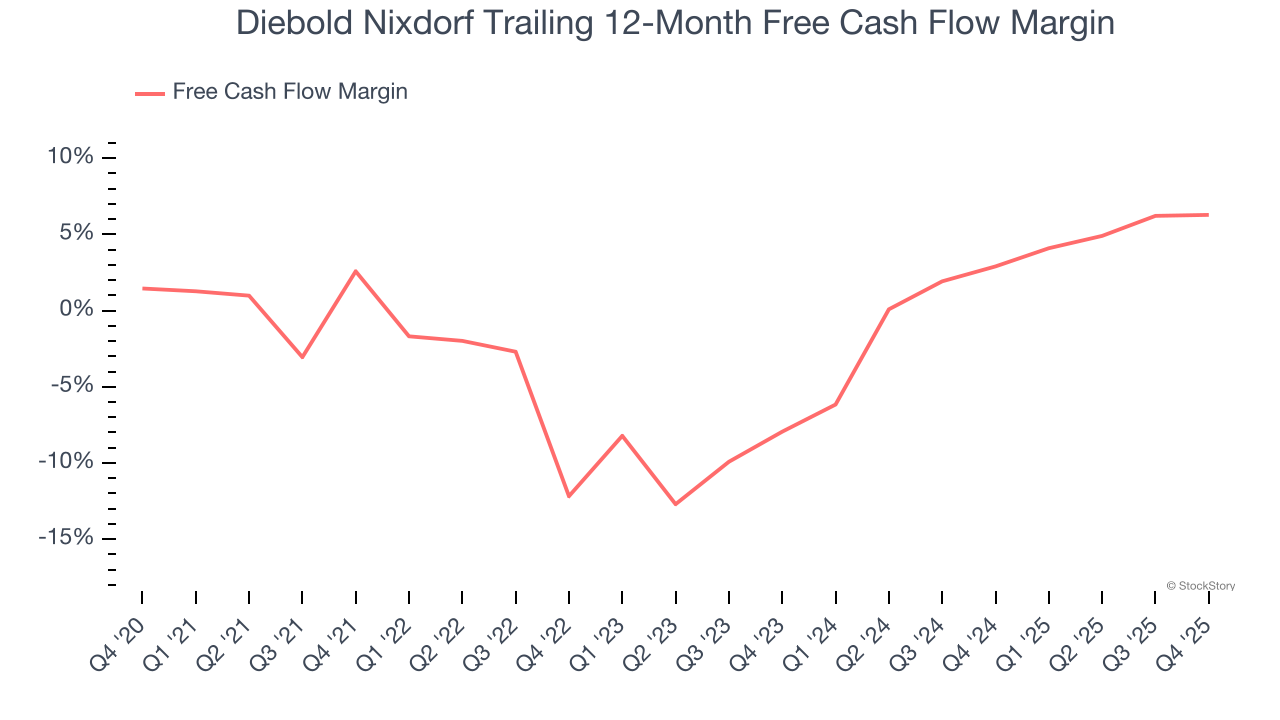
Diebold Nixdorf’s free cash flow clocked in at $195.8 million in Q4, equivalent to a 17.7% margin. The company’s cash profitability regressed as it was 1.1 percentage points lower than in the same quarter last year, but it’s still above its five-year average. We wouldn’t put too much weight on this quarter’s decline because investment needs can be seasonal, causing short-term swings. Long-term trends trump temporary fluctuations.
Key Takeaways from Diebold Nixdorf’s Q4 Results
It was good to see Diebold Nixdorf beat analysts’ EPS expectations this quarter. We were also excited its full-year EPS guidance outperformed Wall Street’s estimates by a wide margin. On the other hand, its revenue was in line. Zooming out, we think this was a solid print. The stock traded up 5% to $76 immediately following the results.
Diebold Nixdorf put up rock-solid earnings, but one quarter doesn’t necessarily make the stock a buy. Let’s see if this is a good investment. The latest quarter does matter, but not nearly as much as longer-term fundamentals and valuation, when deciding if the stock is a buy.
Disclaimer: The content of this article solely reflects the author's opinion and does not represent the platform in any capacity. This article is not intended to serve as a reference for making investment decisions.
You may also like
Cerebras (CBRS.US) Cloud Business Soars, Masking Hardware Decline; OpenAI Supports Half of Cloud Revenue
Cerebras achieved record Q3 revenue, but hardware income dropped by nearly 30%, while cloud business accounted for two-thirds of total revenue. OpenAI contributed $72.4 million. The company raised its full-year guidance and expects Q4 to be close to breakeven.
Microsoft (MSFT.US) offers voluntary buyout packages to about 60,000 employees: Structural divergence in U.S. employment under AI transformation
In 2026, the U.S. labor market is characterized by both low layoffs and weak hiring. Companies like Microsoft and American Express are leveraging AI to optimize their workforce, while data centers are driving growth in the construction sector. However, entry-level white-collar jobs face increasing pressure, with real wages experiencing negative growth and structural transformation risks becoming more prominent.
"Inflation is really too high"! Federal Reserve "third-in-command": The Fed must continue to take action and promptly bring the price level back to 2%
John Williams, President of the New York Federal Reserve and the “number three” official at the Federal Reserve with a permanent voting right, stated that U.S. inflation remains high and policymakers must take further action to curb price pressures.

Jensen Huang steps down, and the "biggest patron" of new AI players is gone too
Anthropic's tens-of-billions IPO investment, Figure AI's additional $1 billion, and Nscale's over $5 billion credit guarantee are all in negotiations but their outcomes remain uncertain. Meanwhile, its $500 billion AI financing platform has stalled, and some clients are considering switching to AMD or Google. Successor Kress has a conservative style and has repeatedly vetoed deals aggressively promoted by Jensen Huang, signaling the possible end of Nvidia's era of bold investments.
Crypto prices
More


