
Ether slips below $2K as ETH holder confidence faces major stress test

Ethereum’s native token, Ether (ETH), dropped to a year-to-date low of $1,927 on Thursday, and is currently down more than 60% from its all-time high of $4,950.
Analysts said the decline is stress-testing holders’ convictions, and onchain and crypto exchange inflow data point to the start of a bear market. Despite the selling intensity, one group of Ether holders has been buying, but whether this will help ETH reclaim $2,000 is to be determined.
Key takeaways:
Mid-sized holders (100–10,000 ETH) reduced their holdings, signaling a capitulation phase.
Large holders (10,000-plus ETH) have increased exposure during the last quarter, absorbing sell pressure for the altcoin.
ETH is trading below the realized price for all investor cohorts, and the rising exchange inflows keep downside risk elevated.
Onchain data shows who’s holding, adding and capitulating
Over the past five months, the Ether balance-by-holder-value data shows a clear change in behavior across different wallet sizes.
The metric clarifies which investors are absorbing downside pressure and which are exiting as prices return to May 2025 levels.
Data from CryptoQuant noted that on Aug. 18, 2025, wallets holding 100–1,000 ETH controlled 9.79 million ETH, 1,000–10,000 held 14.51 million ETH, 10,000–100,000 held 17.18 million ETH, and 100,000-plus wallets held 2.75 million ETH.
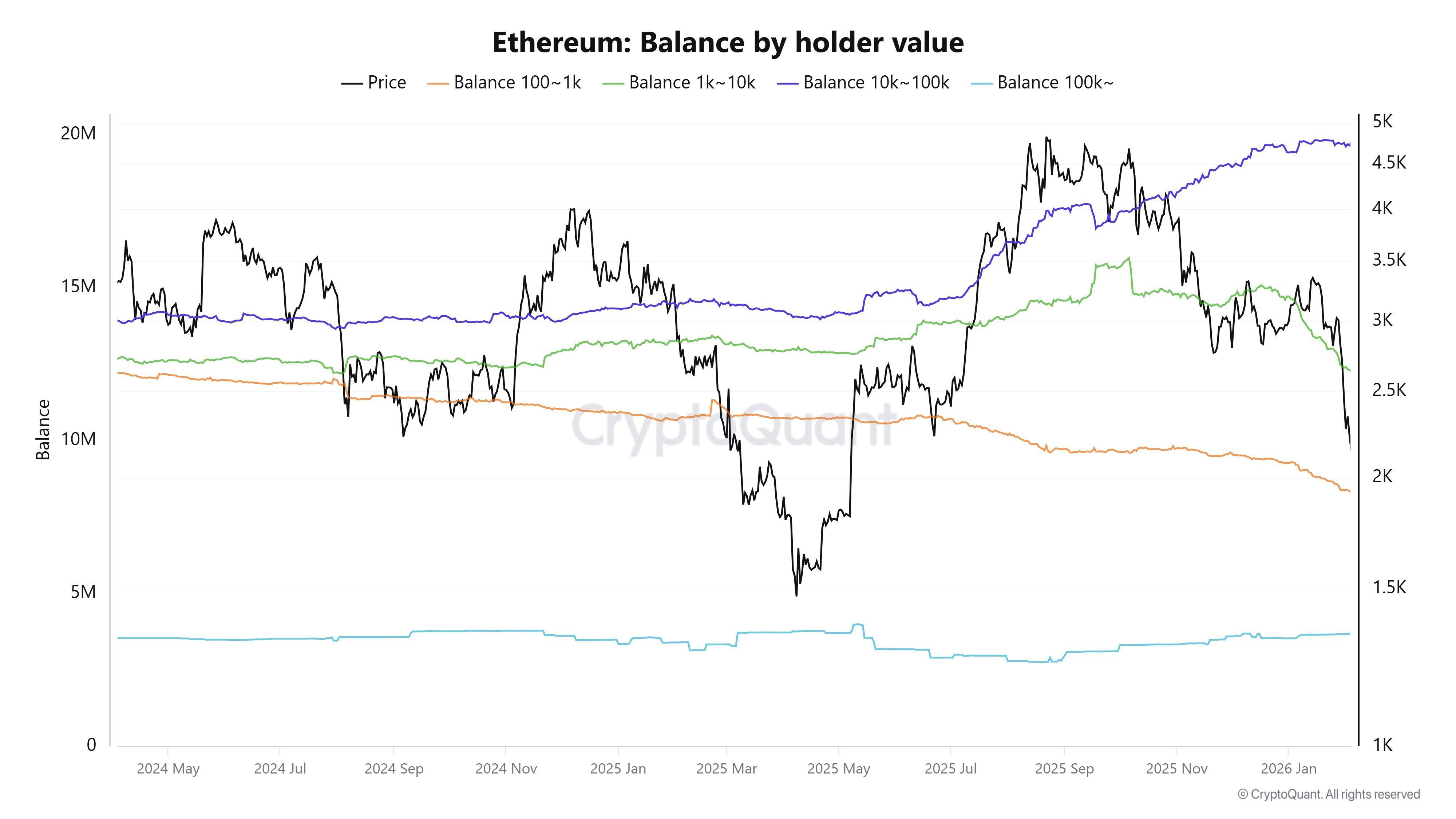 Ether balance by holder value. Source: CryptoQuant
On Wednesday, the balances of the 100–1,000 and 1,000–10,000 cohorts fell to 8.32 million ETH and 12.26 million ETH, respectively.
In contrast, 10,000–100,000 wallets increased holdings to 19.77 million ETH, while 100,000-plus wallets expanded to 3.68 million ETH.
The data pointed to accumulation by whales and large entities, while smaller and mid-sized holders appear to be distributing into the current price weakness.
Ether is also trading below the realized price of every cohort, which reflects the average cost basis at which each group last moved its ETH. Realized prices cluster between $2,120 for 100,000-plus holders and $2,690 for 100–1,000 holders, with ETH briefly closing below the aggregate realized price of $2,630 on Saturday, a level linked with stress-driven selling.
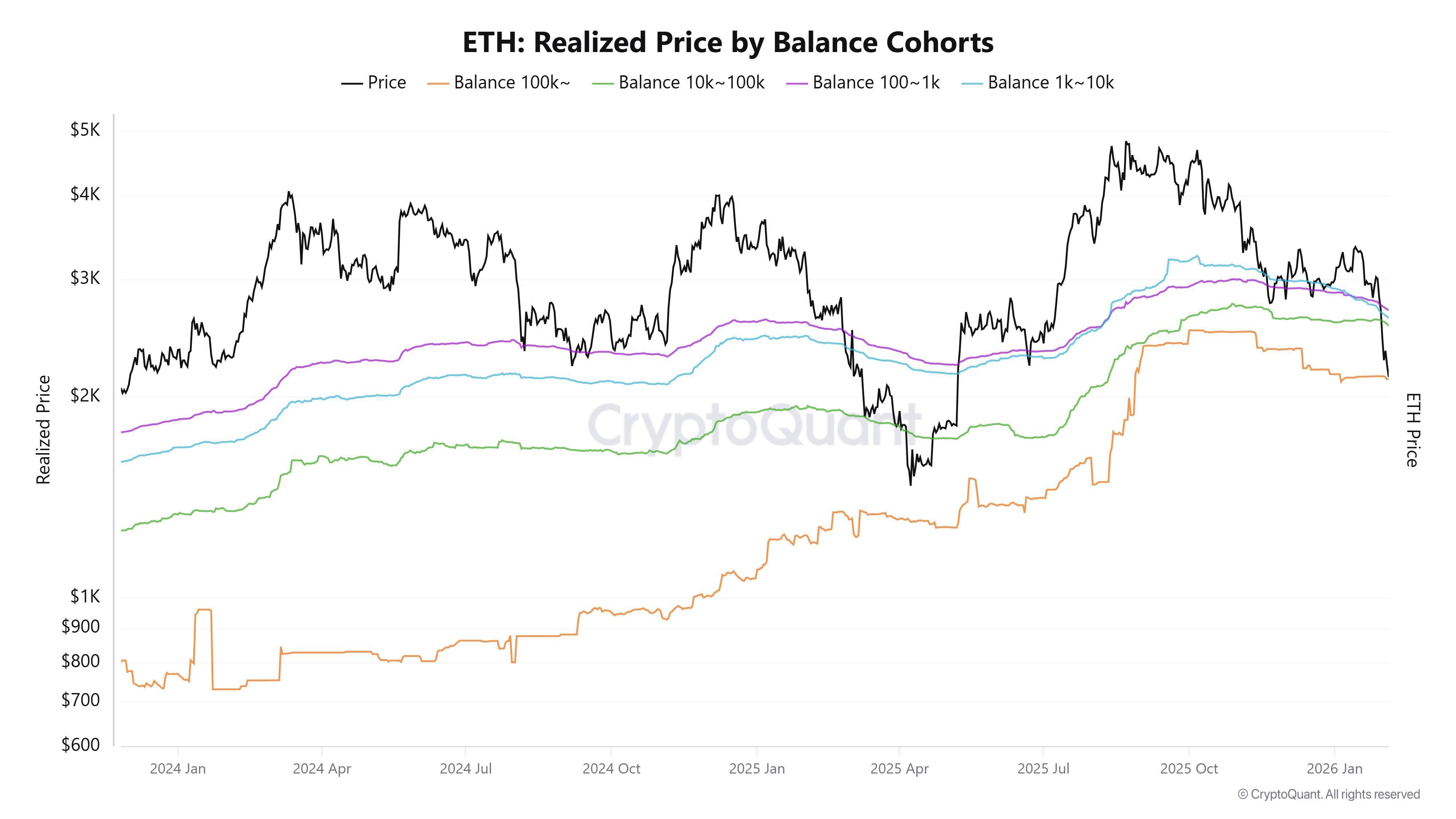 ETH realized price by balance cohorts. Source: CryptoQuant
Exchange inflows and taker data keep pressure on ETH’s price
Ether exchange inflows on Binance surged to about 1.63 million ETH on Wednesday, the highest daily reading since 2022. Large inflows may reflect preparation to sell or rebalance, and an inflows spike during a weak price action phase reinforces the concern.
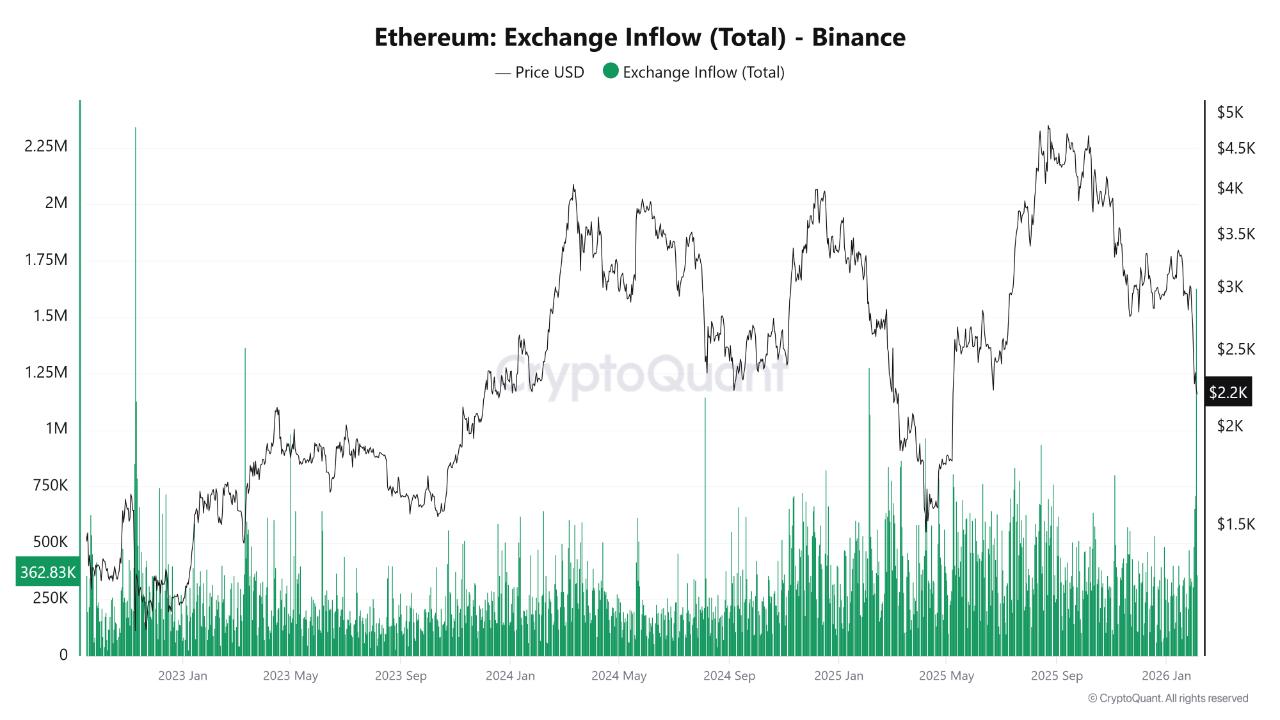 Ether exchange inflow on Binance. Source: CryptoQuant
Market execution data adds to that picture. Crypto analyst PelinayPA noted that Ether’s Binance taker buy/sell ratio sits “around 0.94,” below the neutral level of 1. Both the 30 and 50-day averages remain under 1, suggesting selling pressure is the dominant trend rather than a temporary phase.
PelinayPA added that this may also mark the beginning of a “true bear season” for the altcoin, expecting difficult price conditions to persist for a while longer.”
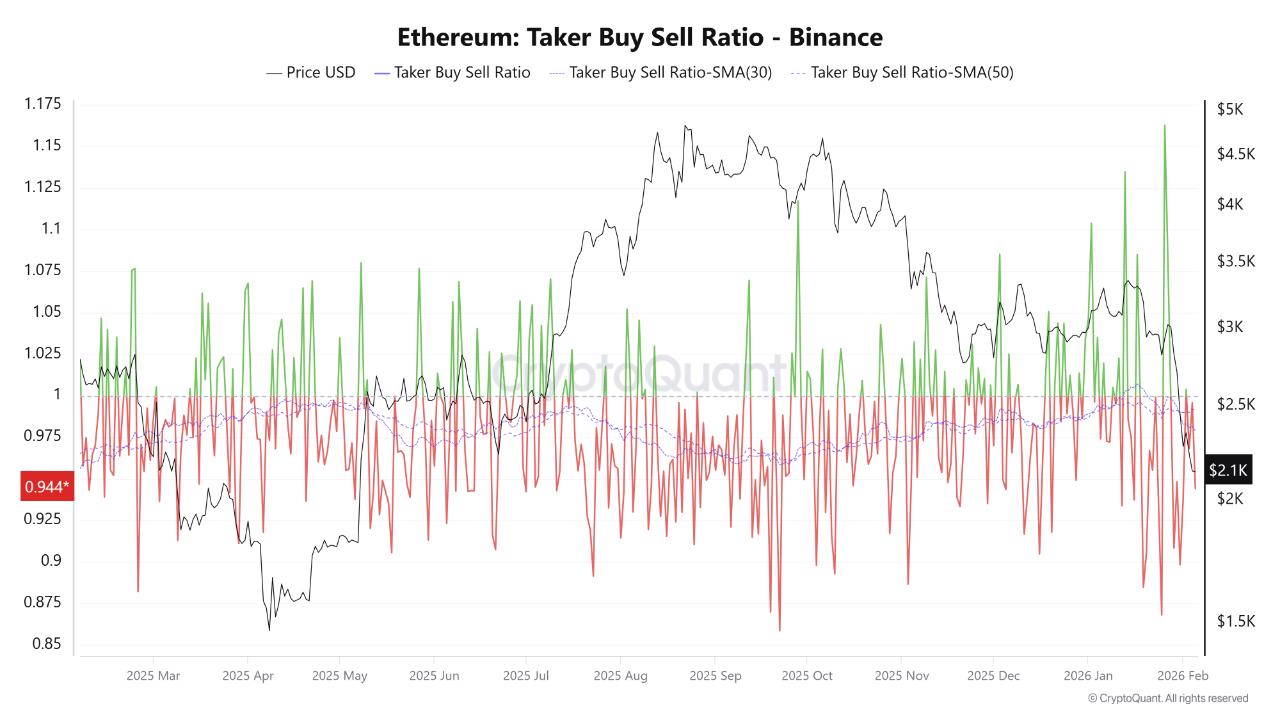 Ether taker buy-sell ratio on Binance. Source: CryptoQuant
Disclaimer: The content of this article solely reflects the author's opinion and does not represent the platform in any capacity. This article is not intended to serve as a reference for making investment decisions.
You may also like
Jensen Huang steps down, and the "biggest patron" of new AI players is gone too
Anthropic's tens-of-billions IPO investment, Figure AI's additional $1 billion, and Nscale's over $5 billion credit guarantee are all in negotiations but their outcomes remain uncertain. Meanwhile, its $500 billion AI financing platform has stalled, and some clients are considering switching to AMD or Google. Successor Kress has a conservative style and has repeatedly vetoed deals aggressively promoted by Jensen Huang, signaling the possible end of Nvidia's era of bold investments.
Applied Materials (AMAT.US) Q4 Earnings Call: CEO Responds to Capacity Mismatch Concerns, Says No Customer Delayed Delivery; System Capacity Expected to Double by 2028
Applied Materials released its financial results for the fourth quarter of fiscal year 2026 (ending October 25, 2026) after the US stock market closed on November 12.
The End of an Era! Semianalysis: Without Jensen Huang, Nvidia Will Become the Next Apple
Semianalysis believes that Jensen Huang’s departure marks the end of a founder-driven era. Nvidia is highly likely to replicate the "post-Steve Jobs Apple model"—shifting from aggressive bets to stock buybacks—which is not beneficial for either technological advancement or shareholders. A greater concern is that the supply chain advantages, customer trust system, and open-source ecosystem moat personally built by Jensen Huang will be difficult for his successor to replicate. By 2028, over 70% of total production capacity may shift to non-Nvidia players.

Crypto prices
More


